The United States carried out new bombings against Iran at dawn on Thursday, which announced responses against military bases in Kuwait and Bahrain and promised to target all ships venturing into the Strait of Hormuz.
The strikes, which the US military says targeted Iranian military surveillance facilities, communications systems and air defense sites throughout the country
were triggered after Donald Trump accused Tehran of procrastinating in negotiations to stop the war in the Middle East.
We were really close to making a deal, but they keep leading us on, they don’t care about us
the American president raged to the press on Wednesday.
US Defense Minister Pete Hegseth blamed Iran for playing cat and mouse
in negotiations. If we have to negotiate with bombs, we will negotiate with bombs, and we are very good at that
he said.
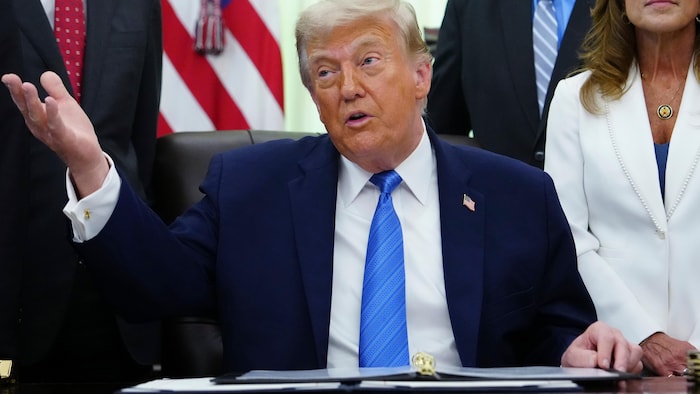
United States President Donald Trump speaks to the press in the Oval Office on June 10, 2026, at the White House.
Photo : Associated Press / Julia Demaree Nikhinson
The United States and Iran had already attacked each other during the night from Tuesday to Wednesday, despite a ceasefire that came into force on April 8 after more than five weeks of bombing.
Explosions were heard early Thursday morning on the island of Qeshm, Minab, Sirik and the port of Bandar Abbas in the south of the country, Iranian media reported.
In retaliation for the latest American strikes, the Revolutionary Guards, Tehran’s ideological army, said they had launched drones on the military bases of Ali Al-Salem and Ahmad Al-Jaber, in Kuwait, and on the Sheikh airbase Isa, in Bahrain. Iranian media had previously announced an attack on the headquarters of the US 5th Fleet in Bahrain.
Air warning sirens were triggered in Bahrain, according to the Interior Ministry. In Kuwait, the army announced that it was in the process of combat hostile aerial targets
and the civil aviation authority closed the emirate’s airspace.
The Revolutionary Guards also claimed to have fired 12 ballistic missiles against the Al-Azrak base in Jordan, used by the United States.
Tehran also warned that its forces would target any ship attempting to cross the strategic Strait of Hormuz, through which a fifth of the world’s trade in oil and liquefied natural gas normally transits.
Hell for you
Following repeated violations of the ceasefire by the American enemy, the Strait of Hormuz will be closed until further notice
said the Revolutionary Guards, quoted by state television.
No ship should leave its anchorage in the Persian Gulf and the Sea of Oman. Any approach to the Strait of Hormuz will be considered collaboration with the enemy
they indicated.
In the process, the Iranian navy, cited by the media, announced that two ships trying to illegally cross the Strait of Hormuz were hit
without further details.
Are you making the sacred Strait of Hormuz dangerous?! We will make this region hell for you
said Revolutionary Guards Air Force Commander Sardar Mousavi.
Washington, which for its part imposes a blockade on Iranian ports, has denied any blockage of the strait. Commercial ships continue to transit the Strait of Hormuz this evening
wrote about the US Middle East Military Command (CENTCOM).
This worsening situation in the Gulf continues to fuel the rise in oil prices. Thursday morning, a barrel of Brent from the North Sea gained 1.7% to $94.68, and that of American WTI gained 2% to $91.84.
Israeli Prime Minister Benjamin Netanyahu, for his part, on Wednesday called on the Lebanese to join Israel’s fight against Hezbollah, affirming that their country had been taken hostage
by the pro-Iranian group.
After Israeli strikes on Beirut, first Iran, then Israel, carried out reciprocal attacks on Sunday and Monday, for the first time since the fragile ceasefire between Tehran and Washington came into force on April 8.
Tehran demands that Lebanon, where its ally Hezbollah and Israel have been clashing since March 2, be included in any agreement to end the war in the Middle East, triggered at the end of February by an Israeli-American attack against Iran.
More than 3,600 people have been killed in Lebanon in Israeli strikes since the start of the war.