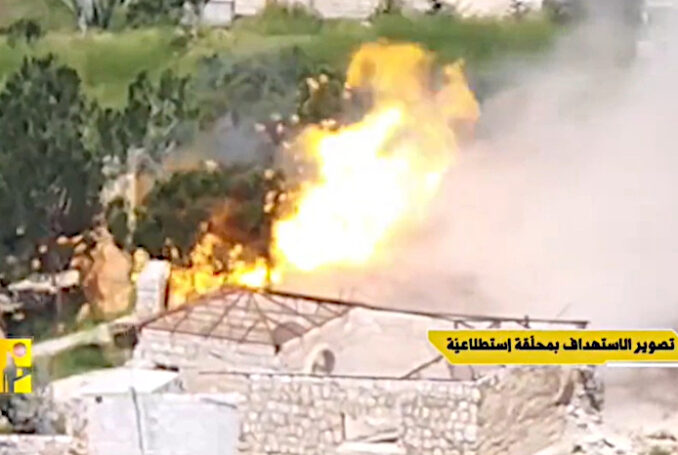
Video extract: military media of the Lebanese resistance
Par Al-Mayadeen
Precision operations carried out by Hezbollah using FPV drones are inflicting increasing losses on Israeli invasion units in southern Lebanon, highlighting the inability of the occupying army to neutralize an inexpensive but increasingly effective threat.
Three soldiers from the Israeli occupation army, stationed near a tank, heard a slight humming sound before identifying the source. In a few seconds, the FPV drone [First Person View] equipped with fiber optics appeared in their field of vision, too late for them to react.
The live broadcast abruptly ended when the drone exploded nearby, killing one soldier and injuring six others, in an incident emblematic of Hezbollah’s escalating drone war along the Lebanese border, as reported The Guardian.
Incidents of this type are increasingly common in southern Lebanon, where the Islamic resistance movement Hezbollah has integrated drones into its guerrilla campaign against Israeli aggression.
Images of FPV drones hitting Israeli tanks, bulldozers and soldiers are circulating more and more widely.
The one-minute video, dated Friday, May 5, begins by showing an FPV (first-person view) drone flying over an area controlled by the Israeli army. The drone is seen following an Israeli soldier moving near a Merkava tank in the recently established Israeli position of Nimr Al-Jamal, facing the Lebanese border town of Alma al-Shaab in the south of the country.
Fiber optic drones
These drones are inexpensive, “expendable” and difficult to dodge. Unlike conventional radio-controlled systems, they are connected to their operators by fiber optic cables several kilometers long, which makes them impervious to electronic jamming.
They also allow operators, using live video feeds, to directly guide the explosion points that are triggered on impact. This FPV functionality has now been used to target Israeli armored units and personnel, with increasing effectiveness.
Hezbollah used these drones to kill a bulldozer driver, bypass the Trophy defense system of “Israeli” Merkava tanks and repeatedly strike military positions.
An Israeli military official said that “Israel recognizes the threat posed by drones” and was working to develop “capabilities to detect and intercept these weapons.” A senior officer was also tasked with finding solutions, because “Israel” has also deployed FPV drones in Lebanon.
An inexpensive weapon suitable for guerrilla warfare
For Hezbollah, FPV drones provide a cost-effective way to inflict damage on a better-equipped military force and increase the cost of continuing the “Israeli” occupation in southern Lebanon.
Hezbollah’s military media broadcast a video entitled “The pride of Lebanese industry”, accompanied by the Hebrew text “×’×’× ×•×•×”, תוצרת ×œ×’× ×•×Ÿ”. video shows footage from inside one of Hezbollah’s drone manufacturing factories.
A source within Hezbollah said the development reflected structural changes within the group. “This development is part of efforts to overcome supply difficulties following the disruption of the Syrian supply route following the fall of Bashar al-Assad at the end of 2024,” the source said.
The group relies more and more on locally manufactured systems. Manufacturing each drone costs around $300 to $400 (250 to 350 euros), thanks to 3D printing and “commercially available electronic components that can be adapted for dual civil and military use,” the source added.
The evolution of Hezbollah’s war tactics
The use of FPV drones also reflects a return to guerrilla-style tactics, intended to increase pressure on Israeli occupying forces in southern Lebanon.
The estimated range of the drones, of several tens of kilometers, forces “Israel” to reassess the depth of its “buffer zone” in the region. Previous Israeli plans had set the “buffer zone” at around 11 km, based on Hezbollah’s use of anti-tank guided weapons in previous confrontations.
Israeli countermeasures and technical challenges
Despite its “Iron Dome” system, which cost several billion dollars, “Israel” did not succeed in intercepting these small drones. In some recent cases, soldiers have even attempted to shoot them with their personal weapons.
March 2026 – Hezbollah military media broadcast footage of the Islamic Resistance’s attack on a Merkava tank belonging to the enemy Israeli army at the recently established Markaba site in southern Lebanon.
An Israeli military source said intelligence units across the armed forces were working on “more effective warning models” and advancing research into new counter-drone technologies.
“Fiber-optic cable FPVs cannot be jammed by electronic warfare, and they are more difficult to detect,” said Rob Lee, a senior fellow in the Eurasia Program at the Foreign Policy Research Institute.
Lee added that militaries around the world were now prioritizing countermeasures against drone tactics first seen in Ukraine.
Lessons learned from the war in Ukraine
Fiber optic FPV drones appeared in the war in Ukraine in late 2024, in response to widespread electronic jamming.
Both sides have tested these systems, but Russia has made particularly heavy use of them due to its easier access to fiber optic materials.
The Hezbollah source acknowledged that the group had studied their impact on the battlefield in Ukraine, where these drones proved very effective.
Beyond causing damage on the battlefield, FPV drones also have a propaganda function. Videos showing soldiers moments before impact circulated widely in both Lebanon and Ukraine, reinforcing their psychological impact.
Hezbollah’s media arm recently released drone footage interspersed with footage of a hunting golden eagle, accompanied by music under the title “We Will Hunt You Down.”
The video shows Resistance drones flying over the area, simulating eagle-like attacks on their targets, to emphasize the precision and power of their strikes.
“The goal of guerrilla warfare is not a quick victory, but rather the gradual exhaustion of the enemy,” explained retired Lebanese Brigadier General Mounir Shehadeh, the Lebanese government’s former coordinator with UNIFIL.
“If used wisely, [les drones FPV] are capable of modifying the balance of forces on the battlefield, particularly in the context of asymmetric conflicts,” underlined Mr. Shehadeh.
May 12, 2026 – Al-Mayadeen – Translation: Chronicle of Palestine