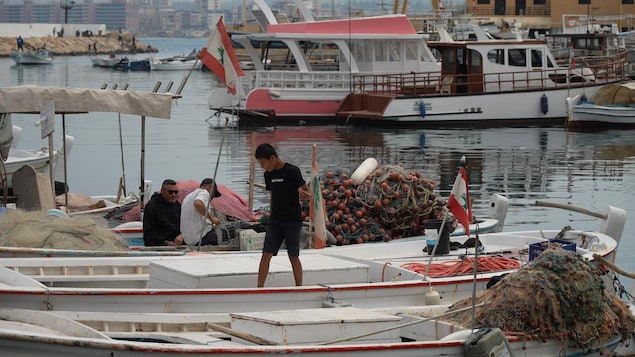
TYR, Lebanon – The ancient port of the city of Tire is bathed in radiant sunshine. It’s 20 degrees in the shade on this day at the end of April.
Usually, in this pre-summer period, the platforms should be packed with people, but the situation is far from normal.
A deep rumble, that of an Israeli fighter plane, echoes in the sky above our heads. It is accompanied by the piercing hum of a drone flying over the port at very low altitude. It is visible even to the naked eye.
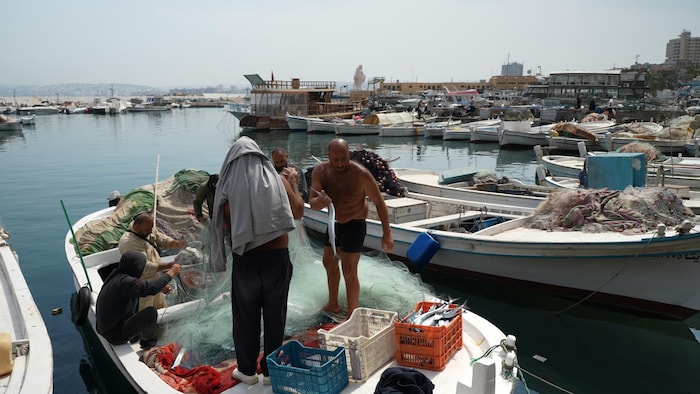
General view of the Easter port of Tyr.
Photo : Radio-Canada / Jimmy Hutcheon
Here, it is difficult to forget the war which continues to wreak havoc in the region, despite the truce in force for 12 days.
And for good reason: we are less than 10 kilometers from the zone tampon
that Israel wants to establish all along its border, in southern Lebanon.
Bounded by a yellow line
Designed by Israel, this zone includes more than 60 Lebanese villages, most of which have been partially or completely demolished and which are now closed to civilians.
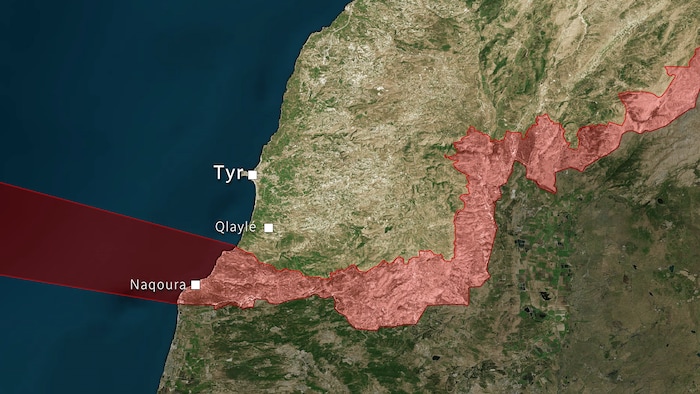
The “buffer zone” that Israel wants to establish includes more than 60 Lebanese villages, most of which have been partially or completely demolished and which are now closed to civilians. It also extends into the sea.
Photo : Radio-Canada / Francis Lamontagne
The zone tampon
is not limited to the earth; it also extends into the open sea, depriving southern fishermen of their traditional fishing grounds, where fish are more abundant.
For Issa Darwish, a fisherman from Palestine, born in Lebanon, who has been fishing since the age of 9, there is clearly a before and after war.
Before the war, you could go off Naqoura, Qlaylé and Bayada, to the border, he said. There are a lot of fish there. There is snapper and lobster. The fishing was good!
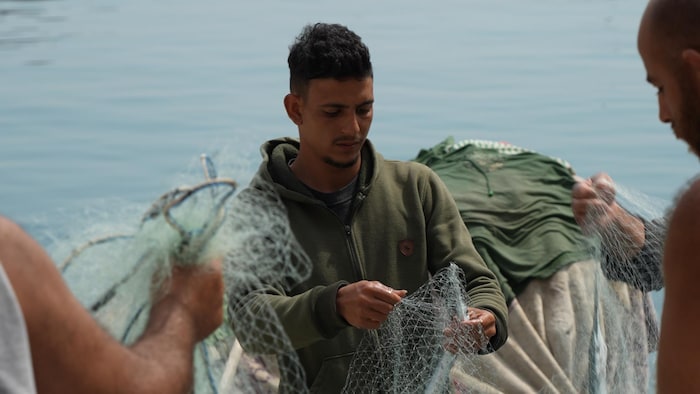
Issa Darwish removing a fish from the mesh of a fishing net.
Photo : Radio-Canada / Jimmy Hutcheon
But when Israel intensified its strikes against Lebanon on March 2, after Hezbollah had launched rockets against its territory in response to the war against Iran, its godfather, the fishermen of Tire were confined to the port, and their boats immobilized at the quay.
It was only 46 days later, with the announcement of the truce, that the fishermen were able to take to the sea again, but not without restrictions: they can now only sail during the day and in one direction only, the north.
Sometimes, [les Israéliens] contact the Lebanese army intelligence services which are based in the port of Tire to tell them that fishing boats are prohibited from going out to sea
explains Issa, 22 years old.
If we are already at sea, the Lebanese army contacts us every five minutes to tell us not to delay, to return to port. […] What is this truce? This is not a real truce!
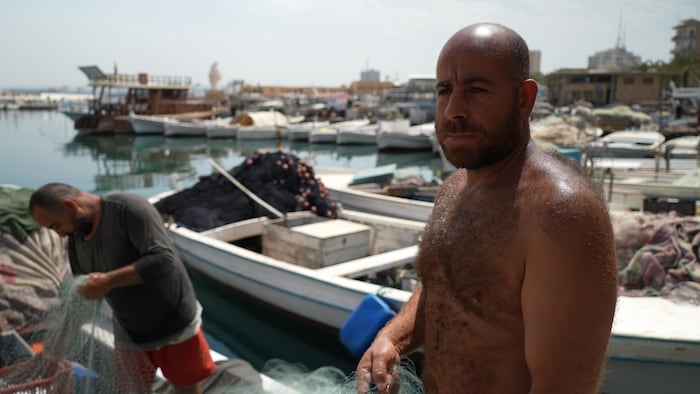
Mohammad Darwish on his fishing boat in the port of Tyre.
Photo : Radio-Canada / Jimmy Hutcheon
Less profitable fishing
There are a lot fewer fish off the coast of Tire
says Mohammad Darwish, Issa’s uncle. We earn less money from fishing today. The price of fish has fallen because there is not enough demand, there are fewer customers.
Issa and Mohammad remove the fish from the meshes of their nets one by one. These are needlefish, a long-beaked fish that lives near the coast. They therefore did not have to venture very far out to sea to capture it.
This day, they collected 150 kilos. Before the war, they often returned with at least 400 kilos, and a greater variety.
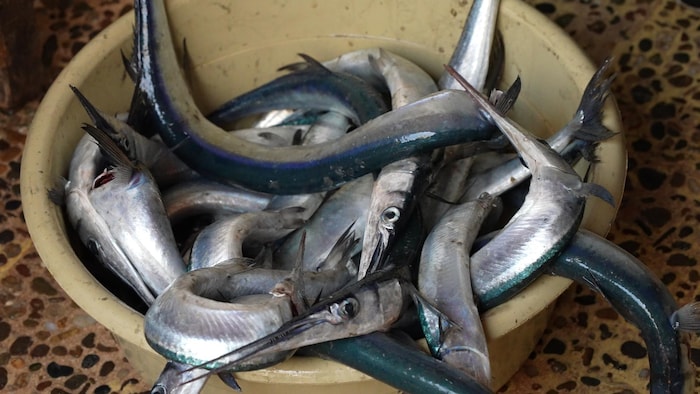
A bin full of needles.
Photo : Radio-Canada / Jimmy Hutcheon
Sitting on his fishing boat, on the quay opposite, Kamal Istanbouli, 53, is busy repairing his nets. They need to be maintained from time to time.
he said.
This fisherman, who dropped out of school at the age of 13 for his love of the sea, was not as lucky as the Darwishes. His catch is slim: five kilos of sea bass and an octopus. He sold everything at the port fish market.
Sometimes I make US$50 a day, other times US$60 or US$70. It’s not like in the West here, the State doesn’t help us. If we don’t work, we don’t eat. We have to go out to sea every day to fish.
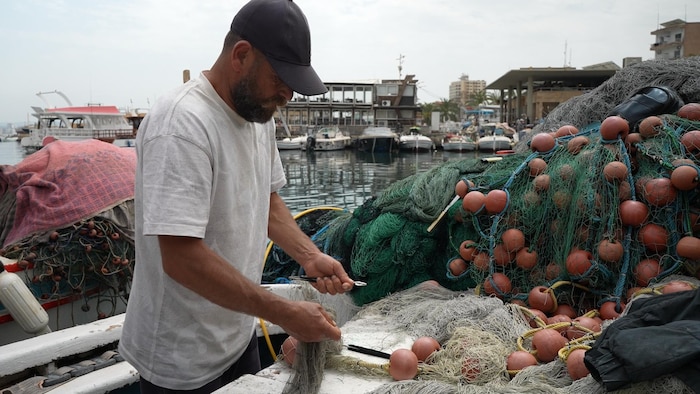
Kamal Istanbouli repairing his Easter nets.
Photo : Radio-Canada / Jimmy Hutcheon
Witness to the difficult life of fishermen
Moustapha Chahine, the owner of the fishmonger, notes the exodus of fishermen from Tyre. Before the war, there were nearly 500. Today, there are around 70 left.
He denounces the harassment they suffer at sea from the Israeli navy.
During the truce which ended the last war between Israel and Hezbollah a year ago, two fishermen were kidnapped in the open sea, a few nautical miles from Tyre. They have still not been released.
The Israeli army justifies these interventions by saying it monitors the Lebanese coast to prevent any infiltration or activity linked to Hezbollah. In October 2024, Israel had already ordered the evacuation of certain coastal areas of southern Lebanon to carry out maritime operations, paralyzing the local fishing economy.
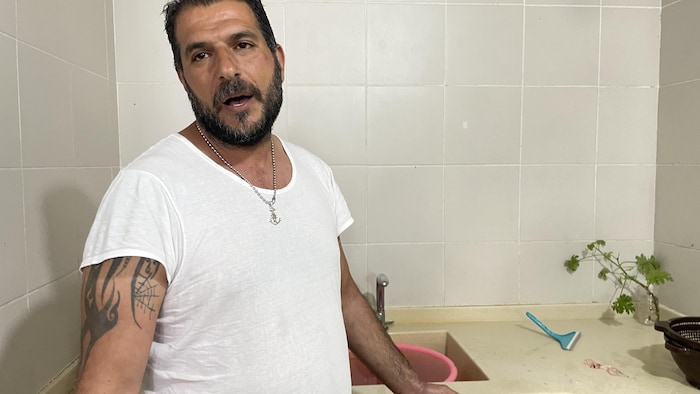
Moustapha Chahine, the owner of a fishmonger in the port of Tyre.
Photo : Radio-Canada / Rania Massoud
Moustapha, however, assures that the Israeli practice of kidnapping fishermen in the open sea dates back to the 1980s, even before the creation of Hezbollah. He says his own father was kidnapped by the Israeli navy while fishing. However, my father was not affiliated with any political party, says Moustapha. He was interrogated and detained for 40 days in Israel, before finally being released.
We have suffered too much. Those who do not live in southern Lebanon do not know the suffering we endure. This is why we defend our lands. […] It’s unfair.
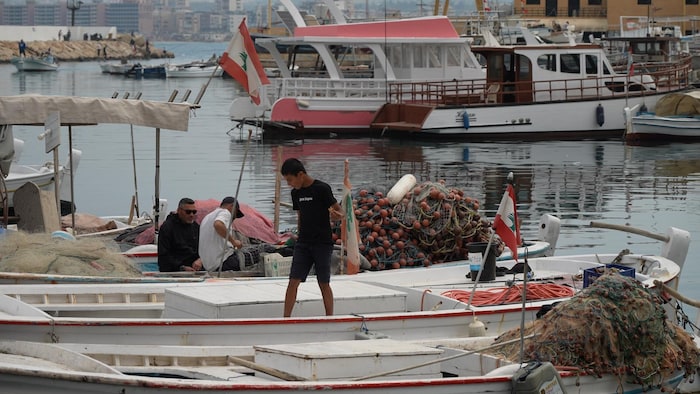
General view of the Easter port of Tyr.
Photo : Radio-Canada / Jimmy Hutcheon
However, he refused to leave Tyre. I was practically born in the sea. I have spent my whole life here
he says, while scaling a fish.
I am 40 years old. I experienced the wars of 1990, 1992, 1996, the year 2000, as well as the wars of 2006, 2024 and that of 2026. I never left here. I won’t leave
he assures.
The feeling of attachment to the sea is what binds all the fishermen who remained in Tyre, despite the restrictions and the war.
Most say they feel safer on the water than on land. But everyone hopes for better days to return to sea, where fish abound.
 3:31
3:31Rania Massoud’s report
Photo : Radio-Canada / Jimmy Hutcheon

/2026/06/10/6a28930de28d1465956743.jpg "War in the Middle East: the United States announces strikes \"proportionate\" against Iran after the attack on an American helicopter")