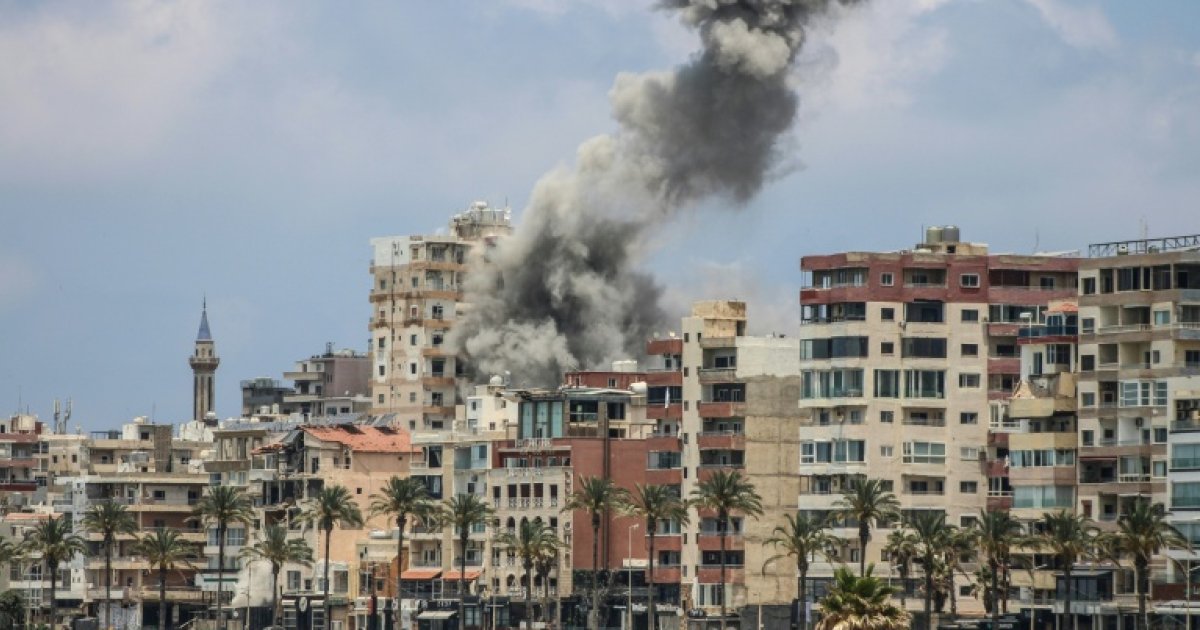
Despite a ceasefire imposed by the United States in Lebanon since Thursday evening, Israeli pressure to disarm Hezbollah remains strong, but is still seen as “potentially bloody and complex” by the Lebanese, says Anthony Samrani of L’Orient-Le Jour.
Published on April 17, 2026 at 09:48. Reading time: 3 minutes.
Funerals for 13 Lebanese security forces soldiers killed on April 8, 2026 in Nabatieh by an airstrike on the local administration building. (Nicolas Cleuet / Le Pictorium / MAXPPP)
At the time of the fragile truce in Lebanon, which came into force on Thursday, the death toll from the war exceeds 2,100 (including an unknown number of Hezbollah fighters), with several dozen villages destroyed in the southern part of the country. “You have a country in pieces and an Israeli army occupying the territory deeply, with the ability to continue bombing at will based on what they perceive as a threat. So it’s real freedom of action in Lebanon,” commented Anthony Samrani, editor-in-chief at the French-speaking Lebanese daily L’Orient-Le Jour on April 17.
The journalist fears that fighting will resume soon, wondering if this respite is only due to “essentially American considerations”, namely “Donald Trump’s desire to say, ‘I have taken the Lebanese issue in hand. I will also achieve a victory’.”
While Anthony Samrani sees this fragile agreement as “very, very favorable to Israel”, President Trump is facing opposition from his own camp in the United States for his unwavering support for Israel.
After imposing the ceasefire on Benjamin Netanyahu, which he did not even have time to present to the Security Council, Donald Trump announced that he would “invite” the Israeli Prime Minister and Lebanese President Joseph Aoun to the White House very soon. “If it’s just for the photo, it will put the Lebanese side in total embarrassment,” reacted the journalist from L’Orient-Le Jour.
Lebanon must face the Israeli army’s occupation until Hezbollah is disarmed. However, “there is a technical question and a political question,” the journalist believes. “This operation would in any case be bloody, complicated, difficult, and lengthy, while the Israelis are very eager. In addition to that, there is a real political problem, meaning that there is currently no unanimity in Lebanon in the political will to disarm. So you have a Prime Minister who is willing and wants to do it, and you have a Lebanese army that, unfortunately, has not been following this logic so far. You have a Lebanese army that absolutely wants to avoid confrontation.”
In the broader negotiation between Iranians, Americans, and Israelis, Lebanon has been invited to direct negotiations to obtain this ceasefire. “It’s actually good news,” said Anthony Samrani. “Furthermore, there is a clear desire from Israel to separate the Iranian front from the Lebanese front, and there is an American desire to achieve a diplomatic victory in Lebanon. In Iran, at least in the past few hours, negotiations are not going in the right direction at all. Lebanon remains tied to a regional issue that transcends it.”