Here are the latest events on Tuesday related to the Middle East war, as a fragile ceasefire between Iran and the United States has held for a week:
– Israel and Lebanon agree to start direct negotiations after “productive discussions” Israel and Lebanon have agreed to start direct negotiations for a lasting peace following “productive discussions” in Washington between representatives of both countries, according to American diplomacy.
US Secretary of State Marco Rubio called on them to seize a “historic opportunity” for lasting peace in Lebanon.
Before they even began, in Washington, Hezbollah, which was not represented, had rejected them.
– Washington will not extend sanctions relief on Iranian oil The US Treasury announced that it will not extend the temporary relief of certain sanctions on Iranian oil, decided in March to alleviate the effects of the war in the Middle East on the oil market.
However, Washington will extend the partial suspension of sanctions against the Russian giant Lukoil until the end of October, amidst rising oil prices.
– Israel transfers three Hezbollah members for questioning The Israeli army announced that three fighters from the Islamist Hezbollah movement surrendered to its troops in Bint Jbeil, southern Lebanon, where they were later transferred to Israel for questioning.
– Hezbollah claims 13 attacks after the start of Israeli-Lebanese talks Hezbollah claimed simultaneous attacks on 13 locations in northern Israel shortly after direct talks began between Israelis and Lebanese.
“Following an assessment of the situation and in light of recent developments, an intensification of firing from Lebanon is possible,” warned the Israeli army shortly before.
It also announced that ten of its soldiers had been injured, including three seriously, in clashes with Hezbollah in Bint Jbeil.
– Lebanese president hopes talks with Israel will mark “the beginning of the end” of his people’s suffering Lebanese President Joseph Aoun expressed hope that talks with Israel in Washington will mark “the beginning of the end of the suffering of the Lebanese” after several weeks of war between Israel and Hezbollah.
– Call to Israel and Lebanon to “seize the opportunity” of peace talks Seventeen countries, including France and the UK, called on Lebanon and Israel to “seize the opportunity” of direct peace talks to be held in Washington under American mediation.
“We want to achieve peace and normalization with the Lebanese state. (…) The problem is Hezbollah,” said Israeli Foreign Minister Gideon Saar.
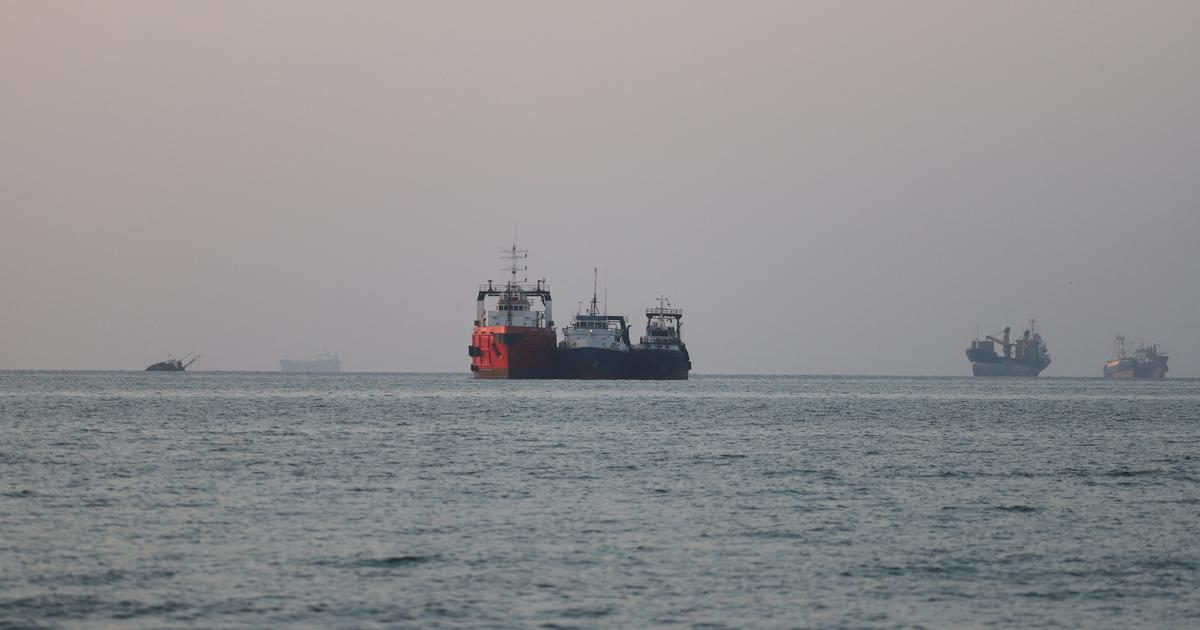
– Six ships turned back by the US army The US army announced it had prevented six ships from leaving Iranian ports in the first 24 hours of the blockade imposed by the United States on the Islamic Republic.
On Monday, at least two ships from Iran crossed the Strait of Hormuz.
– Conference on Friday on Hormuz with “non-belligerent” volunteer countries French President Emmanuel Macron and UK Prime Minister Keir Starmer will co-chair a video conference on Friday in Paris with “non-belligerent countries willing to contribute” to “a purely defensive multilateral mission” in the Strait of Hormuz.
– Meeting between Saudi Arabia, Pakistan, Egypt, and Turkey The Saudi, Pakistani, Turkish, and Egyptian foreign ministers will hold talks this week in southern Turkey on the situation in the region.
– Pakistan says working on new talks between the US and Iran “Efforts are underway to bring both parties back to the negotiating table. Of course, we want them to return to Islamabad but the location has not yet been determined,” said a senior Pakistani source to AFP, assuring that “the meeting could take place soon.”
– Macron says called Trump and Pezeshkian to “resume negotiations” French President Emmanuel Macron said he spoke on Monday with his American counterpart Donald Trump and Iranian President Massoud Pezeshkian, asking them to “resume interrupted negotiations” between the US and Iran.
– Sharp drop in oil prices Oil prices continued to fall, with the market seeming to believe in a calming of the Middle East conflict after statements from Donald Trump interpreted in that way and ahead of talks between Lebanon and Israel.
Midday, the price of a barrel of West Texas Intermediate (WTI) for delivery in May fell by 6.20% to $92.94, and that of Brent, the international benchmark, for delivery in June, dropped by 3.77% to $95.61.
– IMF lowers growth forecasts for the Middle East and the eurozone The International Monetary Fund (IMF) has revised down its growth forecasts for the eurozone and the Middle East and North Africa region, partly due to the situation in the Gulf.
The US is expected to be among the countries least economically affected by this conflict.


/2026/06/11/6a2a8294ada60297066700.jpg "Finale NBA : comment Victor Wembanyama et les Spurs ont dilapidé une avance de 29 points et perdu le match 4 crucial face aux New York Knicks")