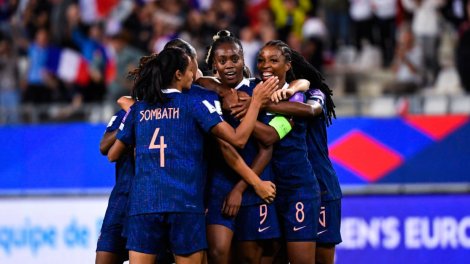
French women’s football remains without a collective agreement after three seasons of unsuccessful negotiations. The only sticking point remains the image rights, despite the creation of the Professional Women’s League.
“It is no longer acceptable”: the captains of the teams in the French women’s championship denounce in a column the lack of progress in negotiations on the collective agreement for professional female footballers, expected for three seasons now.
On this subject, the different parties, including the players’ union, the UNFP union (National Union of Professional Footballers), and Foot Unis, representing the clubs, blame each other for this failure, despite the creation of the Professional Women’s Football League (LFFP) in July 2024. Since then, the status of professional female players in France has not progressed, even though the clubs had adopted a recommendation providing maternity protection for players, raising hopes for a collective agreement to be signed shortly after. “Efforts have been made since the creation of the LFFP, we acknowledge that. But the essential is lacking: a collective agreement,” declared the captains of the first and second divisions in a statement on Tuesday.
“In 2026, professional female players still do not have it. We practice the same sport. We train with the same demands. We face the same physical constraints and risks. And yet, we do not have the same protections,” they added, stating that “this gap is puzzling. It is no longer understandable. It is no longer acceptable.”
“It’s handicapping”
For the UNFP, it’s been “three years that the negotiations for a collective agreement have not led to anything. It is no longer understandable,” and “a collective agreement must be signed before the next season.” However, at this point, it seems unlikely that such a measure will be implemented by September.
On April 9th, the captain of the French team, Griedge Mbock, expressed regret to AFP about this situation, saying “that other championships are progressing and for us, it is still stuck on certain points: it’s handicapping for French women’s football.”
Regarding this collective agreement, several points of contention existed, but only one persists today: image rights, according to Vincent Ponsot, president of the women’s football group at Foot Unis. On the subject of image rights, the UNFP wants to be able to commercialize players’ images using the clubs’ logos, which Foot Unis refuses.
For the rest – the end-of-career bonus, the minimum contract duration for part-time contracts, maintaining salary in case of injury, or the management of “loans” used by clubs to get rid of unwanted players – discussions between the UNFP and club representatives have been fruitful, Foot Unis claims.
“An unacceptable situation”
“I am not surprised that the players are getting impatient because this situation is unacceptable for women’s football,” said Vincent Ponsot, noting that the UNFP is “mainly responsible” for the final sticking point. According to Foot Unis, a revised version including the maintenance of a player’s salary for 90 days in case of injury was sent several weeks ago to the UNFP, which has not responded.
Asked by AFP, the players’ union deplores this situation, emphasizing that three out of four representative organizations have reached an agreement on a collective agreement for the men’s League 3 in six months (excluding Foot Unis). “We hope that a mirror effect of this agreement will apply to the players,” said Fabien Safanjon, vice president of the UNFP to AFP.
Paul-Hervé Douillard, general manager of the LFFP, hopes for a collective agreement “as soon as possible”, as it will be an “important marker for the league’s structuring,” although he is “unable to give a date” but is certain that “it will happen one day.” The LFFP, not being the decision-maker, aims to bring all stakeholders back together. This column comes at a difficult time for women’s teams in France, burdened by the economic crisis affecting male clubs due to the collapse of TV rights.
An emblematic example is the case of the women’s section of Dijon, who ranked fifth in the Premier League and could abandon professionalism and return to a lower level if the club does not find a buyer.