The reality is that while many shopping centers and malls are still crowded, the capital’s heritage and natural spaces have not been used effectively to serve children.
Lots of “ingredients”, but few “products”.
A quick survey of several large shopping malls in Hanoi during the weekends and summer months revealed a familiar scene: crowds of people jostling in the early hours, indoor playrooms crowded with children, and long lines waiting for the thrill rides.
At the same time, in many parks such as Thu Le, Thong Nhat and Bach Thao, attendance, particularly that of children, is in constant decline from year to year. Mrs. Dang Phuong Thao (Ngoc Ha district) testifies: “I have two children, one 10 years old and the other 8 years old. They are both very curious and explore a lot. So, finding a place where they can play is always a real headache. »
Hanoi is full of assets to create the most attractive tourist offers for children: dozens of museums, hundreds of historical remains steeped in history which tell of the thousand years of its past. There is also a network of unique craft villages, such as the pottery of Bat Trang, the silk of Van Phuc or the conical hats of the village of Chuong… Not forgetting the ecological parks, the large lakes, the libraries and the cultural centers present in almost all the neighborhoods and communes.
However, according to Ms. Nhu Thi Ngan, Managing Director of Hanoi Tourism Investment Joint Stock Company, Hanoi still lacks immersive and engaging activities for children. Many museums and historic sites have not invested sufficiently in interactive technologies, expert guides, or modern storytelling methods. The activities offered in artisan villages, historic sites or parks are generally seasonal and lack coordination, failing to create a real discovery trail that would make children want to come back. Most children visit museums to listen to explanations and then leave, or historical sites to take photos and then leave, due to a lack of interactive activities and stories suitable for their age.
These efforts are laudable.
To address the gaps, many places in Hanoi are actively changing their approach to children and families. This is particularly the case for the library network. At the end of May, the youth area of the Hanoi library was exceptionally busy. Many parents took their children there to get a library card and learn about the summer activities offered. The reading area has been enriched with books on practical skills, historical comics and scientific works appropriate to children’s ages, in order to make the library not only a place for reading, but also a space for cultural experiences, thus encouraging independent learning and children’s curiosity.
Likewise, the West Lake water park is striving to reinvent itself. After a period of renovation, it reopened its doors on April 18, offering themed spaces recreating the ocean with treasure maps, a steering wheel and representations of marine animals, as well as a reception area for visitors.
At the same time, the Temple of Literature – National University, is organizing this summer a cultural initiation program entitled “A day of entertainment”, aiming to offer a precious spiritual gift, by offering children a fun and educational experience of popular culture, thus contributing to the development of their dexterity, their thinking skills and their physical skills.
Dr Le Xuan Kieu, director of the Van Mieu Center for Cultural and Scientific Activities – Quoc Tu Giam, said the event offers a harmonious blend of tradition and modernity. At Giám Garden, children and their families can take part in traditional folk games such as hopscotch, animal races, ball games (with specially designed costumes) and walking on miniature stilts. They will also be able to try out creative activities such as creating pictures from leaves and coloring Bat Trang ceramic pottery. In the backyard of Ho Van Lake, children and their families can observe and learn from artisans during various activities such as weaving, rush braiding, clay modeling and Do paper kite making. The objective of these activities is to offer young children a most enriching and stimulating educational experience.
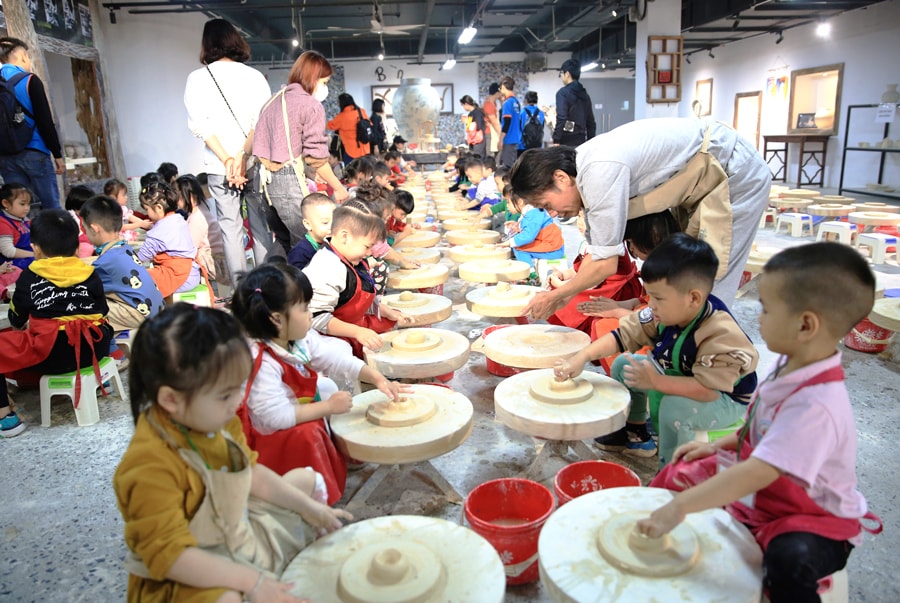
Not far from the city center, the pottery village of Bat Trang remains a popular destination for families. Here, children can learn about pottery, model, color and take their creations as souvenirs, under the guidance of craftsmen. Nguyen Minh Anh (from Ba Dinh district) enthusiastically exclaimed: “My favorite part was making my own clay cup. At first it was all crooked, but thanks to the advice of the master potter, I gradually improved. I was really delighted!”
Recently, Vice Chairman of the Hanoi People’s Committee Vu Thu Ha signed and released Plan No. 118/KH-UBND for the implementation of the Children’s Action Month in 2026. Under the plan, the city will organize cultural activities, recreational, entertainment, physical education, sporting and exchange activities with beneficial content and varied forms for children; encouraging children to participate in group games, folk games and creative games which develop their intelligence.
According to Dang Huong Giang, director of Hanoi’s tourism department, the capital’s tourism sector is also moving toward developing tourism products focused on traditional craft villages, educational tourism and experiential tourism for families with young children. The objective is not only to create more places for leisure, but also to allow children to access a healthy educational environment.
Source : https://hanoimoi.vn/diem-vui-choi-dip-he-cho-tre-em-tai-ha-noi-doi-moi-de-khai-thac-hieu-qua-tiem-nang-976047.html