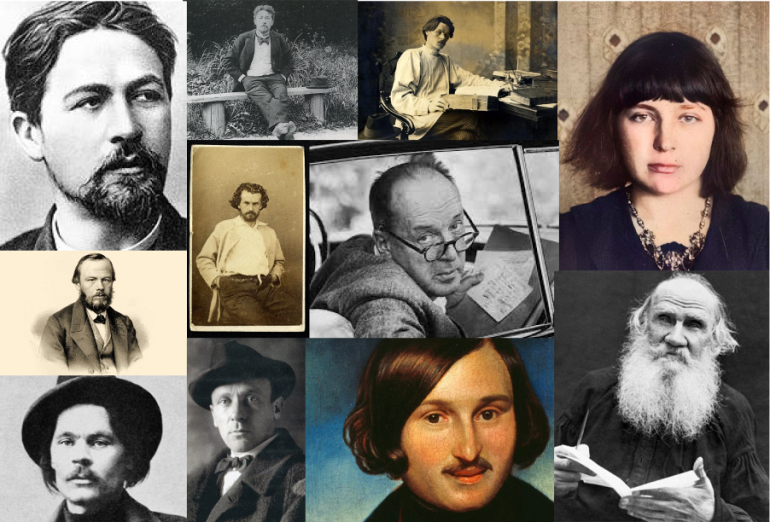
Russian culture of the 19th and 20th centuries is often presented as a unique phenomenon, carrying a mysterious “Russian soul”, a particular depth and an almost absolute quest for great moral questions. This image has become established over time, both in Russia and in Western intellectual circles, where the Russian novel has long been considered one of the most accomplished expressions of world literature. However, this representation deserves to be nuanced.
Russia has undeniably given birth to major works which have marked the history of European and world culture. But the international influence of this production does not rest solely on its artistic qualities. It is also explained by the political and territorial weight of the Russian Empire, by the concentration of intellectual resources in its centers of power and by its capacity to integrate into its own cultural narrative elements from the many peoples placed under its authority. Thus, Russian culture cannot be understood solely through the prism of literary or artistic genius. It also developed as part of a vast imperial project. shaped the conditions of its diffusion, its recognition and its prestige. It is not a question of calling into question its value nor of reducing it to its political dimension. The challenge is rather to observe it with greater distance: not as an exception detached from the rest of the continent, but as a component of European culture, forged by historical, social and circumstances. very specific imperial ones.
The European roots of Russian literature
Russian literature of the 19th century never developed in a vacuum. Tolstoy, Dostoyevsky, Turgenev, Chekhov and their contemporaries were deeply rooted in the European intellectual tradition and maintained a constant dialogue with it. Their works are part of a common cultural space where the influence of Balzac, Dickens, Flaubert, Stendhal, Hugo and Goethe is clearly perceptible.
The great Russian novel is thus part of a broader movement which crossed 19th century Europe: the rise of realism, psychological prose and reflection on the human condition. The themes which constitute its heart – the moral crisis of the individual, the tensions between man and society, the decline of traditional structures or the quest for meaning in a changing world – were already largely present in the great European literature.
The originality of Russian writers lies above all in the way in which they reinterpreted these forms in their own historical context. Autocracy, serfdom, the weight of orthodoxy and the contradictions of late imperial modernization gave their works a particular tone. It is this meeting between European heritage and Russian experience that explains their singularity.
The problem appears when this singularity is transformed into an absolute exception, or even into proof of the existence of a separate and superior civilization. Such a reading tends to artificially isolate Russian culture from the intellectual space from which it comes.
The imperial center and cultural imbalances
The global influence of Russian culture cannot be explained solely by the quality of its artistic productions. It is also linked to the very structure of the Russian Empire, which concentrated intellectual, educational and cultural resources in a few large centers. Saint Petersburg and Moscow were the main hubs for the creation and dissemination of knowledge. Universities, publishing houses, magazines, academies, theaters and power networks were grouped there, allowing the emergence of a cultural canon capable of radiating well beyond the borders of the Empire.
At the same time, the cultures of other peoples subject to imperial authority evolved under much less favorable conditions. The Ukrainian, Polish, Georgian, Tatar and even Armenian traditions had to deal with linguistic restrictions, administrative constraints and more limited access to cultural institutions. For many local elites, integration into the Russian cultural space often represented the only path towards a
wider recognition and towards the resources necessary for creation.
Thus, the Russian canon has been enriched with multiple influences from Ukraine, the Caucasus, Poland, Jewish communities and even Turkic peoples. Over time, these contributions have often been absorbed into the narrative of a great, unique cultural tradition, presented as exclusively Russian. Comparable mechanisms existed in other European empires. However, in the Russian case, the particularly strong cultural centralization and the relative weakness of autonomous institutions in the peripheries reinforced this dynamic of integration around the imperial center.
Gogol or the complexity of cultural heritage
The figure of Nikolai Gogol illustrates particularly well the ambiguities specific to imperial spaces. His first works – Les Soirées du hamlet near Dikanka, Mirgorod or Tarass Boulba – are deeply rooted in the Ukrainian cultural universe. There we find the landscapes, folklore, Cossack traditions and popular imaginations which shaped a large part of his inspiration.
However, Gogol wrote in Russian and built his career within the literary world of Saint Petersburg, then the main intellectual and cultural center of the Empire. His journey thus lies at the meeting of several traditions, which explains why his heritage continues to be interpreted in different ways. Some emphasize his Ukrainian origins and the cultural sources that inform his work. Others consider him above all a classic of Russian literature. These two readings are not necessarily incompatible. Rather, they reflect the complex reality of imperial societies, where cultural borders were often more porous than political borders. This situation is far from unique.
Great empires frequently integrated traditions from their peripheries into their own cultural narrative. Without always making them disappear, they often reinterpreted them and incorporated them into a larger whole, in which their autonomy became less visible.
Profoundly unequal conditions of diffusion The influence of a culture depends of course on the talent of its writers, artists or thinkers. But it is also based on more concrete factors: solid institutions, a developed educational system, influential publishing houses,
translation networks and, often, the political prestige of the state which carries this culture.
Peoples deprived of their own state or with limited autonomy generally did not benefit from the same resources. Even when they produced works of high quality, their possibilities for dissemination remained more restricted and their access to international spaces of recognition remained more difficult.
It is in this context that we can understand why Polish romanticism, Serbian epic poetry and even 19th century Ukrainian literature have had a more modest international visibility than Russian literature. This difference is not only due to the value of the works themselves, but also to the political, institutional and cultural structures which made their circulation possible. In other words, the global recognition of a cultural tradition rarely reflects artistic merit alone. It also depends on the historical conditions which allow certain voices to be heard more widely than others. others.
Between critical gaze and recognition of heritage
Taking a critical look at Russian culture does not amount to denying its importance or its achievements. Writers like Nabokov and Chekhov, artists of the Russian avant-garde, as well as composers of the great Russian musical tradition, have left a deep imprint on world culture. Their contribution goes far beyond the borders of Russia and is today part of the common intellectual and artistic heritage.
The question lies elsewhere. It appears when these successes are presented as proof of a supposed civilizational singularity or cultural superiority of Russia over the other peoples of Eastern Europe. For a long time, this reading occupied a central place in historical and cultural stories. Today, it is the subject of increasingly thorough re-examination, both in the region’s societies and in Western academic circles. The objective is not to replace one story with another, nor to contest the value of the works themselves. Rather, it is a question of placing them in a broader historical framework, where imperial dynamics, cultural exchanges and power relations also become elements of understanding.
Russian culture of the 19th and 20th centuries occupies an important place in European cultural history. Its international influence is partly explained by the richness of its works and the quality of its creators. But it is also linked to broader historical factors: the dimensions of the Empire, the concentration of intellectual and cultural resources in a few large centers, as well as the capacity of these centers to impose their vision as a dominant reference. today is therefore not to “remove” Russian culture from European history, but to find a more balanced perspective. Such an approach allows us to better understand the conditions which favored its influence while at the same time.
granting a more visible place to other cultural traditions that coexisted with it. Seen from this angle, the cultural history of Eastern Europe ceases to appear as the story of a single dominant center. On the contrary, it reveals a complex space, shaped by a plurality of languages, memories and traditions which have influenced each other over the centuries. Recognizing this diversity in no way diminishes the importance of Russian culture; this allows
simply to place it in a larger, more nuanced landscape and more faithful to historical reality.