In Nîmes, the Musée de la Romanité welcomes nearly 120 major pieces from the Louvre in an exhibition that dusts off preconceived ideas. From gladiator helmets to imperial portraits, from mosaics to luxury tableware, the exhibition tells the story of a civilization that made images an everyday language.
We think we know Roman art. Marble busts lined up in museums, statues exhibited like works of art, a few frescoes torn from Vesuvius, miraculously saved from Pompeii. What if this image was a modern invention?
This is the starting point for Roman Art in the Louvre. A world of images, presented at the Musée de la Romanité until January 10, 2027. Taking advantage of the temporary closure of the Roman rooms of the Louvre for renovations, the curators brought together in Nîmes nearly 120 works which rarely travel together. An exceptional concentration of pieces usually scattered throughout Parisian galleries.
The curators, Martin Szewczyk, Isabel Bonora Andujar, Manuella Lambert • @Yannick Pons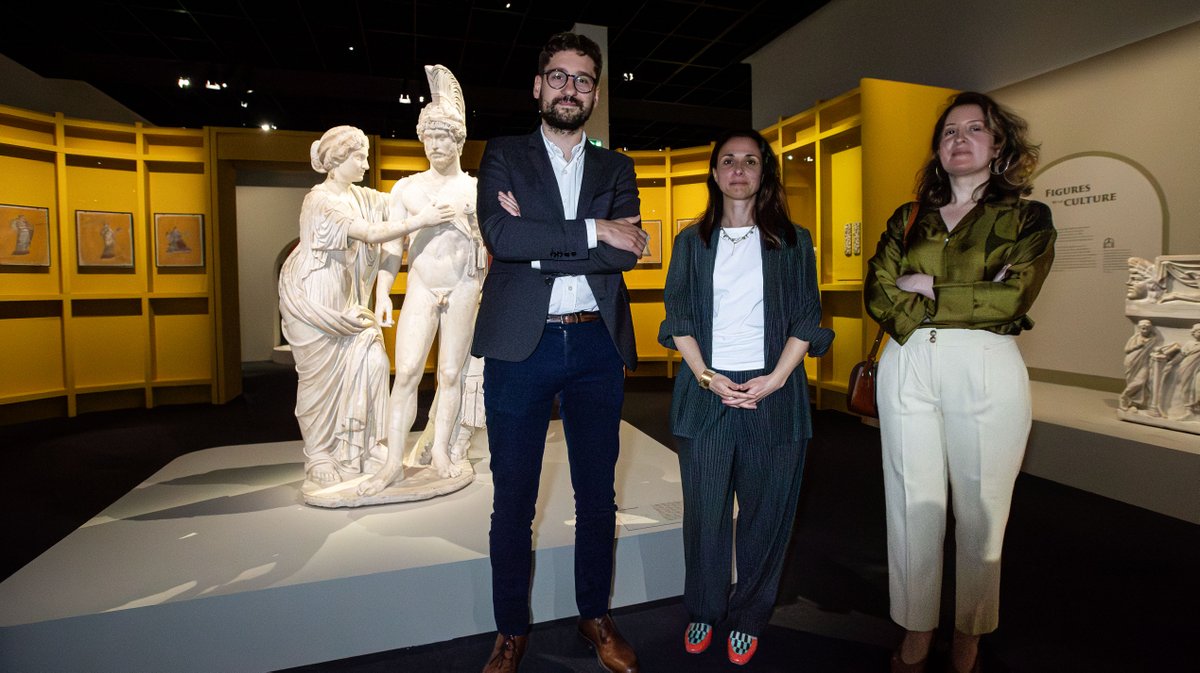
But the challenge is not to offer yet another panorama of the Roman Empire. HAS” The Roman art of the Louvre is not Roman art in its completeness » recalls Nicolas de Larquier, chief curator of the Musée de la Romanité. The idea is rather to question the way in which these objects became works of art in our eyes and to rediscover, as much as possible, the way the Romans themselves looked at them: that of objects integrated into daily, religious and political life.
The gladiator helmet that repairs our certainties
The exhibition opens with a revealing face-to-face. On one side, a fragment of a wall painting from Pompeii. Originally, it was part of a large decoration covering an entire wall. In the 18th century, when it entered collections, it was cut out, framed and transformed into a painting. In other words, an element of architecture that civilization has transformed into a work.
To his left, a gladiator helmet also discovered in Pompeii. Long considered a parade helmet as its decoration is so sophisticated, it nevertheless bears the traces of numerous repairs. He served, even served a lot. Its refinement therefore did not prevent its use.
Medallion bearing in its center a solidus of Emperor Constantine I, surrounded by six female and male busts in the round, one being missing, inserted in an openwork foliage, made using the opus interrasile technique, around 324-326 AD. • @Louvre Museum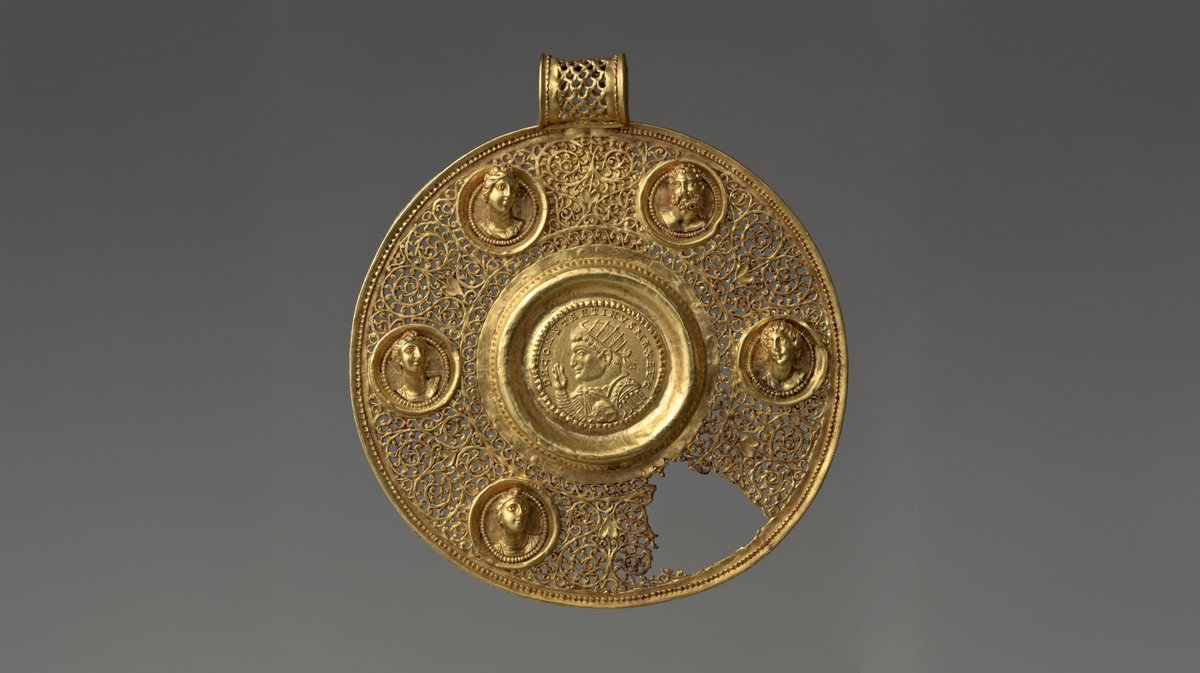
These two objects tell the same thing. The Romans did not compartmentalize existence between fine arts and utilitarian objects. Aesthetics overflowed everywhere. In houses, temples, tombs, military equipment, clothing or city wall streets covered with graffiti as in Pompeii.
A civilization that takes center stage
The rest of the exhibition explores this omnipresence of images. Some are used to honor the gods or the dead. Others accompany banquets, religious ceremonies or major civic events. All respond to a specific function at the time before becoming objects of contemplation today.
Among the most remarkable pieces are two bronze portraits of Livia and Augustus discovered in 1816. Their interest goes far beyond their artistic quality. The inscription preserved on their base reveals that they were offered by a notable Gaul following a wish granted. An extremely rare case which allows us to know exactly the destination and use of these works.
More than simple imperial representations, these bronzes were both gestures of religious devotion and marks of political loyalty.
The power of images
One of the most compelling sections shows how images participated in the construction of community.
The famous relief known as Domitius Ahenobarbus, produced at the end of the 2nd century BC, represents a census followed by a sacrifice intended to place the city under the protection of Mars. What is shown here, the commissioners explain, is not an exceptional event but a founding moment in Roman civic life.
Inlaid bronze cup discovered in Caesarea • @Louvre Museum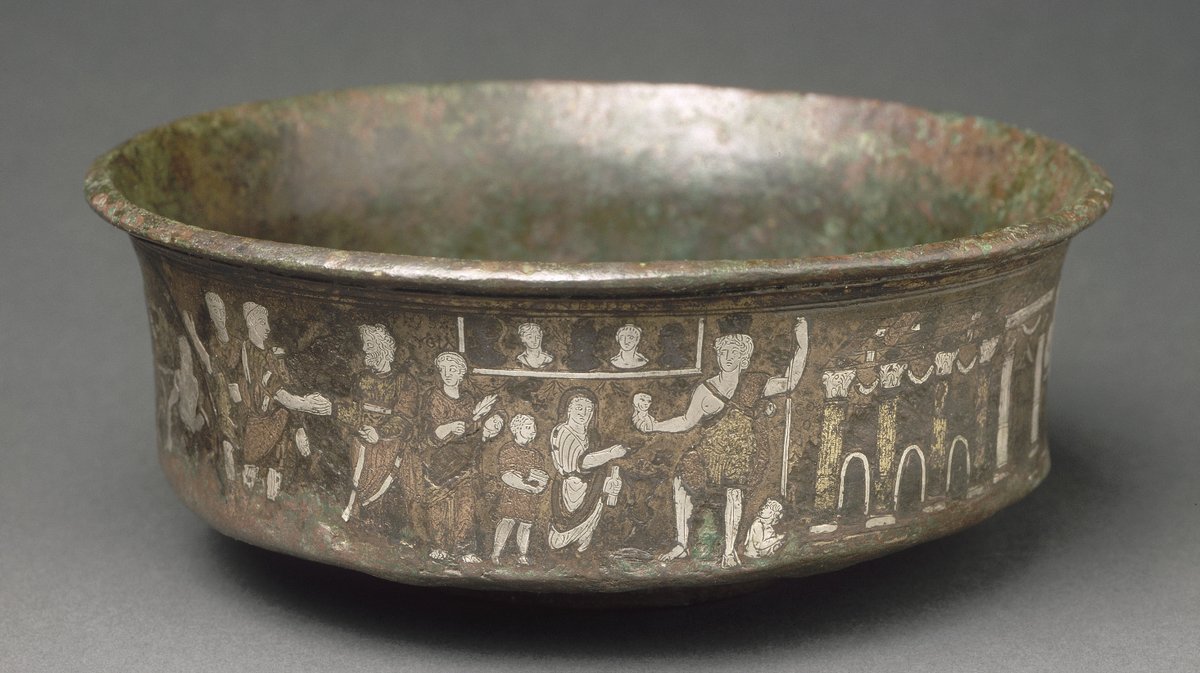
Same logic on an extraordinary inlaid bronze cup discovered in Caesarea, on what is now the Israeli coast. Its decor recounts the legendary founding of the city, its rites and its protective deities. A way of reminding us that images do not just reflect society, that they contribute to producing a common narrative and uniting communities.
The demonstration continues with the political uses of art. Portraits, statues, jewelry or insignia are an immediately understandable language. The deep and austere wrinkles of a portrait attributed to a representation of Crassus seek to display the experience, authority and sense of responsibility expected of a statesman, more than to reproduce a face.
Further on, a fibula offered by the emperor to high officials or a medallion from Constantine show how objects were also used to display a position in the imperial hierarchy. Receiving these insignia meant making one’s rank visible to all.
The Romans did not copy the Greeks
The last part tackles another stubborn cliché. Yes, Roman artists borrowed extensively from Greek models. But they don’t just reproduce them. They combine them, adapt them and transform them.
Marcellus, mi-Grec mi-Romain • @Louvre Museum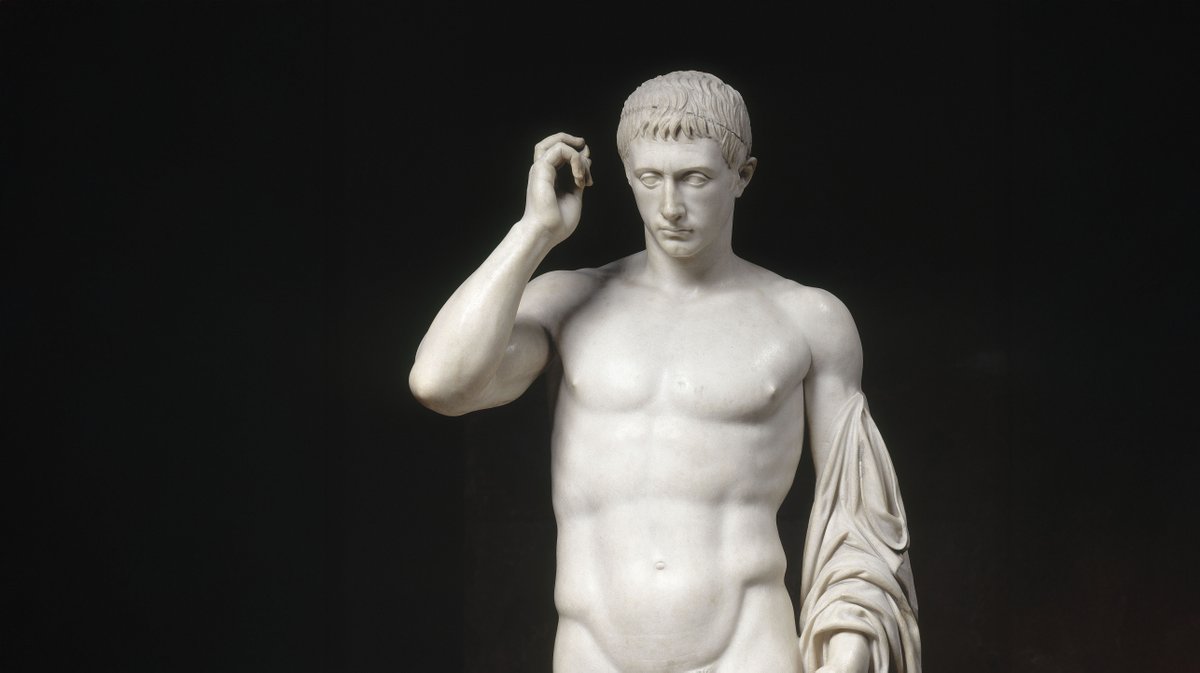
The superb Marcellus provides a good example. The body takes up the canons of classical Greek sculpture while the head is an individualized Roman portrait. A characteristic assembly of this Roman eclecticism which draws from several traditions in order to produce something new. Isn’t that a bit like the definition of creation?
It is also in this section that the important notion of mimesis is explained, at the heart of ancient aesthetics. For Roman artists, it was not a question of slavishly copying reality but of producing the most convincing illusion of life possible. Volumes, textures, movements, looks, polychromy, everything combined to give the works a living presence. Like this bust of a naked woman, which displays an absolutely striking expressiveness.
Last room • @Yannick Pons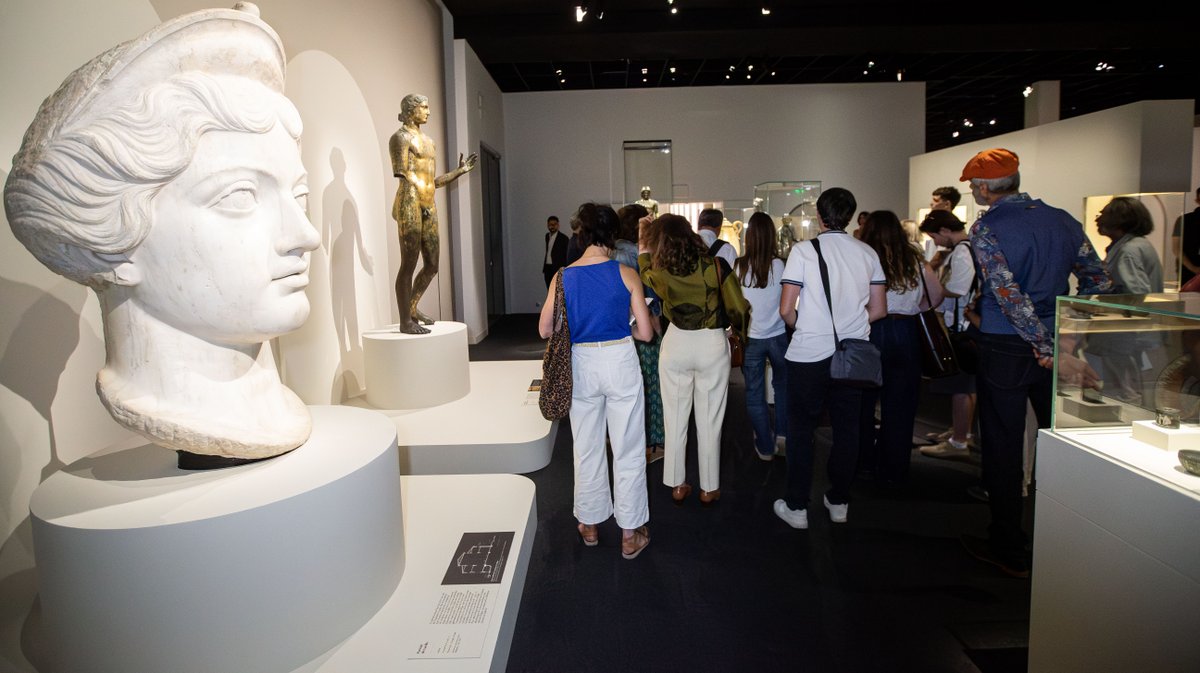
Basically, the merit of this exhibition is there. For the Romans, all these images were not really isolated objects on a pedestal. They were part of the decor, rituals, power, beliefs and everyday life. In short, they were everywhere because they served a purpose. And it is precisely this innovative concept that our curators are offering us here.
General Staff
Isabel Bonora Andujar, curator at the department of Greek, Etruscan and Roman Antiquities at the Louvre
Manuella Lambert, curator at the Department of Greek, Etruscan and Roman Antiquities at the Louvre
Martin Szewczyk, curator in the department of Greek, Etruscan and Roman Antiquities at the Louvre
Nicolas de Larquier, chief curator of the Musée de la Romanité
Commissariat exécutif
Claire Champetier, assistant to the curator of the Musée de la Romanité
Practical information
From June 11, 2026 to January 10, 2027. From April to October, every day from 10 a.m. to 7 p.m. From November to March, every day except Tuesday from 10 a.m. to 6 p.m. Last entry one hour before closing. The website here