Majestés,
Royal Highnesses,
Distinguished Authorities and members of the Diplomatic Corps,
Ladies and Gentlemen,
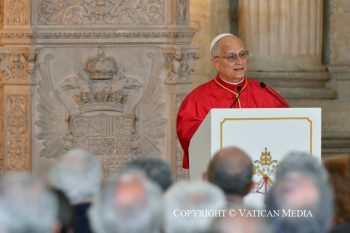 I give thanks to the Lord for this meeting and I express my gratitude to you for the invitation to make this Apostolic Journey to Spain: an itinerary in several stages, each of which will reveal an aspect of the multifaceted richness of a great country which, for almost two millennia, has welcomed the Word of the Gospel. Tradition has always linked the first evangelization of the Iberian Peninsula to the preaching of the Apostle James the Greater. This link has considerable theological importance, because it expresses the awareness of the local Church of being in continuity with the apostolic mission born at Pentecost. This very ancient link between the Christian faith and this land, without exhausting the multifaceted identity of your people, has profoundly shaped its culture and represents a source of hope and orientation in the face of the challenges that we must face together today as a human family. I am thinking of the expressions of popular faith which, in each city and each village, represent a true staging of salvation at the rhythm of the year and in the various contexts of life. With the artistic and musical heritage, with the multiple brotherhoods and charitable associations, they bear witness to the fruitful encounter between Jesus Christ and your people. They are a people full of passion who love life and show it!
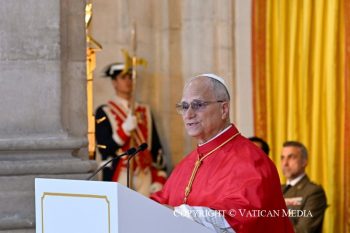 I come among you to confirm, encourage and inspire a renewed fidelity of believers to the Gospel, as well as a deeper reconciliation and cooperation between the different forces of this nation. Indeed, your own story shows that it is not the culture of confrontation but that of encounter which generates stability and prosperity. If we look closely, the message of peace, which in these times unfortunately sounds naive to some and provocative to others, finds an echo among those who do not lock themselves into ready-made ideologies, but are open to the truth. As Pope Francis taught us, “There is also a bipolar tension between idea and reality. The reality is, quite simply; the idea is developed. Between the two it is necessary to establish a permanent dialogue, avoiding that the idea ends up being separated from reality. It is dangerous to live in the reign of words alone, of images, of sophism” (the joy of the Gospeln. 231). Indeed – he concluded – “the reality is superior to the idea” (ibid.). The truth is always greater than us and that is why it surprises us and attracts us towards paths of purification and reconciliation where dialogue with others – and with the Other with a capital A – becomes fundamental.
 In this regard, I would like to evoke two figures from this country who, for five centuries, have nourished the life of the Church and the spiritual quest of many people, even beyond its visible borders. They are John of the Cross and Teresa of Vila, whose passion for the divine mystery made them friends. Theirs is a mysticism of “open eyes”, that is to say that it is not foreign to history, but on the contrary, it leads us to the root of the questions, to the heart of reality. In particular, the theme of the night, so dear to Saint John of the Cross, of whom we celebrate the Jubilee Year, helps us to interpret the transformations and to bear the tensions which make our times so dark. In his thirst for light, paradoxically, he learned to appreciate the darkness – “blessed night” (Dark night3) — like the time when the soul frees itself from what it thought it knew and possessed. Even today, it is the unknown that frightens us the most, causing in many the obscuration of reason and the violence of emotions, and in the face of which the feeling of no longer having any This is why we need, in public life too, men and women who sense in the darkness, the light; a possible beginning, almost the irruption of a truth like a light which still blinds, but which – if we trust and find peace. — will delicately lead us towards herself: “the night that guided me! A night more lovable than the dawn! A night that reunited the Beloved with his beloved, the beloved transformed into his Beloved! HAS” (ibid., 5).
 Our time, apparently shaken by terrible imbalances and conflicts, aspires deep within itself to peace, to a new knowledge of the human person and his inviolable dignity, to the civilization of love (cf. Great humanityn. 186).
Sainte Thérèse describes this same journey through the image of the interior castle. By moving from room to room towards the most intimate place – that is to say, each towards his own heart, sanctuary of truth – the space expands, the mind opens, contradictions are resolved, tensions dissolve, others find their place, the universe becomes a home. it is not an intimate escape, but a radical opening to completely different and always newwhich comes true when we come back to ourselves. This dimension of the human being is the reason why religious freedom and freedom of conscience must be protected.
Today, the temptation to gain popularity by fanning the flames of polarization seems to be growing, instead of diminishing; human dignity continues to be violated. This is why we need culture, interiority, free and quality education, we need transcendence. And yet, since those dark nights, men and women faithful to the truth have been driven to advance from piece to piece until the point where, in conscience, justice and peace embrace each other. It is from their freedom that we learn to be free.
The Catholic Church serves this thirst of the human heart, not in an imposing manner, but through evangelical witness supported by a multitude of martyrs and saints, and today it is prepared to put itself at the service of the future of a people in search of reconciliation and peace.
 I invite everyone, for the love of truth, to abandon the discourses that divide and polarize your social reality and your history, in order to move from sterile simplifications to a fruitful appreciation of complexity. I see there a specific vocation of Europe, of which Spain is a founding and essential actor. This is the gift that the Old Continent can offer to the world if it wants to remain young, because young is the one who has the feeling of having a future and a mission still to accomplish. Appreciate complexity and study it, learn not to deny it and experience it as a blessing, flee these identity-based approaches which seem to clarify everything, but which populate the world with ghosts and enemies: such is the task of those who have a great history behind them. New technologies have become an artificial environment where our fundamental choices are put to the test: within them, prejudices are exacerbated, critical thinking is weakened, dominating interests sow death drives. On the other hand, good can resist and be communicated.
 It is necessary, especially on the part of those who have economic, political and institutional responsibilities, to make a qualitative leap, a change of direction in investments intended for schools, universities and research, for local communities and for civil society as a breeding ground for participation and cultural mediation. Security, which we too often hope to find in weapons and walls, comes from learning to move forward alongside each other, to grow together, side by side. Your own story bears witness to this. The presence of Islam in the Iberian Peninsula, for example, constituted a long-lasting political, cultural and religious reality. During this period, there were not only clashes, but attempts were made to create a space for meeting, conversation and dialogue on the meaning of truth between Christians, Muslims and Jews. At the school of translators of Alphonse In particular, cities like Córdoba and Toledo became places of mediation between languages, religions and knowledge. But this is the truth that European cities manifest, their historical stratification, the fabric of solidarity which, over the centuries, has shaped their differences, transforming inevitable conflicts into starting points.
 As another noble son of this earth taught us, it is in trials and failures that it is possible to rethink everything: Ignatius of Loyola had this audacity, paying attention to the desolations and consolations of his heart, in an exercise of discernment and imagination by which he preferred peace to arms and saints to the powerful. He understood that the good that attracted him was not utopian, and his crisis was then transformed into grace. It can be the same with the “new developments†which worry us today and on which our sensitivities are divided. Let us avoid words that humiliate or oppose us. Let us choose the light that enlightens and the frankness that opens paths. Let us not bless naive enthusiasms, let us not fuel sterile fears. goods, option for the poor, care of the common Home, peace – and let us translate them into practices: a responsible approach, human and social impact assessments, inclusion of the most vulnerable, digital literacy, research and industry oriented towards justice and peace” (Great humanityn. 14).
 Majesties, Royal Highnesses, Ladies and Gentlemen, I express my gratitude to your country for its loyalty to international law and multilateralism, which translates into a constant commitment to peace and solidarity between peoples. At the same time, I encourage you to also cultivate within yourself dialogue and social friendship, to take into account the perspectives of the poor and young people when imagining the future, to reconcile the demands of autonomy and unity, and to advance the process of European union, not in opposition to other powers, but as a gift for the whole human family.
God bless Spain!