Originally from a small town near Nantes, Melen Guesdon, aka Woizo, discovered drawing very early on thanks to a painter who introduced him to colors, compositions and different artistic techniques from childhood. After an adolescence marked by the discovery of graffiti, he simultaneously developed a practice of graphic design and street art before increasing his travels throughout France and abroad. Installed in Toulouse after a long journey to the Philippines, the artist today constructs an abstract and organic universe, nourished by graffiti, human encounters, urban architecture and the search for emotions through color.
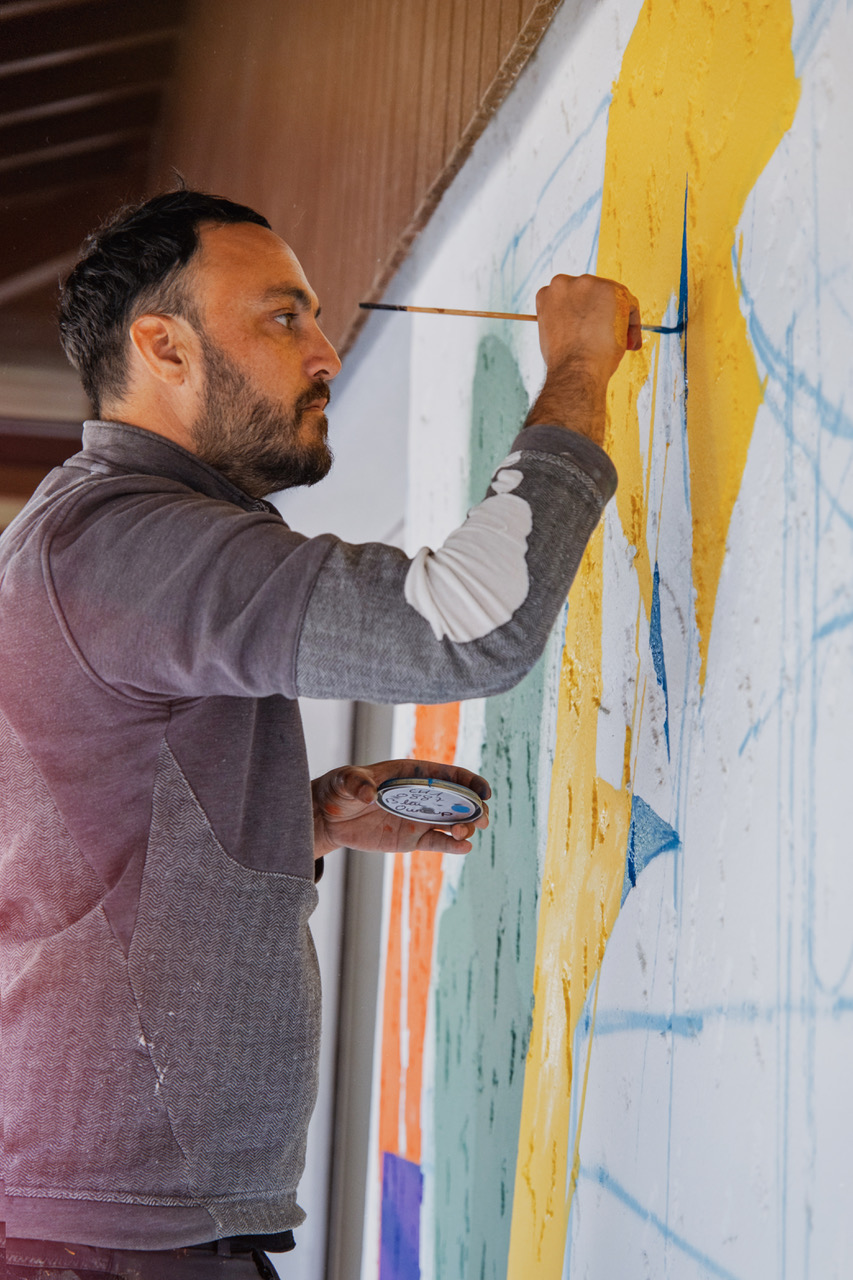
Graffiti frescoes, with passion as the only guide ©Mr Blønde
Graffiti is a practice that has obviously changed your way of making art, but has it also changed your way of looking at the city?
Totally, graffiti really taught me to read the city differently. When you make graphs, you develop a very particular attention to surfaces, to architectural rhythms, to forgotten places, to the breathing that exists in urban space. You no longer just look at a facade as “just a wall”, but as a potential field of expression. And it also taught me to feel the energies of places. A city is not just a setting, it is an accumulation of human traces, tensions, flows, history. Graffiti gave me this very instinctive relationship with public space. It was physical.
Toulouse is a city which has a very active street art scene, but less publicized than other large cities. Do you feel an artistic identity specific to Toulouse emerging since you have been here?
Toulouse has always been a real graffiti scene. Afterwards, there was street art. There were important artists who came out of Toulouse, I am thinking in particular of Tilt, Miss Van, FafiRémi Tournier. A whole team in graffiti that laid the foundations, the true school. There is a history here, a fairly strong visual culture, even if it is not always publicized. For a long time, there was a balance between the different practices. There were the more vandal graffiti artists, the muralists, the studio artists. I find that today this balance is lost a little. With new generations and social networks, everything goes faster, it becomes more individual. But despite everything, in Toulouse, there is always a real creative energy. It’s alive, it’s free.
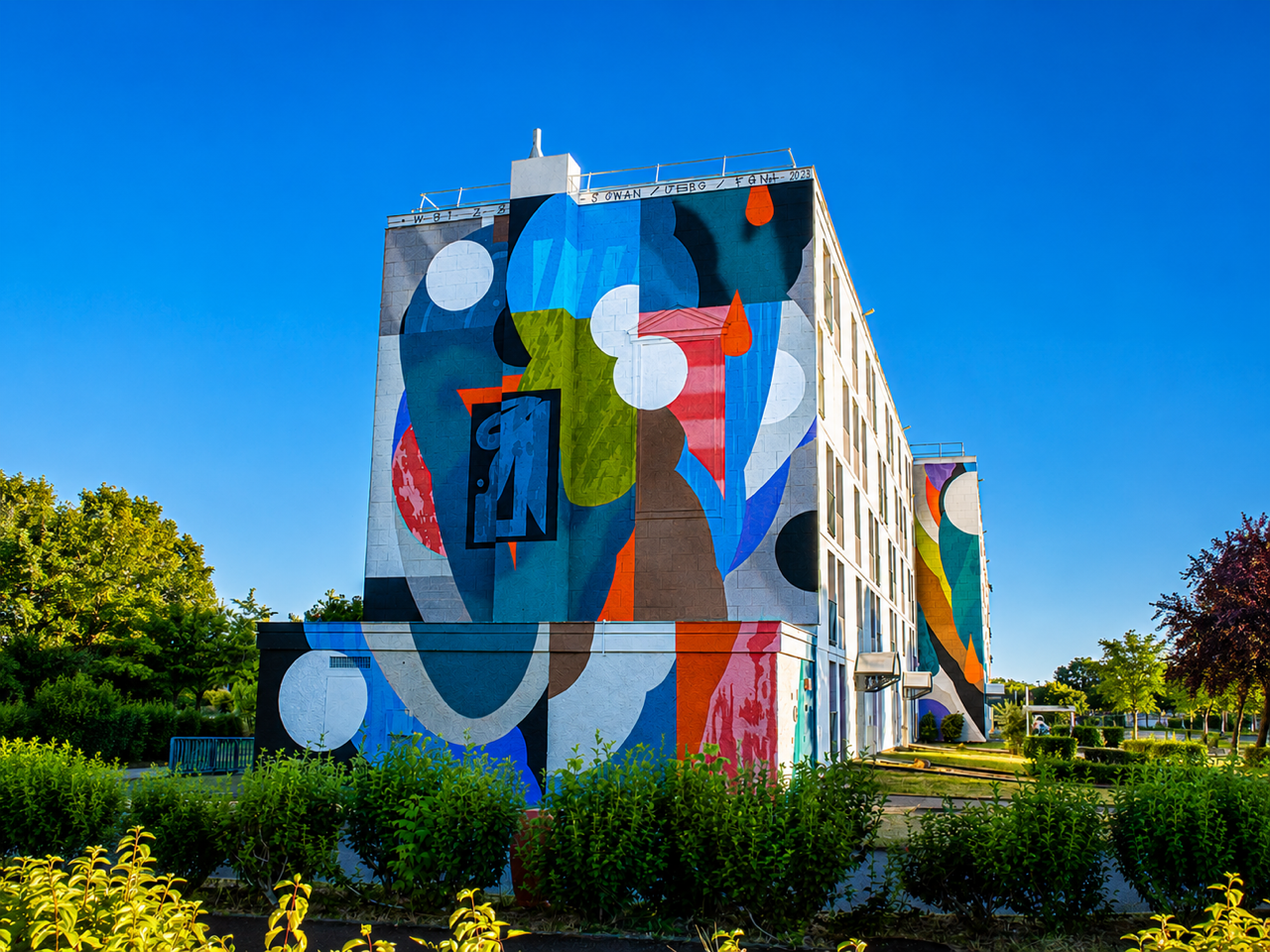
Colors and shapes to refresh what is dated ©Woizo
Today, street art is everywhere: festivals, public commissions, brands… Are you sometimes afraid that urban art will lose its initial relationship to spontaneity or freedom?
I think that there is still something very lively in graffiti. Basically, the codes of this art structured themselves. And despite the fact that we sometimes try to standardize it or polish it a little, it lives by itself. It’s a microcosm. All the basics are there, and it will always live on its own. There will always be artists who will explore, search, discover. It’s a bit like free parties; there are crews, people organize themselves, meet up, learn together. So there will always be this impulse of freedom. We tried to recover this culture because it was emerging, original, but many artists still keep this strong link with this culture.
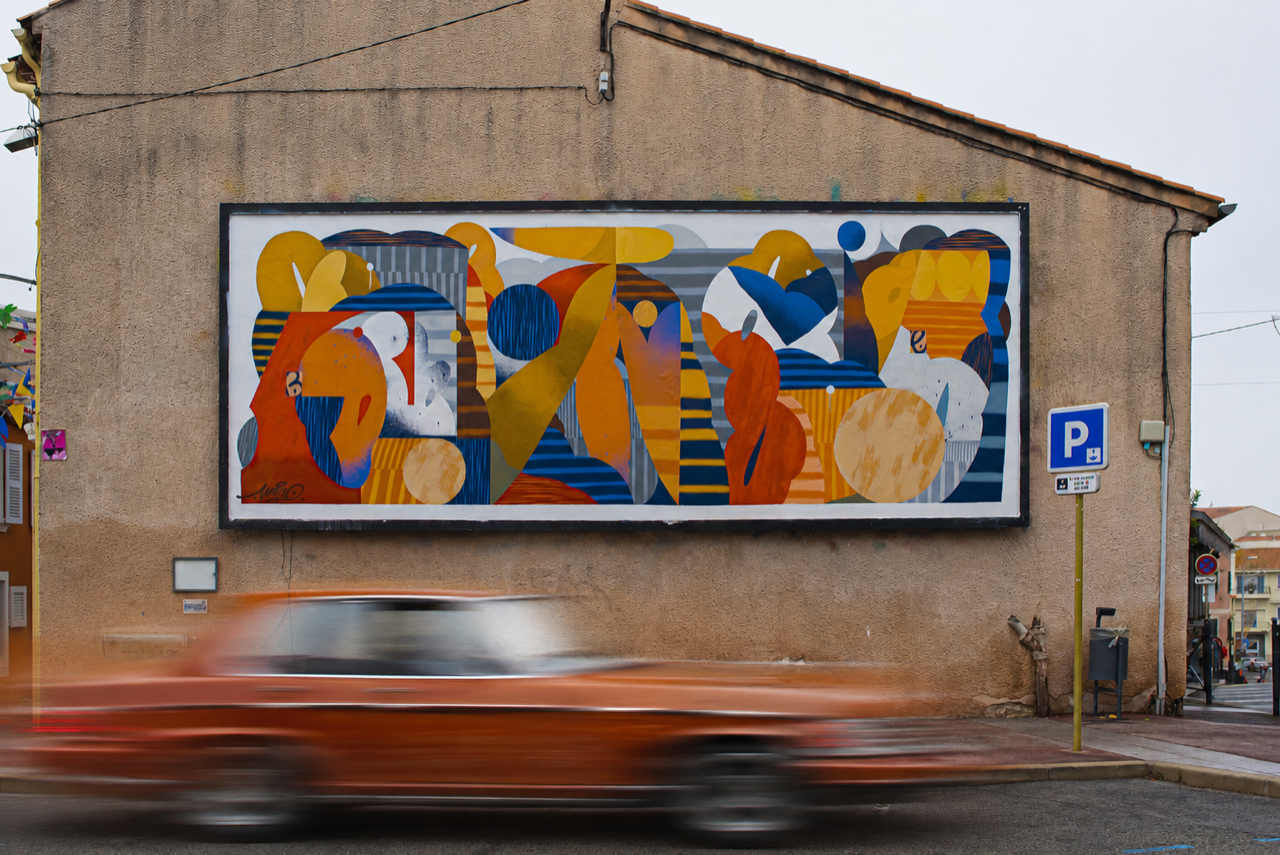
A wall no longer so invisible ©Woizo
You often talk about your travels, particularly your stay in Africa. What specifically changed in your work at that time?
The trip to Africa was a major event for me. It changed the way I felt about color or symbol. I was marked by architecture, fabrics, masks, vernacular paintings and their entire system of signs, like adinkras for example, which express emotions or symbols. I find that there is a very direct and spiritual graphic power in what they create.
In your work, color seems to be a real emotional language more than an aesthetic choice. When you arrive in front of a wall or a canvas, do you think of your frescoes as sensory experiences?
Yes, completely. Color acts a bit like an emotional frequency. Certain associations create tension, calm, movement, heat. I always try to compose my frescoes as spaces to be felt rather than read. When someone walks past one of my works, I like the idea that they can be overcome by a sensation, without necessarily needing an intellectual explanation. Color touches something more instinctive.
Your works often give the impression of having been designed to enter into symbiosis with the surrounding architecture. When you arrive in front of a wall, what do you look at first?
Above all, I look at how the wall lives with its environment. Its light, the rhythm, what it already says at the base. I look at the architectural lines, the openings, everything that circulates around. But also the human users of the place. For me, a fresco should not be placed on a building like a big sticker. It must dialogue with the space and reveal certain qualities of the place.
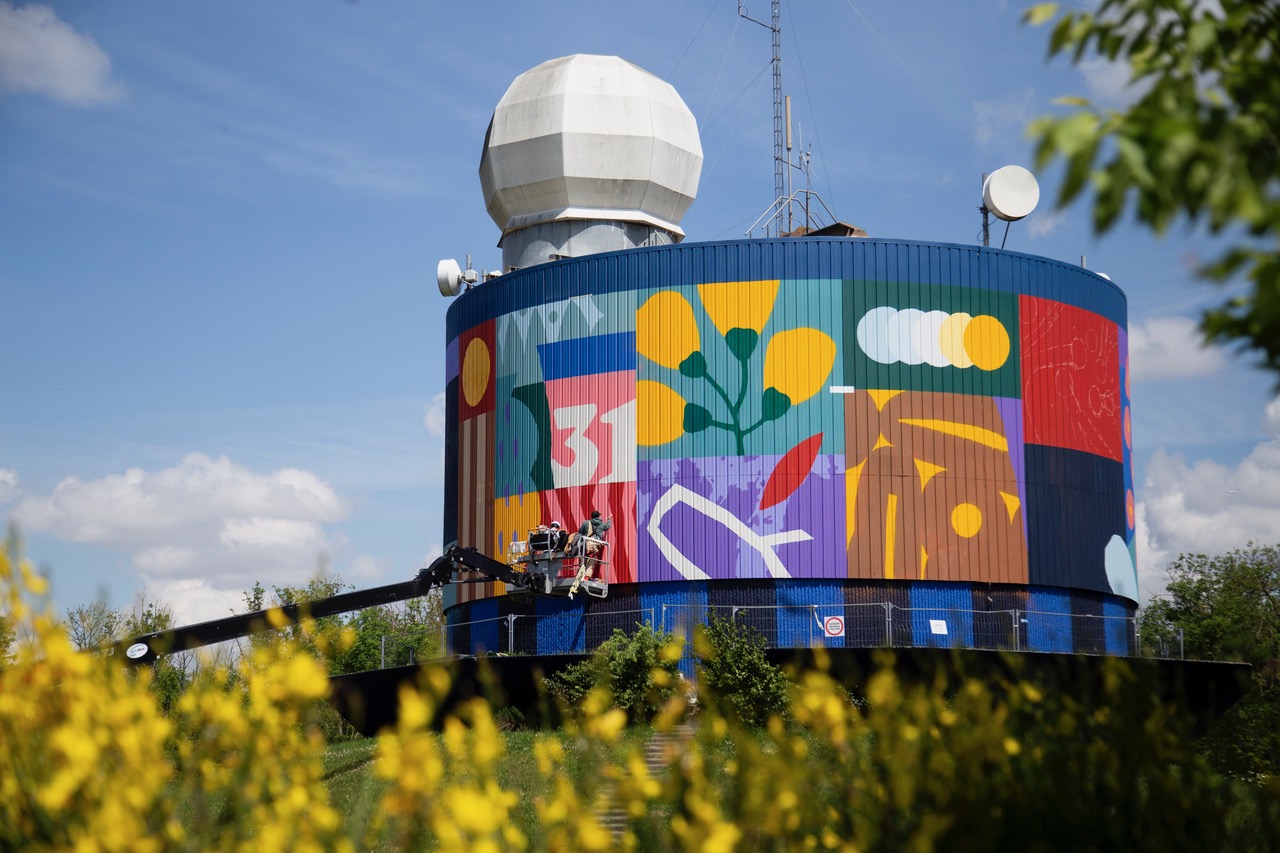
An art anchored in the landscape ©Julien Vareille
Why did you choose this path of abstraction and free interpretation rather than more figurative work?
I started by doing more figurative things, but over time I realized that I felt fixed in my way of constructing images. I needed to find something more instinctive, more alive, more personal. My evolution has led me to purify forms, to gradually remove the superfluous to move towards more free and organic compositions. Abstraction allows me today to work more on rhythm, tensions, balance, the energy of movement and also to leave room for interpretation. And since I come from graffiti, I always have this relationship with the sign, with the deconstructed letter, with the gesture.
You quote Wassily Kandinsky, Mark Rothko or even Piet Mondrian among your influences. What do these artists still bring you today?
They taught me that painting could go beyond simple representation. When Kandinsky spoke of inner vibrations, or Rothko of emotional presence, it really struck me. Mondrian worked a lot on the balance and tensions in the composition. It opened me up to the idea that a shape, a color or a void could produce a very strong sensation.
Do you have feedback or a reaction from a passerby who struck you when faced with one of your works?
Yes, once, while I was painting a fresco, an elderly lady came to see me. She was almost in tears. She told me that she had walked past this wall every day for years and didn’t even look at the place anymore. And for the first time, she felt like this place was breathing again. It touched me greatly. She told me the whole history of the neighborhood. She told me that her eyes were opening again. There, you understand that you really have your place.
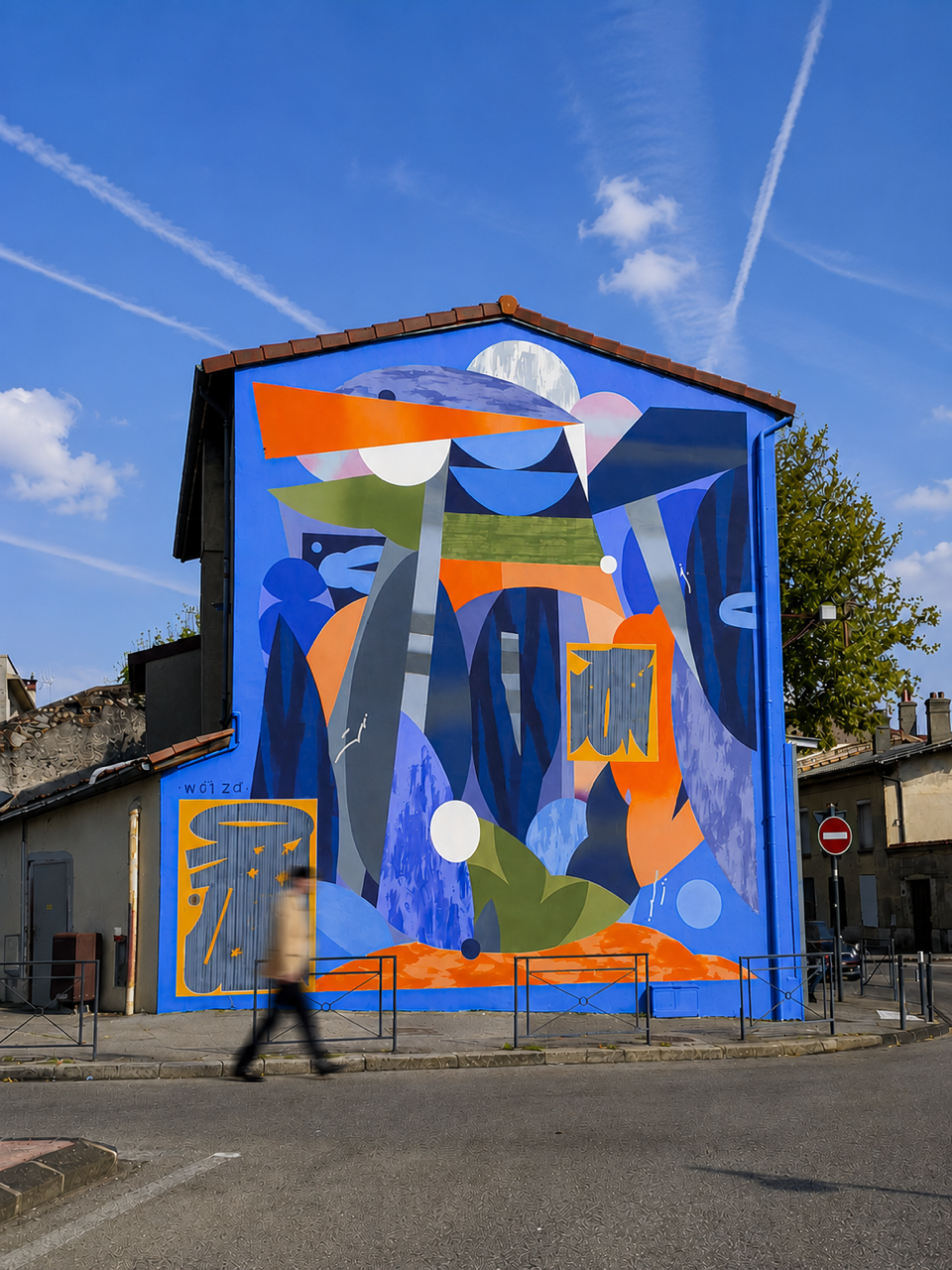
Bringing new life back to landscapes that had lost them ©Woizo
Do you think that urban art can change the way we inhabit a space and see it?
Deeply. Art has always transformed our daily lives. Humans have always painted, sculpted, decorated and told stories on walls. A work can change the way we pass through a place, the way we feel it, the way we re-appropriate it. It can create poetry, pride, connection. Even in a very concrete and functional city, art reintroduces something sensitive. And I believe that today, more than ever, we deeply need it.
Julie OLD
Woizoner
Woizo.art

Â