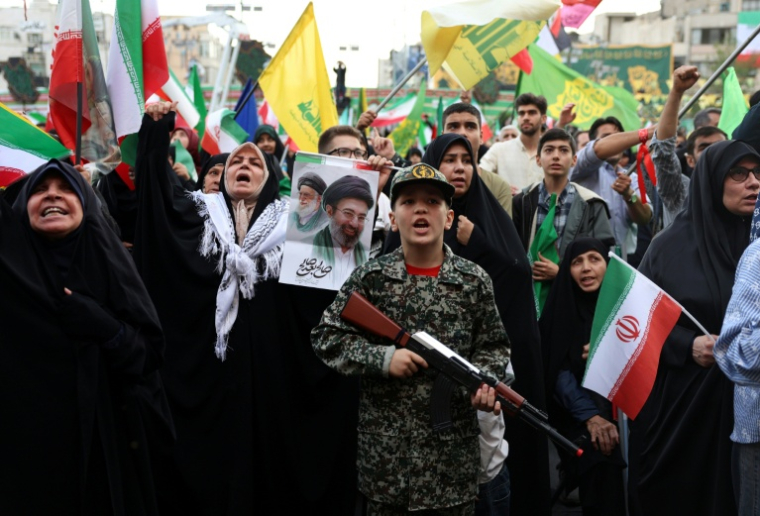
A young Iranian in military uniform during a rally in support of supreme guide Mojtaba Khamenei, April 29, 2026 in Tehran (AFP / -)
The Islamic Republic has not collapsed: at the end of the American-Israeli offensive against Iran, not only are the ultraconservative clerics still in power in Tehran, but the opposition is more marginalized than ever.
American President Donald Trump, who supported anti-government demonstrations at the start of the year, argued at the start of the conflict that the bombings should pave the way for a popular uprising capable of bringing down Iranian power.
But Iranian dissidents are the first losers of the agreement reached this week between Washington and Tehran to end the chaos, according to experts and human rights defenders interviewed by AFP.
The opposition movements in exile, who rushed to position themselves for a hypothetical transition, did not succeed in “seizing the opportunity”, explains Thomas Juneau, professor at the University of Ottawa.
“On the contrary, internal struggles within the opposition in exile have intensified,” he believes, while the domestic opposition “has been considerably weakened” after decades of repression.
In Iran, some had expressed the hope of foreign intervention after the protest movement in January, which was bloodily repressed.
And on February 28, on the first day of the Israeli-American strikes, cries of joy greeted the announcement in neighborhoods of Tehran that the supreme guide Ali Khamenei had been killed.
But as the war progressed, expectations soared in the face of the response of the Islamic Republic which, far from retreating, attacked Israel and its Gulf neighbors allied with the United States.
The deaths of civilians and destruction from the conflict, the wave of arrests and executions, and massive internet outages have ultimately only aggravated the suffering of residents, against a backdrop of economic stagnation.
“Peace with my executioner”
“This war was never fought for the human rights” of Iranians, asserts Mahmood Amiry Moghaddam, director of the NGO Iran Human Rights. And on the contrary turned against them by allowing the authorities to use it as a “pretext to intensify the repression”.
For him, “democratic change must come from the Iranian people, and not from foreign military intervention.”
US Vice President JD Vance insisted this week that the war was primarily about ending Iran’s nuclear program and that Trump’s position had always been: “If the Iranian people want to rise up, great. That’s their business.”
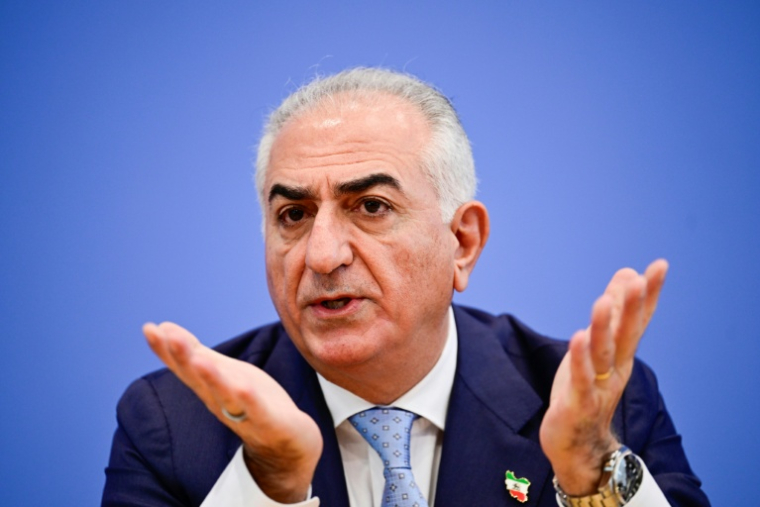
Reza Pahlavi, the son of the deposed shah of Iran, in Berlin on April 23, 2026. (AFP / John MACDOUGALL)
Nevertheless, Iranians have confided their feeling of betrayal in recent hours.
“They may try to embellish the agreement, but that will only give them (the Iranian authorities, Editor’s note) the power to oppress us further,” said Sima, a 34-year-old resident of Tehran, on condition of anonymity: “Any form of peace with the Islamic Republic would amount to making peace with my executioner.”
For Reza Pahlavi, son of the former Shah of Iran overthrown in 1979, “any negotiation with this regime is doomed to failure and we will all suffer the consequences.” It is “morally reprehensible and a strategic error,” he wrote on X.
Mr. Pahlavi, whose name was chanted during recent protests in Iran, has often been cited by the media as a possible alternative. But neither he nor any other opposition figure has obtained the support of Donald Trump.
Political prisoners
According to Thomas Juneau, the demonstrations did not allow a united coalition to emerge, with the different factions of the diaspora preferring to organize their rallies each on their own.
Another prominent group, the People’s Mojahedin (PMOI), has lambasted both the Islamic Republic and the monarchists in response to the US-Iran deal, saying they were the only ones who “want war”.
Their leader, Maryam Rajavi, called for the end of the executions of political prisoners to be included in the discussions, a point absent from the protocol signed by Washington and Tehran.
The United Nations and NGOs are alarmed by the sharp increase in executions in Iran – more than 40 since the start of the war – and arrests in recent months, many of which are linked to demonstrations that the authorities have described as “terrorist riots”.
“Protesters, dissidents and all those campaigning for fundamental political change remain at serious risk of further atrocities from the Iranian authorities,” warned Amnesty International Secretary General Agnès Callamard.