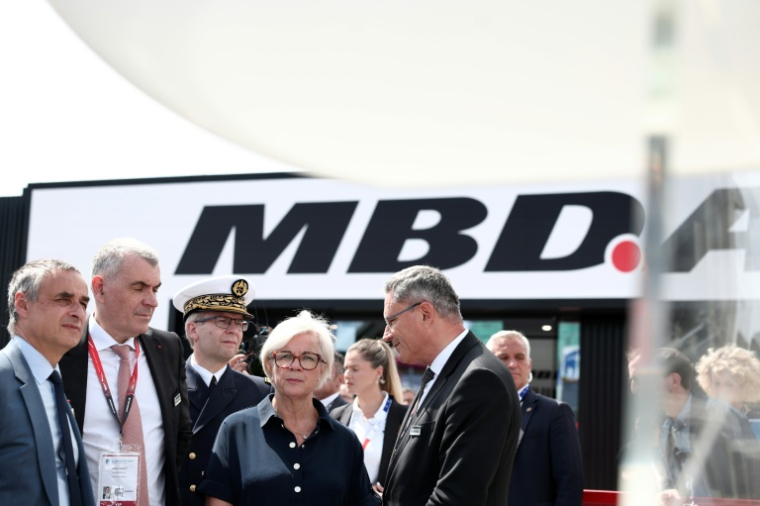
French Minister of the Armed Forces Catherine Vautrin on the star of the MBDA missile at the Eurosatory show in Villepinte, north of Paris, June 15, 2026 (AFP / Guillaume BAPTISTE)
From Ukrainian trenches to the outskirts of airports, the threat of drones is pushing defense manufacturers to expand their markets: the French missile manufacturer MBDA is offering its shield for civilian uses while Naval Group is extending its own solution to the needs of the army.
At the Eurosatory world defense exhibition in Villepinte near Paris, the European missile champion unveiled its Sky Warden anti-drone shield supposed to create “a 7 km protective bubble” around airports, nuclear power plants, prisons and other installations vital to national security.
“We did not wait for recent conflicts to work on this system,” underlined Cécile Macé, responsible for the fight against drones within MBDA, specifying that Sky Warden for military use had already been sold to numerous countries in the Middle East and Europe.
While drones are omnipresent at Eurosatory, “which was not the case” during the previous edition in 2024, the need to deal with them now goes well beyond the military framework, according to Cécile Macé.
“The drone threat is visible near our critical infrastructures,” she underlines, citing as an example the airport overflights observed in recent years in Munich, Copenhagen and Oslo, which have disrupted air traffic.
In this growing market, Sky Warden competes with other projects such as SkyDefender developed by Thales, a multi-layer air defense dome.
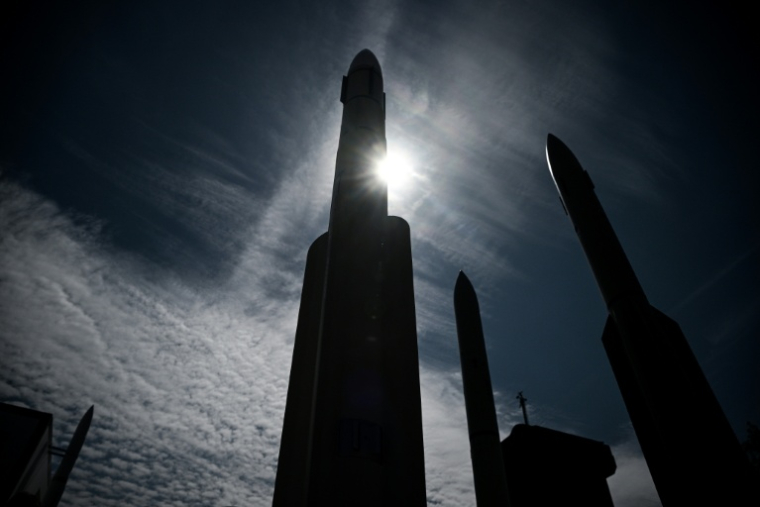
MBDA missiles at the Eurosatory exhibition in Villepinte, near Paris, June 16, 2026 (AFP / JULIEN DE ROSA)
Sky Warden relies on a command and control center (C2), described as “the brains of the system”. This aggregates information from multiple sensors – radars, cameras, optronic means or radio frequency detectors.
Once the malicious engine has been detected and identified, several means of neutralization can be used depending on the type of threat and the environment attacked.
MBDA particularly highlights laser weapons developed by Cilas, a French gem that the group holds jointly with Safran.
Such a system was deployed during the Paris Olympic Games and is currently being delivered to the French armies.
Open and versatile
The group is also developing an interceptor drone with the French SME Novadem. Launched against the hostile aircraft and capable of reaching up to 200 km/h, this interceptor is designed to destroy the enemy drone by kinetic impact without explosive charge.
MBDA is targeting a first operational capacity at the end of 2026 and ultimately envisages production of up to a thousand units per month.
“Our system is completely open” allowing the customer to integrate sensors and anti-drone weapons of their choice, underlines Cécile Macé.
It is also modular, allowing new capabilities to be quickly added as drones evolve.
Sky Warden can also be available as Sea Warden, a naval version embarked on board ships.
For Rampart, a versatile modular launcher designed by Naval Group as a “near-field self-defense system”, the evolution follows the opposite trajectory: originally developed for combat vessels, it is now adapted to the needs of land forces.
Tested at the start of the year by the French Navy, this system capable of protecting a perimeter of around 8 kilometers is now arousing the interest of the Army and the Air Force, responsible for protecting the “sensitive sites”.
Result: at Eurosatory, this Naval Group system equipped with four modules for munitions (rockets, missiles, remotely operated munitions, drones, decoys) is presented on an Arquus land truck.
“We will be ready to move into the industrialization and mass production phase at the end of 2026-beginning of 2027,” underlined Guillaume Fevre, sales director for France at Naval Group.
“On a boat, it will be used for anti-aircraft defense, defense against surface drones, or even launch anti-submarine grenades (…) If it is on the edge of a forest, it can fire on a column of tanks and at the same time ensure protection of the trench which is behind against drones”, explains Stephan Meunier, director of operational marketing at Naval Group.