lediplomate.media – printed on 06/16/2026
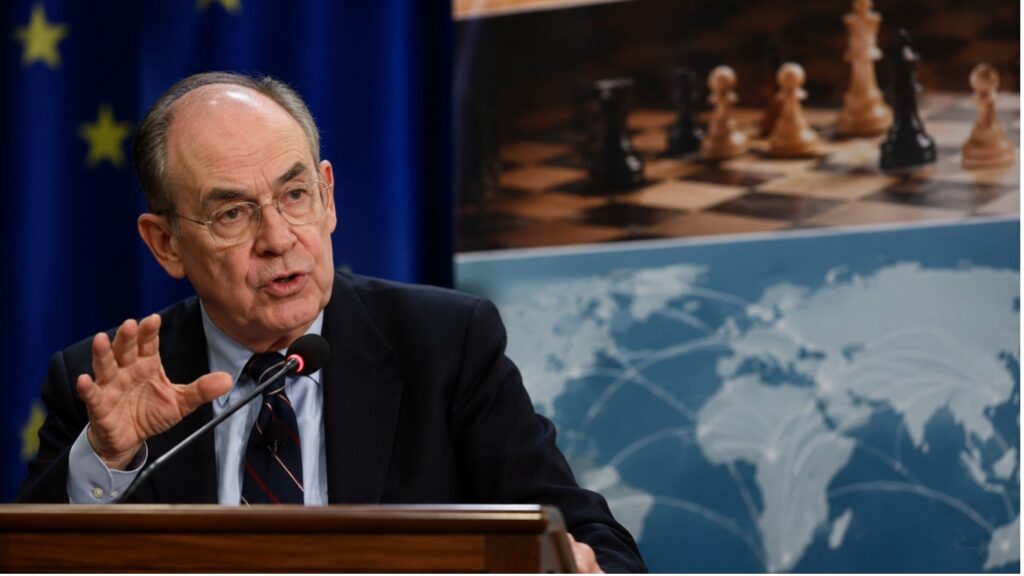
By Giuseppe Gagliano, President of the Centro Studi Strategici Carlo De Cristoforis (Côme, Italy)
Theory is not an intellectual luxury, but the compass of power
John Mearsheimer begins with a statement that may seem provocative: no foreign policy exists without theory. Even political leaders who claim to act solely on the basis of pragmatism are in reality relying on a representation of the world. The question is therefore not whether we are using a theory, but which one.
According to him, the major Western decisions since the end of the Cold War – the economic integration of China, the enlargement of NATO, the promotion of globalization or even the belief in the universal diffusion of liberal democracy – were based on theoretical hypotheses which were revealed to be erroneous. The problem is not that these theories were immoral or naive, but that they poorly explained the real functioning of international relations.
For Mearsheimer, any theory necessarily simplifies reality. The world is too complex to be understood in its entirety. A theory selects certain factors considered determining and excludes others. No theory is perfect, but some allow us to understand more phenomena than others. Realism belongs to this category.
Realism versus the illusions of liberalism
Offensive realism is based on a few fundamental postulates. The international system is anarchic: there is no higher authority capable of protecting States. They have offensive military capabilities. The real intentions of other states can never be known with certainty. Survival is the ultimate goal and leaders generally act rationally to preserve it.
From these hypotheses a deeply competitive universe emerges. States live in uncertainty and fear. They must constantly prepare for the possibility that another power becomes hostile.
Conversely, liberal theories emphasize economic interdependence, international institutions and the spread of democracy. They consider that increased trade reduces the risk of conflict and that democracies tend to maintain peaceful relations with each other.
For Mearsheimer, this vision led the West to make several major strategic errors.
China: Washington’s fundamental error
The most important example is that of China. For several decades, American elites considered that the integration of Beijing into the world economy would promote its gradual transformation into a responsible partner.
The reasoning was simple: capitalism would lead to prosperity, prosperity to political openness, and political openness to democracy. A democratic China would then naturally become peaceful.
Mearsheimer rejected this analysis in the 1990s. According to him, any great power that becomes rich seeks to transform its wealth into military power. Once it becomes sufficiently strong, it attempts to secure its regional environment and reduce the influence of external powers.
In his eyes, the rise of Chinese power therefore made a strategic confrontation with the United States inevitable.
Chinese leaders could well proclaim their peaceful intentions. Realism considers that intentions are impossible to measure in the long term. Material capabilities, on the other hand, are visible: economic growth, industry, technology, army, fleet, missiles, strategic infrastructure. They are the ones who determine the balance of power.
The century of humiliations and the logic of power
Mearsheimer emphasizes a factor often underestimated in the West: Chinese historical memory.
China retains the memory of the “century of humiliations”, a period during which it was dominated by Western powers and Japan. For Chinese leaders, avoiding a return to this vulnerability constitutes a strategic imperative.
In this logic, Beijing naturally seeks to become the dominant power in East Asia, just as the United States dominates the Western Hemisphere.
Taiwan occupies a central place in this strategy. For Chinese leaders, this is not only a question of identity or nationality, but a fundamental issue of security and geopolitical credibility.
NATO and Ukraine: the announced crisis
The same logic applies to Russia.
Mearsheimer recalls that several realists, including George Kennan, had warned in the 1990s that NATO’s eastward enlargement would inevitably provoke a Russian reaction.
According to him, the great powers consider their immediate neighborhood as a zone of vital interest. The United States has applied this logic for nearly two centuries through the Monroe Doctrine, which refuses any significant military presence of external powers in the Western Hemisphere.
Why would Russia accept what Washington would never accept for itself?
For Mearsheimer, the Ukrainian crisis must be understood above all as the result of a geopolitical clash between two incompatible visions of European security.
Survival versus prosperity
The fundamental difference between realism and liberalism can be summed up in two words: survival and prosperity.
Liberal theories place prosperity at the center of their reasoning. They consider that mutual enrichment reduces the incentives for war.
Realism places survival at the top of the hierarchy of priorities. When a state considers that its security is threatened, it is prepared to sacrifice part of its economic prosperity.
The major historical example is that of Europe before 1914. The continent then experienced a remarkable level of economic integration. However, this did not prevent the outbreak of the First World War.
When German leaders felt that the balance of power was shifting against them, security considerations took precedence over the economic benefits of peace.
According to Mearsheimer, this mechanism remains valid today.
The return of geoeconomics
One of the most important parts of his analysis concerns the transformation of the international system since the end of the American unipolar moment.
During the 1990s and 2000s, globalization seemed to have marginalized geopolitics. Economists took center stage and security issues seemed secondary.
This period is over.
Since the emergence of China as a great power, the economy and security have become inseparable. Semiconductors, artificial intelligence, digital networks, rare earths, global supply chains and advanced technologies are now instruments of power.
Sino-American competition is as much economic as military.
For Mearsheimer, when security logics and economic logics collide, it is almost always strategic imperatives that prevail.
The debate between realists
During the exchanges with the Athenian public, Mearsheimer also returns to the internal divisions of realism.
Defensive realists consider that states primarily seek to guarantee their security and that they can often be satisfied with a stable equilibrium.
Mearsheimer, on the contrary, defends offensive realism. According to him, great powers are constantly encouraged to maximize their power in order to reduce their vulnerability.
This divergence is not simply academic. It produces very different strategic recommendations concerning China, Russia or global balance.
Trump, China and the Western Hemisphere
Asked about recent American strategy, Mearsheimer acknowledges that certain strategic documents published under Donald Trump include elements compatible with his analysis.
The priority given to China corresponds to realistic logic. On the other hand, he criticizes the multiple American interventions in peripheral conflicts which distract Washington from its main strategic challenge.
In his eyes, the wars in Vietnam, Afghanistan and Iraq illustrate the dangers of political engineering and ideological interventions.
A great power must concentrate its resources on decisive issues rather than dispersing themselves into secondary operations.
Europe under American protection
One of the most controversial passages concerns Europe.
According to Mearsheimer, European peace since 1945 has not resulted primarily from the European Union, but from the American military presence.
NATO played the role of ultimate guarantor of continental security. It prevented the return of historic rivalries between the great European powers and created the conditions necessary for economic development.
In other words, European prosperity was made possible by a security architecture dominated by Washington.
Artificial intelligence, drones and permanence of power
Regarding new technologies, Mearsheimer takes a cautious stance.
Drones, artificial intelligence and autonomous systems are profoundly changing military operations. However, they do not change the fundamental structure of the international system.
According to him, only one technological innovation has truly transformed relations between great powers since the 19th century: nuclear weapons.
The other innovations modify the means of competition, but not its fundamental logic.
The tragic return of History
Mearsheimer’s conclusion is unambiguous.
The contemporary world is not moving towards harmonious global governance based on trade and institutions. It returns to a classic configuration where great powers compete for their security, their influence and their survival.
China seeks to dominate East Asia. The United States wants to preserve its status as regional hegemon and prevent the emergence of a comparable rival. Russia refuses strategic encirclement. Europe is discovering the limits of its security dependence.
For Mearsheimer, this is not an anomaly of history. It is History itself which resumes its course.
Realism offers neither moral consolation nor promise of a peaceful future. It simply recalls an ancient truth: in a world without supreme arbiter, power remains the fundamental currency of international relations, and the quest for security continues to shape the decisions of states, whatever the ideologies or technologies of the moment.
#JohnMearsheimer, #Realism, #Geopolitics, #InternationalRelations, #China, #UnitedStates, #Russia, #Ukraine, #NATO, #Taiwan, #Power, #Strategy, #InternationalSecurity, #OffensiveRealism, #ForeignPolicy, #Geoeconomics, #UkraineWar, #XiJinping, #DonaldTrump, #Washington, #Beijing, #Moscow, #Diplomacy, #Multipolar World, #Hegemony, #InternationalConflict, #ArtificialIntelligence, #Drones, #Semiconductors, #Globalization, #Europe, #EuropeanUnion, #MonroeDoctrine, #Sovereignty, #Geostrategy, #BalanceOfPower, #GiuseppeGagliano, #TheDiplomateMedia, #GlobalPolitics, #GeopoliticalAnalysis