lediplomate.media – printed on 06/14/2026
By Giuseppe Gagliano, President of the Centro Studi Strategici Carlo De Cristoforis (Côme, Italy)
When conflict becomes a permanent condition
The focal point is no longer just Ukraine. He is elsewhere, deeper, more disturbing. Moscow now views the confrontation with the West as a historical condition destined to last twenty or thirty years. Not a parenthesis, not a crisis that could be quickly resolved through negotiation, not a diplomatic accident that has become uncontrollable, but a long season of friction, sabotage, rearmament, economic pressure, technological war, informational destabilization and industrial competition.
Russian Colonel Andreï Bezroukov, a former service man and today a figure inserted in the strategic debate in Moscow, formulated this diagnosis with great brutality: Russia must learn to live in a protracted war, where the Western objective would not be the direct conquest of Russian territories, but attrition systematic analysis of the country, its infrastructure and its capacity to resist.
This sentence must be taken seriously, not because it alone would tell the whole truth, but because it reveals the way in which a significant part of the Russian elites read the present. Moscow no longer interprets Western pressure as a simple cyclical response to the intervention in Ukraine. She interprets it as the return, in new forms, of a historical logic of containment. Russia feels surrounded, struck, isolated, but above all subjected to a strategy of progressive exhaustion.
This is where the idea of a long war was born: not a war declared between Russia and the Atlantic Alliance, because that would mean approaching the nuclear abyss, but a war of low and medium intensity, waged through Ukraine, sanctions, drones, energy, finance, propaganda, infrastructure and technology.
The boiled frog strategy
The most effective image is that of the boiled frog. No one immediately brings the water to a boil, because the jump would be inevitable. The temperature rises slowly. First economic aid, then defensive weapons, then ever more advanced systems, then long-range missiles, then the idea that Russian territory could be struck in depth, finally the ever closer integration of the Ukrainian military industry with that of Europe.
Each step is presented as limited, cautious, necessary. But the addition of these steps produces a qualitative change. Moscow sees this progression as a form of indirect war. The West, for its part, presents it as a deterrent, support for Ukrainian sovereignty and a means of containing Russian aggression. The problem is that when two strategic narratives become incompatible, the risk is not just military. He becomes political.
Because each party ends up considering its own escalation as defensive and that of the adversary as offensive. It’s the classic mechanism of the spiral: I arm myself because I fear you, you arm yourself because you fear me, and everyone ends up declaring that they have no other choice.
Russia has drawn a clear conclusion: it can no longer afford to live as if the war were only an interlude. It must reorganize its productive apparatus, protect its critical infrastructure, move part of its industrial and strategic center of gravity to deeper areas, and strengthen its energy, military and technological resilience. It is a logic reminiscent of the great historical mobilizations: not necessarily a total mobilization, but a permanent adaptation of the State to external pressure.
Ukraine as a field of experimentation
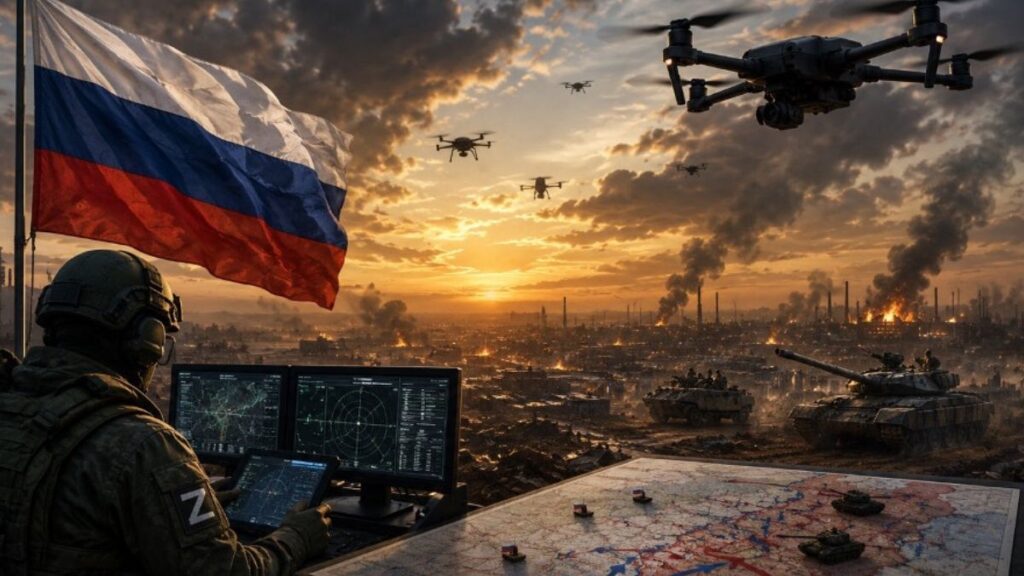
The Ukrainian field has become the laboratory of contemporary war. It is no longer just a conflict of artillery, infantry, tanks and defensive lines. It’s a war of sensors, drones, electronic jamming, lurking munitions, satellites, algorithms, disrupted communications, small tactical groups and the constant hunt for enemy operators.
The front is immense, more than a thousand kilometers long, and no longer allows for the simplifications of the wars of the 20th century. Large concentrations of resources are vulnerable. Units must move in small groups. Inhabited centers become defensive nodes. Artillery retains a considerable role, but it must now coexist with almost permanent surveillance. Every movement can be spotted, followed and struck. Drones have transformed the tactical depth of the battlefield: there is no longer really a rear sure.
This is why Russian operations often appear slow, fragmented, progressive. This is not just about political prudence. It is also a military adaptation. Moving forward in an environment saturated with drones means paying a very high price. Russia has greater industrial depth and reserves than Ukraine, but it cannot afford unlimited losses. Moscow must also take into account demographics, the quality of personnel, the need to preserve forces for a later phase of the confrontation.
The long war is therefore not made up of great spectacular breakthroughs. It is made of attrition, rotation, adaptation, progressive destruction of opposing capabilities. Whoever learns the fastest survives. Anyone who remains a prisoner of old patterns loses men, equipment and credibility.
Also read: ANALYSIS – Lebanon: Can the country still survive permanent war?
The return of military Germany
But the most important data concerns Europe. And, in Europe, especially Germany. For decades, Berlin was an economic power with a restrained military profile. It had industry, technology, finance, exports, productive discipline, but not a great stated strategic ambition. Today, this balance is broken.
Germany wants to once again become the center of European security. Not only by increasing military spending, but by a new conception of its role. Increase in numbers, strengthening of the reserve, technological superiority, national infrastructure put at the service of defense, territory transformed into a logistics and operational platform. It’s a paradigm shift. Berlin no longer wants to be just the workshop and bank of Europe. It also wants to be the command, the strategic rear and the military engine of the continent.
Here reappears the old German question, which Europe believed to neutralize within the European Union and the Atlantic Alliance. A Germany that is rearmed, industrially powerful, technologically ambitious and politically convinced of having to lead European defense is changing the continental balance. This does not automatically mean a return to the past. History never repeats itself mechanically. But deep structures matter. An industrial power that militarizes always produces geopolitical effects.
The paradox is that this return of military Germany is taking place in the name of European defense, but within an architecture still dominated by the United States. Berlin claims to want to assume more responsibilities, but remains linked to the Atlantic system, to American technology, to American nuclear deterrence, to the Western chain of command. It is a monitored autonomy, an expanding power inside an Atlantic cage.
Poland, Germany and the race for terrestrial primacy
Next to Germany, there is Poland. Warsaw invests considerable sums in defense, purchases American and South Korean weapons systems, strengthens its army and intends to become the main eastern stronghold of the Atlantic Alliance. Poland no longer wants to be a periphery. It wants to be an armed border, a strategic platform and Washington’s privileged interlocutor.
Thus is born an internal competition in Central and Eastern Europe. Germany and Poland share distrust of Russia, but they do not necessarily share the same idea of the European order. Berlin thinks in terms of continental leadership. Warsaw thinks in terms of eastern centrality based on the direct relationship with the United States. France observes and tries to preserve its rank, in particular through nuclear leverage. Great Britain, although having left the European Union, seeks to re-enter through the window into the processes of continental security, as a power of external direction.
The result is a Europe that speaks of unity, but acts according to blocs, national interests, industrial rivalries and American dependencies. More than a European defense, it is a disordered militarization of Europe which is being born.
Nuclear risk and the end of caution
The most serious node is that of nuclear power. The possibility of deploying or reinforcing long-range missiles on European territory, German participation in the Atlantic deterrent, the role of French and British nuclear weapons in the containment of Russia: all this indicates a trivialization of the atomic discourse. And this trivialization is extremely dangerous.
Nuclear deterrence is not a political backdrop. It is not used to produce martial declarations. It is a balance of terror based on the certainty that every error can become irreversible. To speak lightly of the nuclear challenge in the face of a power like Russia means not understanding the weight of matter. Moscow will not stand still in the face of the strengthening of Western capabilities near its borders. It will respond, as it has already done and as it will continue to do, by moving systems, updating its doctrines, further integrating Belarus into its strategic posture and increasing pressure on the eastern flank of the Atlantic Alliance.
Europe thus risks becoming the main theater of a new permanent missile crisis. Not a repetition of the Cold War, because the world has changed, but something more unstable: fewer rules, fewer diplomatic channels, less trust, more actors, more technology, more automation.
Also read: DECIPHERED – Atlantic alliance, military commands and political power: The silent turning point
The geoeconomics of separation
The long war also has an immense economic cost. Europe has separated from Russia on the energy, commercial and financial levels. This has produced increased dependence on other suppliers, on the United States, on liquefied gas, on more expensive industrial chains and on increasing military spending. European industry, already under pressure due to energy prices, regulations, Asian competition and technological transition, now finds itself in a security economy which absorbs considerable resources.
Russia has moved towards other markets. China, India, Iran, Türkiye, the Gulf, Africa and the BRICS system have become increasingly important spaces. Moscow is paying a price: increased dependence on Beijing, reduced access to Western technologies, need to reorient its logistics and finance. But it is not isolated as the West hoped. A considerable part of the world has not joined the economic war against Russia, not because it loves Moscow, but because it no longer wants to accept that the West alone defines the rules of the international order.
This is where the European error lies: believing that economic pressure is enough to bend a great power endowed with natural resources, territorial depth, a military industry and diplomatic alternatives. Sanctions can weaken, complicate, slow down. But they do not replace a political strategy.
Why Russia won’t invade Europe
Western rhetoric often emphasizes the idea that, if not stopped in Ukraine, Russia could advance towards Europe. It is a useful theory for political mobilization, but weak on a military level. Conquering hostile territories requires enormous forces. Taking care of them requires even more. Russia has neither the interest nor the realistic capacity to govern vast hostile European spaces, populated, industrialized and integrated into the Atlantic Alliance.
The future confrontation will be different. It will be hybrid, indirect, technological, economic. It will target infrastructure, energy networks, submarine cables, satellites, ports, depots, railways, computer systems, public opinion. We won’t necessarily see Russian tanks heading towards Berlin. We are more likely to see a war of permanent disruption, in which each side seeks to make the strategic life of the other more costly, more unstable and more vulnerable.
This is the real long war. Not the invasion of Europe, but its transformation into a space of continuous pressure.
The failure of politics
The final point is political. If Europe accepts the idea that the confrontation with Russia must last twenty years, then it must make this clear to its citizens. It must explain that more military spending will be required, less social margins, more industrial discipline, more control of infrastructure, more strategic dependence, more nuclear risks. It must explain that security will have an economic, social and democratic price.
But are European public opinion really ready? Will they accept permanent mobilization? Will they accept the return of military service, the reduction of the social state, the war economy hidden under the vocabulary of industrial policy, rearmament as a destiny? The ruling classes seem to have already chosen. Companies, maybe not.
Russia is preparing for a long war because it believes that the West no longer wants a true shared security architecture. The West is preparing for rearmament because it considers that Russia represents a permanent threat. Each feeds the fear of the other. It’s the oldest spiral in history: one person’s security becomes another’s insecurity.
Breaking this spiral would require adult, not naive, diplomacy; a credible, non-hysterical deterrent; a policy capable of talking about peace without giving the impression of capitulating, and of talking about security without transforming into a cult of war. Today, this policy is not visible. We see national ambitions, moral slogans, gigantic military plans, apocalyptic rhetoric and a Europe which risks discovering too late that preparing for twenty years of war can become the surest way to make them inevitable.
Also read: ANALYSIS – The Atlantic Partnership: towards a new geopolitical and economic dynamic
#Russia, #Ukraine, #WarInUkraine, #LongWar, #ProlongedWar, #Moscow, #Kremlin, #Putin, #West, #NATO, #Europe, #Geopolitics, #Strategy, #MilitaryStrategy, #Defense, #EuropeanSecurity, #Rearmament, #WarEconomy, #MilitaryIndustry, #HybridWarfare, #ModernWarfare, #MilitaryDrones, #ElectronicWarfare, #NuclearDeterrence, #NuclearRisk, #EconomicSanctions, #EconomicWarfare, #TechnologicalWarfare, #CriticalInfrastructures, #Germany, #Poland, #Bundeswehr, #BRICS, #InternationalRelations, #GeopoliticalAnalysis, #InternationalPolicy, #NewColdWar, #RussiaWest, #RussiaNATOConflict, #Decryption