The EU should temporarily strip new member states of their right to vote on decisions on the budget, security and foreign policy, according to a proposal from five capitals.
France, Germany, the Netherlands, Belgium and Luxembourg made this suggestion in a document consulted by Rapporteur, the flagship newsletter ofEuractiv. This proposal comes in a context marked by a wave of new political proposals aimed at relaunching the EU’s enlargement ambitions, which have remained dormant since Croatia’s accession in 2013.
This initiative also aims to defuse the political tensions often linked to the accession of new countries to the EU, because each of the 27 member states will have to agree to the accession of a new member, and referendums could prove necessary in Ireland and in France. Diplomats in Brussels have already started drafting a new treaty aimed at integrating Montenegro into the EU.
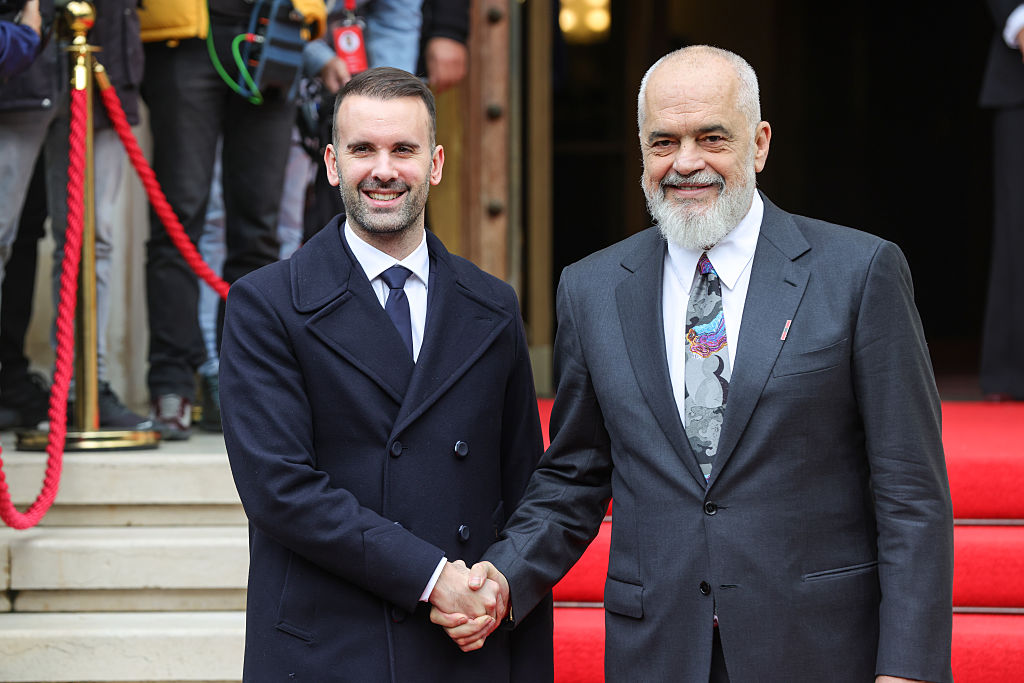
Presented as a “temporary” and “transitional” measure, the voting ban could affect favorites Montenegro and Albania, as well as other potential candidates, notably Ukraine and Moldova. It should not pose a political problem for Albania, whose Prime Minister, Edi Rama, has already shown himself willing to waive the right of veto if and when Tirana joins.
“Enlargement is a strategic tool, but only if it strengthens the EU, not if it weakens it,” Dutch Foreign Minister Tom Berendsen told Rapporteur. “This is why we believe that the time has come to engage in serious discussions on what an enlarged Union should look like. We cannot let enlargement itself compromise the EU’s capacity to act. HAS”
The document also proposes a revamped and more durable “escape clause”, allowing the EU to take protective measures if new members backtrack on democracy, the rule of law or press freedom. Alluding in a veiled manner to Hungary’s refusal, which lasted several months, to support a 90 billion euro loan plan for Ukraine at the start of this year, he suggested introducing guarantees against “any behavior contrary to the principle of sincere cooperation”.
Steven Blockmans, an enlargement expert at the Center for European Policy Studies, said the most striking new idea is to make a non-regression clause legally binding. According to the document, any retreat from “EU values” or democratic standards could result in legal action from Brussels.
“Given the grievances regarding the serious setback observed on these principles in the cases of Hungary and Slovakia, as well as the dysfunction of the post-accession “cooperation and verification mechanism” for Bulgaria and Romania, it is not surprising that the Benelux seizes the opportunity of negotiations on the Montenegro’s accession treaty to propose changes in the modalities of application of the “fundamental” criteria for accession to the EU,” Blockmans said in a statement. Euractiv.
New ideas are redefining the enlargement debate, from German proposals for a to the Franco-German model to the Franco-German model ofenlargement to the Western Balkans.
Thomas Moller Nielsen contributed to this article.
(bw, cs)


/2026/06/10/6a29081855761510979663.jpg "REPORTAGE. Deux tonnes de matériels, 78 maillots par match, des menus préparés sur place… Dans les coulisses de larrivée des Bleus à Boston pour la Coupe du monde 2026")