Ladies and Gentlemen,
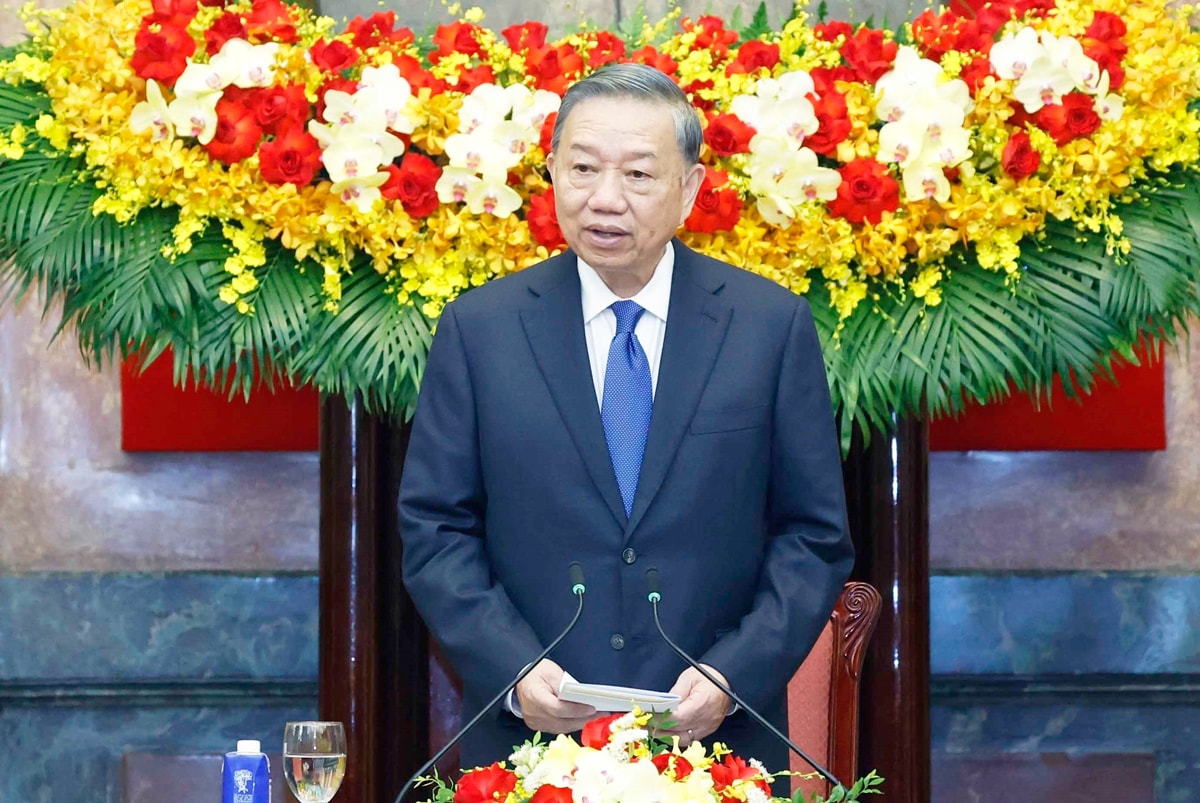
On behalf of Vietnamese Party and State leaders, I warmly welcome you to Hanoi to participate in the Third ASEAN Future Forum. I welcome the presence this year of the Prime Ministers of Laos, Cambodia, Thailand and East Timor, leaders and representatives of ASEAN member states and dialogue partners, numerous international and regional organizations, academics and research institutes, testifying thus a common interest in the future of the region and a desire to discuss the issues facing ASEAN in this new phase of its development.
I fully share and subscribe to many of your relevant analyses. ASEAN enters its first year of implementing the ASEAN Community Vision 2045, with many new expectations and, therefore, higher, more proactive, more effective and more concrete demands. It is precisely this spirit that I expressed during the recent Dialogue of Shangri-La.
For ASEAN, this spirit is based on solidarity, dialogue, trust and cooperation. It is also on these foundations that we launched the ASEAN Future Forum, with the desire to offer a new channel of open and constructive exchange in order to support ASEAN cooperation processes and to share ideas, connect them and explore new concrete avenues of cooperation for the future of the ASEAN. region.
On this occasion, I would like to share with you the following points:
1. The world is changing, the region must think differently.
The world is entering a period of profound transformation. The three major crises we are witnessing – the international order, the development model and strategic confidence – do not occur far away, but are manifest very clearly right here, in this region.
Strategic competition between great powers is intensifying and expanding into fundamental areas of the future such as technology, data, supply chains and new governance standards. Artificial intelligence, big data and quantum computing offer immense development prospects, but also raise many new risks. At the same time, challenges related to climate, energy, water resources, population aging, disinformation, information manipulation and human security have a growing direct impact on the social stability and development potential of each nation.
Traditional development assets no longer provide the same impetus as before. Many familiar approaches no longer meet new requirements. While population size, resources and capital remain important, competitive advantage increasingly relies on the ability to innovate, adapt and anticipate new development trends.
This is an urgent need for ASEAN. Southeast Asia is a crossroads of major developments. The region has the opportunity to attract more resources, integrate supply chain transformations, develop the digital economy, initiate an ecological transition and adopt new technologies. However, opportunities do not automatically turn into advantages. They only become advantages when the region has the capacity to seize them, the determination to innovate and the resilience necessary to maintain a stable environment conducive to development.
Ladies and Gentlemen,
2. ASEAN must preserve its strategic assets while innovating its operational methods.
With the ASEAN Community Vision 2045, ASEAN has clearly defined its direction for the decades to come; However, this is only a starting point. In my opinion, success depends on ASEAN’s ability to carry out two actions simultaneously. On the one hand, it must continue to preserve and develop strategic assets accumulated over decades: solidarity, the central role of ASEAN and the principle of consensus and unity in diversity. On the other hand, it must profoundly innovate in his values-based thinking so that these assets translate into a capacity for adaptation, a capacity for action and an organizational capacity for implementation.
ASEAN’s strategic assets are the result of a long process of building trust, constant dialogue, consultation, resolution of differences and consensus building among member states. In this new phase, ASEAN’s central role can only be fully realized if it preserves its unity, its strategic autonomy, an inclusive approach and its capacity to coordinate and shape the region’s common agenda.
ASEAN’s potential is immense, but its transformation into a concrete force still requires efforts. Intra-block integration must ªtre approfondieHAS ; infrastructure, logistics, digital and energy connectivity must be better synchronizedHAS ; development and technological gaps must be reduced; and the implementation of commitments and agreements, as well as coordination in the face of common challenges, doivent ªtre améliorées .
The world is changing rapidly; The challenges facing ASEAN are also very different from before. It is essential to renew in depth our values-based approach, thanks to more flexible and efficient working methods, in order to better respond to new requirements. First, we need to move from a process-oriented approach to a results-oriented approach, in order to concretize the commitments made in the documents. We need to move from a primarily consultative approach to more substantive coordination, so that cooperation mechanisms can respond more quickly to intersectoral and interdependent issues. Finally, we must move from a consensus on understanding to a consensus on action so that the common voice is expressed through concrete programs, specific resources and tangible results.
You may like

In other words, I believe that the measure of success in the coming period should not be limited to the number of additional ASEAN documents, mechanisms or action plans, but more importantly how effectively ASEAN commitments are implemented, what changes they bring to the region and the benefits they provide to populations, businesses and individual member economies.
In a context of increased competition, delay can lead to missed opportunities. ASEAN must therefore actively promote a proactive approach: strategic proactivity to identify upstream trends and define priorities; proactive adaptation to take advantage of new trends and address emerging challenges; and proactive creation to contribute positively to the development of regional cooperation standards and frameworks.
Ladies and Gentlemen,
3. The ASEAN Future Forum contributes to supporting ASEAN cooperation processes.
In view of the discussions that took place during this Forum, I am convinced that the ASEAN Future Forum can continue to play its role as an open, frank and constructive space for the exchange of points of view on long-term regional issues. As a complementary channel of exchange, the value of the Forum lies in its ability to provide additional perspectives, guidance documents and ideas for ASEAN cooperation processes. With this in mind, the ASEAN Future Forum could pay increased attention to the following areas:
First, Exchanges within the Forum can help identify emerging issues and long-term trends that directly impact the future of the region. Many of these issues are not isolated, but closely linked: technological transformation is linked to employment and governance; the ecological transition is linked to energy, food and livelihoods; information space is linked to social trust and governance capabilities. By looking ahead, ASEAN will be better prepared.
Second, The Forum can help strengthen links between policy makers, academics, research institutes and businesses. Current regional issues are increasingly complex, interdisciplinary and go beyond traditional approaches. Therefore, ASEAN processes also require more perspectives, experiences and initiatives from different channels to enrich the policy planning and implementation process.
Third, the Forum could focus more on generating concrete and implementable ideas. Exchanges at the ASEAN Future Forum, if carefully organized, could enrich perspectives, suggest avenues for cooperation or formulate recommendations for appropriate ASEAN processes. This includes promoting practical solutions such as conflict prevention, the development of artificial intelligence, energy, youth cooperation and the Mekong sub-region.
With this in mind, we hope to continue to benefit from the attention, support and active participation of Member States, partners, academics, research institutes and businesses. Your participation, exchanges and collaboration will help make the ASEAN Future Forum an ever more useful and concrete channel of exchange, thus contributing to ASEAN processes and fostering a spirit of dialogue, cooperation and common action for the shared future of the region.
Ladies and Gentlemen,
4. Vietnam’s contribution
Since its accession in 1995, Vietnam has always considered ASEAN as a central pillar of its multilateral and diversified foreign policy. Its active and responsible participation in the ASEAN Community has contributed significantly to its ability to preserve peace and independence, promote deep economic integration for its national development and strengthen its international influence. Vietnam aspires to work with other ASEAN countries to build a united, resilient and sustainable development community, which retains its central role in the balance of regional security, and actively works towards it.
For its part, major global changes require Vietnam to radically transform its vision of development, its growth model and its governance. The challenges facing ASEAN are also those of Vietnam: how to preserve peace and stability, guarantee a macroeconomic balance essential to rapid and sustainable development, while making major progress to strengthen its competitiveness? At the same time, strategic solutions are needed to narrow development gaps, adapt proactively and build resilience to internal and external shocks.
The dominant feeling today is to act with more determination, to accelerate implementation and to rely on concrete results to measure success . It’s important to be on the right track, but in today’s environment, moving too slowly can result in missed opportunities. This is why Vietnam is committed to removing obstacles, mobilizing resources, promoting strategic and digital infrastructure, developing highly qualified human resources and creating a more favorable environment for citizens, businesses and local communities.
For Vietnam, development is not only an economic objective, but also a foundation for consolidating social stability and improving the living conditions of the population. This is also a point in common with the requirements imposed on ASEAN in this new phase.
Along with socio-economic development, Vietnam is also implementing foreign relations activities in a more substantial and effective manner, in close coherence with the country’s strategic objectives, while contributing more responsibly to peace, cooperation and sustainable development in the region.
We pursue an independent, strong and resolute foreign policy, focused on peace, friendship, cooperation and development, by multilateralizing and diversifying our external relations, and assuming our role as a responsible member of the international community. Vietnam attaches great importance to its relations with its neighbors, ASEAN, key partners and traditional friends; it promotes deeper, more stable, more reliable and more sustainable cooperation frameworks; and it actively and responsibly participates in the resolution of common regional and international problems.
ASEAN has always been a strategic priority of Vietnamese foreign policy. We are determined to do everything possible, together with other members of the ASEAN family, to preserve unity, effectively promote the central role of ASEAN and uphold the rule of law, dialogue and cooperation.
You may like
In this spirit, Vietnam wishes to contribute more effectively to practical cooperation within ASEAN, as well as between ASEAN and its partners, in the coming period, notably by promoting strategic connectivity, ecological transition, digital transformation, human resources development and capacity building. response to common challenges. These areas are all directly linked to the development of each country, the lives of its people and the overall resilience of the region.
We are convinced that contributing to ASEAN firstly involves better assuming our role, while being more proactive and responsible in common efforts. It is in this spirit that Vietnam hopes that its reform and development process will make it possible to become a more dynamic, proactive and efficient country, capable of making concrete contributions and collaborating with ASEAN countries to build a more united, resilient and people-centered Community.
After nearly six decades, ASEAN has built a solid foundation for cooperation and a vast network of ties. Our mission is to transform these founding values into stronger and more effective capacities for action.
I believe that with a spirit of solidarity, innovation and action, ASEAN will continue to be a dynamic, resilient and reliable development space in the region and the world, bringing concrete benefits to the people of each country.
Thank you very much, ladies and gentlemen.
———-
The title comes from the Hanoi Moi publication.
Source : https://hanoimoi.vn/phat-bieu-cua-tong-bi-thu-chu-tich-nuoc-to-lam-tai-buoi-tiep-cac-truong-doan-tham-du-dien-dan-tuong-lai-asean-nam-2026-asean-luon-la-uu-tien-chien-luoc-trong-chinh-sach-doi-ngoai-cua-viet-nam-1159750.html