
An Ibadi thalassocracy
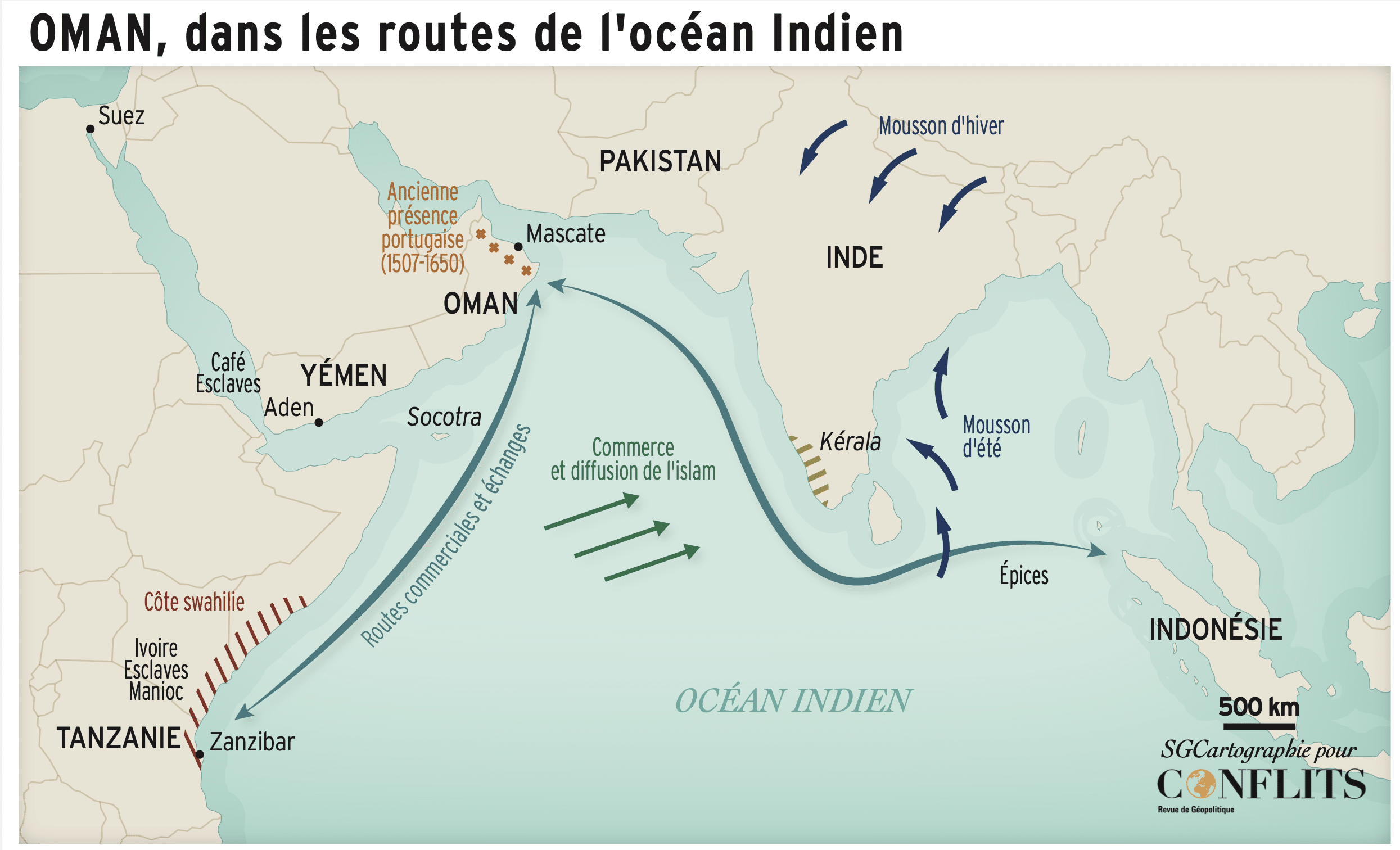
Long before the arrival of European powers, Oman was a structured maritime power, facing the Indian Ocean. The ports of Sohar, Muscat and Sur connect the Arabian Peninsula to East Africa, India and the Persian world. This maritime opening distinguishes Oman from the tribal heart of central Arabia. The Omani specificity is based on an original political duality. There is first the Ibadi imamate, elective, anchored in the mountainous interior, and the sultanate, monarchical and maritime, centered on the coastal cities. Ibadism, an ancient branch of Islam resulting from the first post-caliphate dissensions, is distinguished from radical Kharijism by a doctrine of compromise, a strong community ethic and a rejection of takfir. This religious tradition promotes a culture of moderation, negotiation and consensus. This tension between the interior imamate and the maritime sultanate is not an anomaly: it structures. sustainably the Omani political trajectory, between local roots and transoceanic opening.
The Portuguese shock (1507-1650): dispossession and maritime awakening
The arrival of the Portuguese at the beginning of the 16th century constituted a major geopolitical rupture. Muscat was conquered in 1507 and integrated into the Lusitanian imperial system of the Indian Ocean. Oman is losing control of its strategic trade routes. But this domination remains limited. Firstly because it is essentially coastal, the Portuguese do not penetrate into the interior of the lands in a tribal environment; then because it arouses a reaction of resistance on the part of the Ibadi imamate. In the 17th century, the Yaêruba imams led the reconquest. The Portuguese were expelled in 1650. Oman was then reborn as a regional naval power, turning the experience of the European shock to its advantage. Paradoxically, the Portuguese parenthesis reactivates the Omani thalassocratic vocation instead of destroying it.
The Omani Empire and Zanzibar: peak, fragility, then British supervision
In the 18th and 19th centuries, under the Al Bou Said dynasty, Oman built a veritable maritime empire extending from the Arabian peninsula to the Swahili coast. Zanzibar became a major political and economic center from where cloves, slaves and customs revenues were imported. This expansion is based on an efficient navy, transoceanic trade networks, as well as a profound human mix (Arabs, Africans, Baluchis, Indians). But this thalassocracy is structurally fragile: dependent on trade, vulnerable to European rivalries and politically divided.
Consequence of a succession crisis, the separation of Zanzibar in 1856 marked a decisive turning point: Oman lost its imperial dimension and retreated to the peninsula
From the 19th century, Oman entered the British orbit. London supports the sultan against the imamate and guarantees the stability of maritime routes, but at the cost of a freeze on development and a trusteeship which does not speak its name. In the middle of the 20th century, Oman was one of the poorest states in the region. Infrastructure is almost non-existent, the territory suffers from international isolation and internal conflicts (Jebel Akhdar, Dhofar). This situation prepares the break of 1970.
1970: the silent revolution of Qaboos ibn Said
The “sultanate of Muscat and Oman” as it was designated until 1970, then fell significantly behind its regional environment. From this traditional cocoon a modernizing state will emerge.
The young Sultan Qaboos ibn Said, trained in Great Britain, came to power on July 23, 1970, overthrowing his father, Sultan Saî¿Ä«d bin Taymur, with the support of the British. From then on, he announced the end of the isolation of his country and the beginning of a new era which initially resulted in accelerated normalization with its shady Saudi and Iranian neighbors and the quest for external support to stabilize his country. The latter is undermined by a civil war opposing the sultan’s forces to the Imamite rebellion supported by the Saudis. He subsequently sealed a strategic pact with the Shah of Iran who effectively supported him in crushing the Marxist rebellion in Dhofar supported by South Yemen, while Iran had seized three strategic islets in the Strait of Hormuz. In 1971, Oman joined the UN and the Arab League. The 1970s marked a radical transformation. Oman, from a landlocked state, is transforming into a unified, administered and open country. Qaboos leads the pacification of the territory, the progressive integration of the imamate, the construction of a modern state and above all an independent diplomacy.
Principles and implementation of Qaboos’ foreign policy
Relying on principles of non-interference in the internal affairs of other states, respect for international law and adherence to non-alignment, Sultan Qaboos constantly promoted compromise and the peaceful resolution of disputes. This orientation was evident from the beginning of his reign: Qaboos strives to maintain the best possible relations with everyone, without ever breaking diplomatic relations. Aware of the realities specific to Oman – its history, its geography, the diversity of its population, its economy and its strategic position in the Middle East – it seeks to respond to the needs of the Sultanate on the international scene by consistently pursuing beneficial external relations in the long term.
Having plunged his country into autarchy, his father essentially oriented Oman’s foreign relations towards Great Britain and India, keeping his distance from the Arab world. “The idea of Oman” carried by Qaboos, that of a regional state in its own right, led him to reverse this orientation, by establishing direct diplomatic relations with Arab and non-Arab states. Qaboos thus puts an end to a long diplomatic isolation, reinserting Oman into the Arab and international space according to a pragmatic approach aimed at securing the country in its regional environment.
Première phase : la consolidation (1970-1975)
This phase is marked by the construction of relations with the Arab and international world in order to reduce Oman’s dependence on Great Britain, to legitimize its independence, to restore national unity by facing political unrest in the north, and above all to put an end to the Dhofar War, supported by communist forces, which threatened the Sultanate since 1965 in the south of the country.
One of the major diplomatic achievements of this period concerns relations with imperial Iran, which then asserted its hegemonic claims in the Gulf, in particular by the capture of two islands belonging to the United Arab Emirates. Oman then had limited resources to resolve its own internal difficulties. Recognizing the regional preeminence of the Shah, Qaboos requested and obtained Iranian military aid to combat the Dhofar rebellion, as well as an Omani-Iranian border agreement in the Strait of Hormuz. By offering the Shah the explicit support of a Gulf Arab leader, Qaboos obtained both decisive aid, a strategic agreement and the symbolic recognition of an equal partnership.
Second phase: the transition (1976-1980)
The end of the Dhofar war and civil unrest allows attention to be redirected towards domestic priorities, while continuing rapprochement with Oman’s neighbors. These relations, however, did not prevent Oman from adopting independent positions, notably its public support for the peace initiatives of Egyptian President Anwar el-Sadat with Israel in 1977, then its role in the Camp David agreements in 1978.
Oman was then one of only three Arab states not to break diplomatic relations with Cairo after the recognition of Israel, and refused to participate in the 1978 Baghdad summit condemning Egypt, which earned it temporary exclusion from the other Gulf states.
In 1979, when the Shah was overthrown by the Islamic revolution, Qaboos maintained Omani-Iranian relations
He turned to the United States and signed the agreement on access to military facilities in 1980, the first agreement of this type concluded between an Arab state and Washington. This decision illustrates, once again, Qaboos’ willingness to act according to what he considers essential to Oman’s long-term security interests.
Troisième phase : la maturité (1981-1985)
This period is dominated by the war between Iran and Iraq, as well as other regional tensions. These crises accelerated the success of Qaboos’ efforts to create the Gulf Cooperation Council (GCC) in 1981, the first collective security structure on the Arabian Peninsula bringing together the six conservative monarchies of the Gulf. While participating in the GCC’s regional security mechanisms, Oman refuses to take sides in the Iran-Iraq war, preserving both its regional relations and its security ties with the West. Qabous also calls for direct Israeli-Palestinian negotiations, an unpopular position in the Arab world, but consistent with his vision of long-term security.
Fourth phase: progress (1986-1994)
During this last phase, Qabous is recognized as a trusted regional actor on security issues. After Iraq’s invasion of Kuwait in 1990, Oman participated in the UN-mandated liberation effort and granted the United States access to infrastructure and prepositioned stocks, as part of the renewal of the 1980 agreement. At the same time, the Sultanate maintains its diplomatic relations with Iraq as well as with Kuwait, in the hope of promoting a negotiated outcome to the crisis. When these efforts failed, Qaboos exceptionally broke with the principle of non-alignment, believing that respect for international law required taking a position against an Arab government.
During this period, he also tried, without success, to promote mediation between Iran and Iraq after their conflict. In 1994, he invited Israeli official representatives to a conference on water desalination for the first time, then welcomed Israeli Prime Minister Yitzhak Rabin to Oman, a public first for an Israeli leader in an Arab Gulf state. Here again, Qabous acts alone, going against the regional consensus.
Bilan et héritage
At the end of his first twenty-five years of reign, Qabous largely realized his “idea of Oman”. Long-term security objectives have been achieved, notably with the creation of the GCC in 1981 and the signing, in 1993, of the last border agreement with the Sultanate’s neighbors. At the same time, he negotiated with many countries the forms of aid necessary for the internal development of Oman and the improvement of living conditions. Although the regime remains authoritarian, Qabous has opened spaces for citizen participation, notably with the creation of the Majlis al-Shura (advisory council) in 1991, while advocating a more inclusive discourse among women. To consolidate an attractive narrative, it relies on Ibadism, an interpretation of Islam specific to the Sultanate.
In his 1994 National Day speech, he urged Omanis to reject religious fanaticism and ephemeral causes, recalling that “obstinacy in religious interpretation leads to Muslim backwardness, violence and intolerance.”
From this Ibadi heritage flows the fundamental principle of its foreign policy: to constantly seek security and prosperity through non-violent means. But the originality of the Sultanate of Oman cannot be reduced to Ibadism, diplomacy or geography. It is the product of a long historical trajectory, of a mixed society, of a religion of moderation. And a fundamental strategic choice: to survive through balance rather than domination. In a Middle East dominated by the brutality of the balance of power, Oman embodies a modest power whose influence is based on credibility, constancy and discretion.
/2026/06/14/6a2ef59cbf8cd592764043.jpg "The G7 is a \"world postcard\" for Évian-les-Bains believes the mayor of the city")

/2026/06/11/6a2b0ca847f61161377354.jpg "Economic imbalances, war in Ukraine, Middle East: the thorny issues on the table of the G7, which begins Monday in Evian")
/2026/06/15/6a2f90ee8616d738436083.jpg "Programme de la Coupe du monde 2026 : Espagne-Cap-Vert, Belgique-Egypte, Iran-Nouvelle-Zélande… A quelle heure et sur quelles chaînes suivre les matchs du jour et de la nuit de lundi à mardi ?")

/2026/06/15/6a2f94480b40b859033999.jpg "Après l'accord de paix entre l'Iran et les États-Unis, le pétrole retrouve son niveau d'avant-guerre")
