– Advertisement –
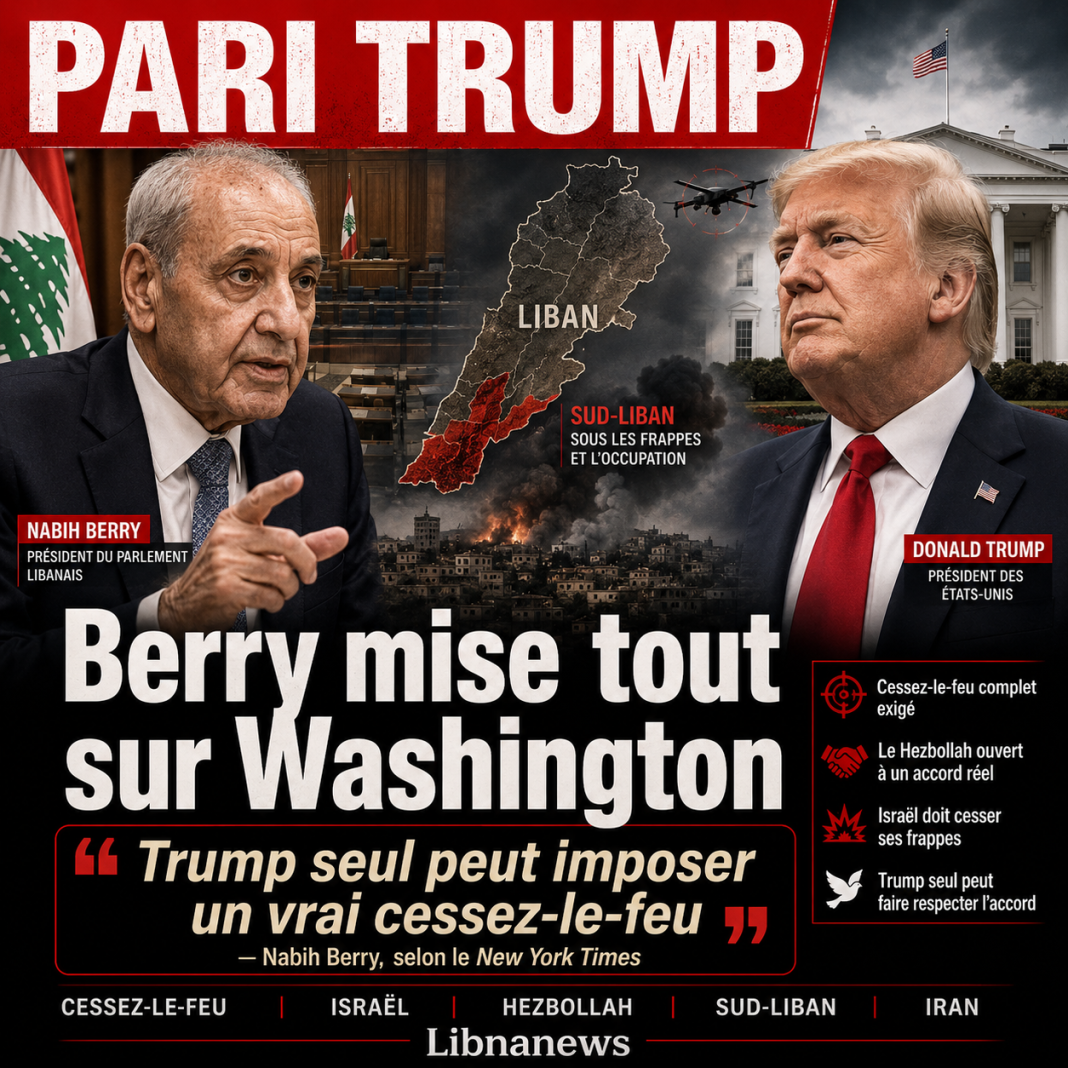
In an interview with the New York Times, Nabih Berry places Donald Trump at the center of the Lebanese equation. The President of Parliament affirms that “American President Donald Trump is the only one capable of concluding a real ceasefire and forcing Israel to respect it”. The formula is strong. It recognizes the decisive weight of Washington over Jerusalem, but it also exposes Lebanese impotence in the face of a war taking place on its territory, under Israeli fire, with Hezbollah as a central armed actor and Iran as a regional background.
The declaration comes the day after a sequence of great tension. Israel threatened the southern suburbs of Beirut. Donald Trump claimed to have achieved a de-escalation between Israel and Hezbollah. Benjamin Netanyahu then maintained that the Israeli army would continue its operations in southern Lebanon. Shootings were still reported. In this context, Berry seeks to shift the debate. He is not talking about a simple break around Beirut. He calls for an effective cessation of hostilities, applicable on the ground, in the air and in all affected areas.
Nabih Berry refuses a partial truce
Berry’s sentence sums up a brutal political reality. Lebanon can negotiate, transmit, propose and guarantee certain commitments. He cannot, alone, force Israel to stop its strikes. Nor can it impose lasting discipline on Hezbollah without a global architecture that reduces the military pretext of armed resistance. The President of Parliament therefore presents himself as an intermediary capable of speaking to Hezbollah, but he returns the key to execution to Washington. For him, Trump should not only announce a truce. He must enforce it.
Berry’s position does not arise in a vacuum. For several weeks, American mediators have been looking for a gradual formula. Hezbollah would cease its attacks against Israel. In exchange, Israel would refrain from hitting Beirut and its suburbs. The proposal aims to avoid an extension of the war to the Lebanese capital. But it leaves South Lebanon in a dangerous zone. This is precisely what Berry disputes. A ceasefire limited to Beirut would create a hierarchy of territories. The capital would be protected, while villages in the South would remain exposed to drones, shells and incursions.
The President of Parliament therefore defends another sequence. He affirms that Hezbollah is “open to a real ceasefire.” This openness, according to him, does not constitute acceptance of a partial break. It assumes a complete cessation of shootings and strikes. It also assumes that Israel stops bombing while it claims to be negotiating. In his reading, the problem is not only the lack of agreement. This is the gap between the diplomatic table and the military field. Tel Aviv, he says in substance, wants to negotiate while continuing the bombings. Lebanon is paying the human, economic and territorial price.
Israel negotiates under military pressure
This criticism is directly aimed at the Israeli method. Since the start of the escalation, Israel has claimed that it is responding to ceasefire violations and Hezbollah attacks. But its operations have taken on an increasing scale in South Lebanon. Strikes hit roads, houses, areas near Nabatiyé, Tyre, Marjayoun and Litani. The Israeli army also advanced on symbolic positions, including the Beaufort region. For the Lebanese authorities, this dynamic makes any dialogue politically fragile. Negotiating under bombs amounts to speaking under duress.
Berry’s formula on Trump must be read through this observation. He does not say that Lebanon chooses to hand over its destiny to a foreign leader out of political preference. He says that the real balance of power passes through Washington. Israel can ignore Beirut. He can defy European calls. He can dispute the UN’s warnings. But it is much more difficult for him to break head-on with the White House when it decides to exert clear pressure. Berry therefore asks Trump to use the leverage he has: aid, diplomatic cover, military coordination and American political weight.
This request involves an element of betting. Donald Trump likes to present himself as a man capable of quickly obtaining agreements. He has already claimed de-escalation by saying that Israel and Hezbollah had agreed to stop their mutual attacks. But recent experience shows that announcement is not enough. After his statements, hostilities continued in the South. Netanyahu confirmed the continuation of military operations. Hezbollah has not publicly expressed full adherence to the American version. Trump’s diplomacy can stop a move, like a strike on Beirut. It has not yet proven that it can impose a lasting ceasefire.
Trump ordered to move from announcement to execution
Berry seeks to transform this diplomacy of announcement into diplomacy of execution. His sentence about Trump being the only one capable of obtaining a real ceasefire is also a test addressed to Washington. If Trump claims to have control over de-escalation, he must demonstrate that this control applies to Israel, not just Lebanon or Hezbollah. An agreement that would force Hezbollah to stop its fire without preventing Israel from bombing the South would be immediately contested. It would nourish the idea that the truce is an instrument of unilateral pressure. It would also reinforce Hezbollah’s discourse on the need to keep its weapons.
This is one of the political cruxes of the matter. Hezbollah may be open to a complete ceasefire if it does not resemble a disguised capitulation. It may accept a cessation of fire if Israel also ceases its operations. But it will refuse to be the only actor ordered to calm down while the Israeli strikes continue Berry, as a political ally of Hezbollah and president of a national institution, tries to dress this position in a state language. national ceasefire.
This position gives him a central role, but also vulnerability. The United States and Israel know that Berry maintains a channel with Hezbollah. They use it because it can transmit messages that the Lebanese state cannot always convey directly. But they doubt its ability to completely guarantee the application of a stopping of shooting. This reserve is not negligible. If Hezbollah accepts a ceasefire through Berry, then a shot comes from Lebanon, Washington will be able to say that the Lebanese guarantee did not hold. Berry therefore plays part of his credit in this mediation.
The Iranian link, useful and risky
The other difficulty comes from Iran. Berry says the urgency is to obtain a ceasefire, whether separate from the Iranian issue or linked to it. This sentence deserves attention. It leaves a double track open. Lebanon can enter into an autonomous de-escalation, if Washington manages to impose an end to Israeli strikes. But it can also remain integrated into a broader regional negotiation, in which Tehran links Lebanon, Gaza, the Red Sea and the Gulf. Berry doesn’t close any options. Above all, he seeks to prevent Lebanon from becoming hostage to an external agenda.
This caution reflects the Lebanese balance. Some political actors want to dissociate Lebanon from the conflict between Washington, Tehran and Jerusalem. They fear that the country will be used as a bargaining chip. Hezbollah and its allies consider that the Lebanese front cannot be separated from regional pressure on Israel. Berry attempts to formulate a synthesis. He says the link with Iran should not block the immediate objective. The ceasefire is necessary, with or without a regional package. The priority is not the diplomatic form, but stopping the destruction.
This analysis reflects a reality on the ground. South Lebanon cannot wait for all the powers to settle their scores. Villages are emptying, roads are becoming dangerous, houses are being destroyed and municipalities are operating under pressure. Displaced families do not judge the agreements by their theoretical architecture. They judge them by a simple question: do the strikes really stop? Berry places himself on this ground. He opposes a real ceasefire to a truce of communiqué. The word real means verifiable, general, applicable and guaranteed.
Four readings of the same ceasefire
The problem is that each actor defines the reality of a ceasefire differently. For Israel, a real ceasefire requires that Hezbollah stop threatening the north of the country and that its capabilities are moved away from the border. For Hezbollah, it first demands an end to Israeli strikes and the withdrawal from areas occupied or held by the Israeli army. For Washington, it requires a reduction in escalation sufficient to preserve discussions with Iran and relaunch Lebanese-Israeli talks. For Beirut, it must prevent the collapse of the South and preserve a margin of sovereignty. These objectives overlap, but they do not merge.
Berry’s declaration therefore has a tactical function. It places Trump in front of his responsibilities. She tells Washington that Hezbollah can be brought in, but that the real question is Israel. She tells Israel that it cannot demand security while continuing the bombing. She tells the Lebanese that mediation is not abandoned. She tells Iran that Lebanon is seeking an end to the war without necessarily waiting for the conclusion of a major regional bargain. It’s a short sentence, but it speaks to several audiences.
It also reveals a Lebanese gene. The President of the House affirms that an American leader is the only one capable of enforcing a truce on Lebanese territory. This reality illustrates the imbalance of sovereignty. The Lebanese state claims its authority, but it depends on an external power to constrain Israel and on an internal compromise to engage Hezbollah. The country is between two dependencies. One is external, towards Washington. The other is internal, towards Berry’s ability to convey Hezbollah’s position within a national framework. This double dependence weakens the State, even when it allows a temporary solution.
The risk of a fait accompli in the South
Berry’s criticism of Israel goes further than a moral reproach. It describes a negotiation strategy under military pressure. Israel wants to obtain guarantees by maintaining its operational advantage. This method is not new. It consists of striking, advancing, demolishing or threatening, then negotiating from modified terrain. For Lebanon, it is unacceptable, because it turns every day of talks into additional loss. The longer the discussions last, the more the military map changes. The more the card changes, the more the eventual agreement risks establishing a fait accompli.
This is why the question of the calendar is decisive. A ceasefire that occurs after the extension of the Israeli occupation to the South, after the destruction of villages or after an strike on Beirut does not have the same scope as an immediate stop. Berry emphasizes the word now. The priority is to block the mechanics before it produces a new threshold. The Lebanese experience shows that temporary situations can last. A temporary security zone can become a long occupation. A limited operation can become a permanent front. A partial truce can become a normalization of the war in the South.
Trump’s margin will therefore depend on his ability to impose clear limits on Netanyahu. The American president can obtain an indirect commitment from Hezbollah through Lebanese intermediary. But this commitment will not hold if Israel maintains complete freedom of strike. Conversely, Trump will not want to appear as the one who forces Israel to stop without security guarantees. All the difficulty lies in this symmetry. A real ceasefire must prevent Hezbollah fire and Israeli strikes. It must also define what happens if one party accuses the other of a violation.
Berry’s statement finally comes at a time when the diplomatic front is expanding. Discussions in Washington between Lebanese and Israeli representatives must continue. France criticizes the Israeli occupation of portions of Lebanese territory. The UN recalls the need to respect the territorial integrity of Lebanon and international resolutions. Iran threatens to link the Lebanese crisis to regional stability. In this environment, Berry seeks to return to Lebanon a simple phrase: first stop fire, then talk. This inversion of the order is fundamental. She refuses to allow negotiations to serve as cover for military operations.
There remains the question of trust. Israel does not spontaneously believe in the guarantees transmitted by Berry. Hezbollah does not believe in Israeli promises not accompanied by American pressure. Official Lebanon does not believe a limited ceasefire can save the South. The United States does not want the Lebanese crisis to derail its Iranian bet. Berry’s statement does not resolve these contradictions. She puts them in full light. It only indicates the place where, according to him, the lock can be blown: in Washington, if Trump decides to move from announcement to constraint.
What happens next will depend on concrete signs. Will Israel stop its strikes in the South and its demolitions? Will Hezbollah suspend its fire towards northern Israel? Will the Washington discussions deal only with Beirut or with the entire Lebanese territory? Will Iran accept a Lebanese de-escalation separate from its own issue? Berry opened a door by asserting that Hezbollah remains available for a real ceasefire. He also set a major political condition: without American pressure on Israel, no truce will be anything other than a fragile break in a war which continues to cost Lebanon dearly.
– Advertisement –

/t:r(unknown)/fit-in/1100x2000/filters:format(webp)/medias/S3E2PZgG71/image/20260611_1028311781166717284.jpg "Nantes. Armed municipal police? “Especially not,” replies a street educator – HIT WEST")