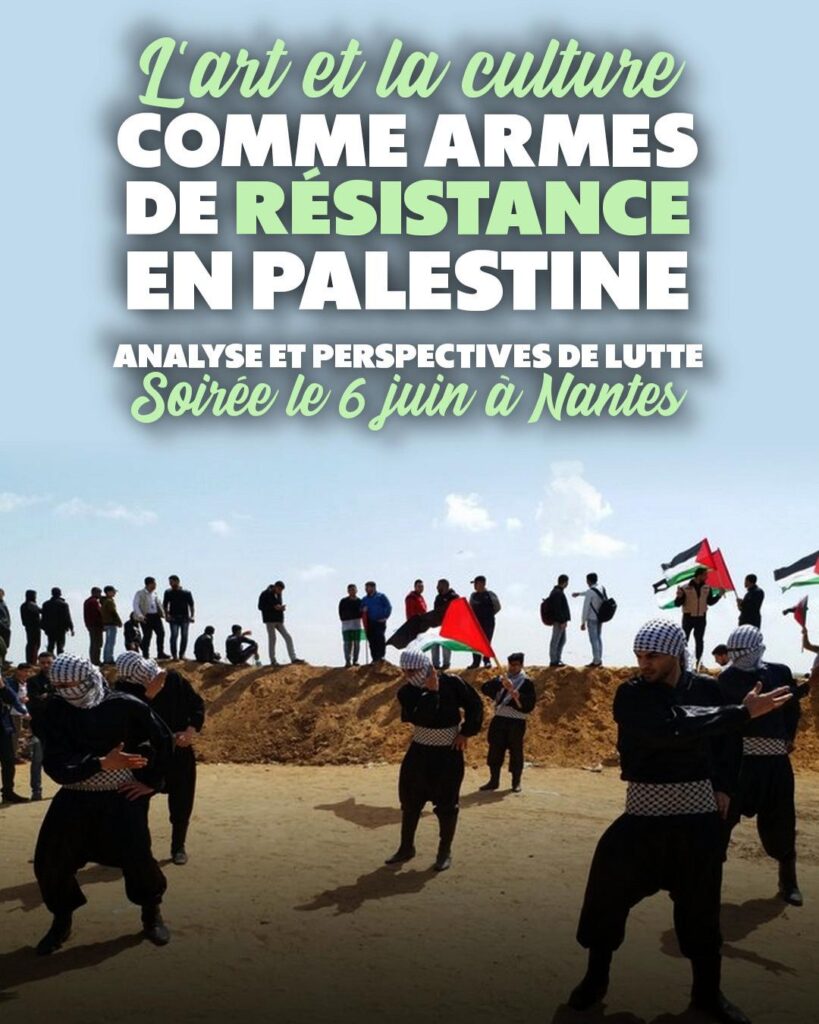
Analysis and perspectives of the fight, evening June 6 in Nantes
In Palestine, since the Nakba of 1948, colonial violence has never stopped: it is reconfigured, intensified and deployed simultaneously on bodies, lands and imaginations. From Gaza, ravaged by genocide for nearly three years, to the West Bank where colonization is accelerating, civilian populations are the first victims, caught in a system of domination which affects all aspects of life. Cultural erasure, far from being secondary, constitutes one of the essential driving forces; it is part of the doctrine “A land without people for a people without land”, which aims to deny the very existence of the Palestinian people and, in doing so, their legitimacy.
Thus, bringing Palestinian art, history and traditions to life and resonating becomes an act of resistance, in Palestine as elsewhere, particularly in France. In this article we will analyze this colonial continuum – from land dispossession to the battle of narratives – while highlighting initiatives that contribute to the promotion of Palestinian culture, from “Beitna – the house of Palestine” in Paris to the Palestine festival “Culture, Arts, Struggles”, which will be held in Nantes on June 6 for the third consecutive year.
The process of making Palestinian culture invisible
The colonial project is always part of a double dynamic: the spatial approach – through the depopulation of the territory – and the process of invisibility of the artistic and historical markers which bind a people together. Because the more the identity of the colonized community is fragmented, appropriated or diluted by the dominant power, the more the prospect of its return – political, territorial and symbolic – becomes difficult to envisage.
Thus the traditions, history and emblems of Palestine are systematically attacked by the Zionist entity. Regularly large operations to uproot olive trees take place in the West Bank: in August 2025 the State of Israel sent its bulldozers to raze thousands of trees in the village of Al-Mughayyir day and night for 72 hours. In Hebron on July 31, 2025, it was the peasant seed bank that was stormed by the occupying army, which Yasmine Al-Hassan, Palestinian environmental activist, then described as “an attack on food sovereignty in Palestine – which is one of the foundations of a sustainable Palestinian future, which would “is scary, so they are targeting initiatives to try to prevent us from staying on our land.”
In Gaza, over the last three years and according to archaeologists, there are more than 200 cultural and historical sites including mosques, Greek cemeteries, Egyptian remains, Ottoman markets as well as the central archives – containing more than 150 years of history relating to Palestinian culture and life – which were destroyed by Israeli bombing.
In East Jerusalem, the authorities of the colonial power regularly prohibit access to the faithful Palestinians at the Al-Aqsa mosque. And even when this is not the case, we can no longer count the terrible videos of police assaults inside the third holiest site of Islam: dispersions by tear gas, widespread beatings and violent arrests have multiplied there in recent years.
Culture as a weapon of resistance in Palestine
Not forgetting means continuing to fight for the Palestinians’ right to return to their lands. Thus, in refugee camps and among the diaspora, history and traditions are passed down from generation to generation. More than simple memories, it is an act of resistance to combat the project of erasure through oblivion of the Zionist entity. By preserving memory, Palestinians resist and assert their rights to exist and return to Palestine.
In Gaza, despite the genocide, famine and blockade still ongoing, life goes on. Young people are taught with the means at hand and learning circles are organized during which dance, music and embroidery are practiced. Traditional dishes are revisited with accessible foodstuffs and the cultivation of the land persists, despite the destruction of infrastructure and chemical contamination of the soil. More than a transmission, culture allows us to celebrate life and is a tool for healing trauma. By continuing to celebrate weddings, graduations or traditional holidays, Palestinians continue to live where the only narrative we are allowed to hear is that of – at best – victims.
By preserving their identity, Palestinians affirm their existence as a people in their own right and oppose the propagandist and racist logics which seek to dissolve them in a vague otherness, reducing them to simple “Arabs among others” to better legitimize their expulsion to the countries neighbors. Sharing this culture also means fighting against Zionist historical rewriting which, not content with sowing death and destruction wherever it has the opportunity, has the cynicism to reappropriate this culture that it bludgeons: traditional dishes, embroidery, music, everything that Palestinians have created for hundreds of years is hijacked by his oppressors.
The battle of stories is also being played out in France
As for the French authorities, they do not skimp on the means to support the oppressor’s speech. Voices of solidarity are systematically repressed: subsidies withdrawn for the Rock En Seine festival following the programming of Kneecap, an openly pro-Palestinian group, the Parisian restaurant “La cuisine de Souad” was closed for refusing to remove a “Free Palestine” sticker. “, the flag of Palestine is perhaps the only one in the world that can lead to an arrest (outside any legal framework obviously).
On the dominant media, how many times have you heard the war criminal and spokesperson for the Zionist army Olivier Rafowicz spout his propaganda without contradiction, for how many Palestinian voices? Complicity does not stop at the sale of arms or the maintenance of trade agreements, by censoring and condemning Palestinian speech, the state and the media play the game of the oppressor, surely thinking of seeing “the problem of Palestine” disappear so as never to have to account for their participation in Zionist crimes.
Despite the omnipresent censorship, initiatives to promote Palestinian art and culture are developing, led by those primarily concerned from the diaspora, and can only survive thanks to the support of the supportive public. In the 18th arrondissement of Paris, it is the place “Beitna – the House of Palestine” (@maisondelapalestine) which will soon see the light of day with the objective of “becoming a nerve center for the Palestinian community and its allies, by promoting solidarity, celebrating culture and promoting independence.”
In Nantes, for the 3rd consecutive year, the local collectives of Urgence Palestine and Action Palestine are organizing the “Culture, Arts, Struggles” festival which will be held on June 6 at the Stéréolux, and which presents itself as a political, educational, cultural and festive space, affirming that the struggle is nourished by joy and solidarity. This festival, supported by Palestinians and their allies, is intended to be a moment of collective strength, aiming to transform astonishment and the feeling of powerlessness into dynamics of action. Participating also means supporting the inhabitants of Gaza who are fighting for their survival, with all profits from the festival being donated to Resilience Gaza, a local association helping refugee families for two years.
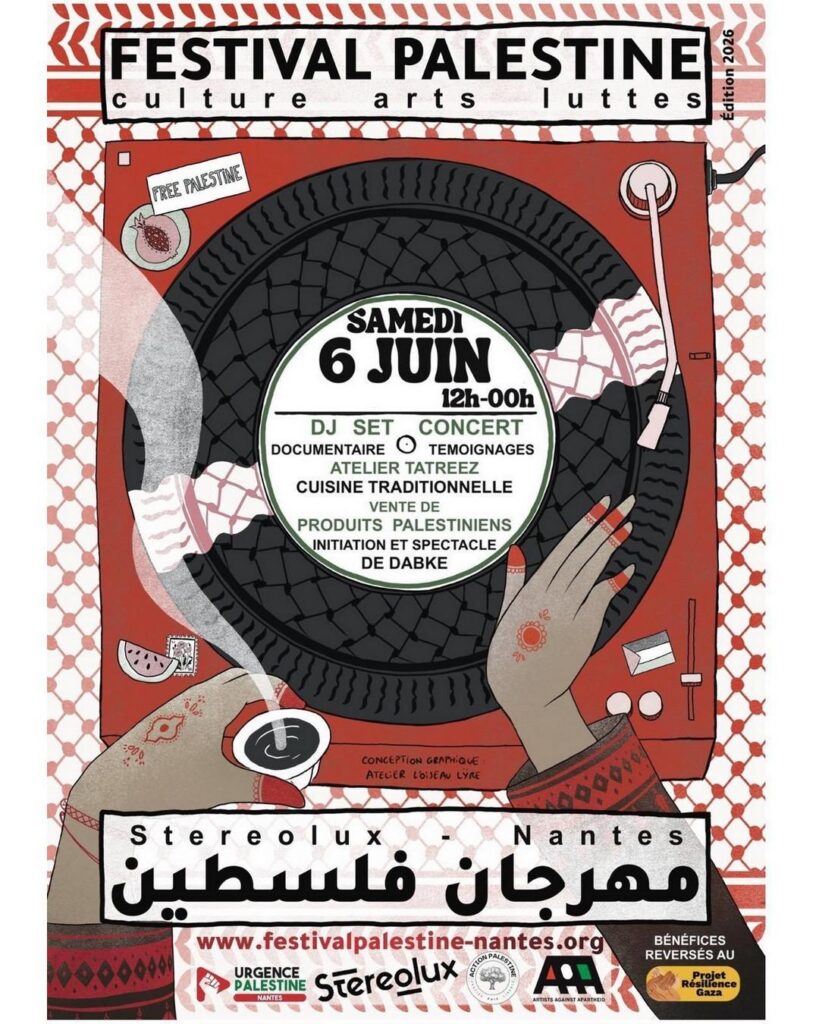
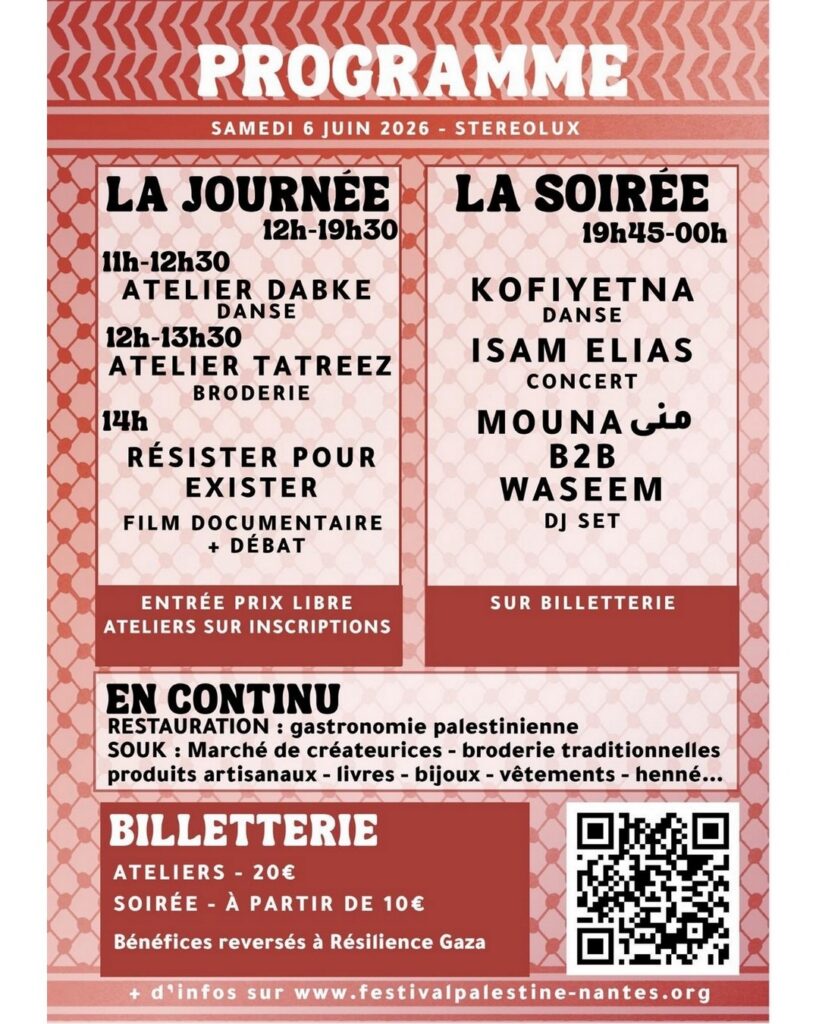
Photo: Dabkeh during the return march to Gaza in 2018. Palestinian dancers brave Israeli snipers. By Ibrahim Abu Naja.
SUPPORT AGAINST ATTACK
Since 2012, we have been offering you quality, free information. To continue this essential work we need your help: every euro counts!
Every 15 days, receive our latest news and much more directly to your email address by subscribing to the Contre Attaque newsletter.