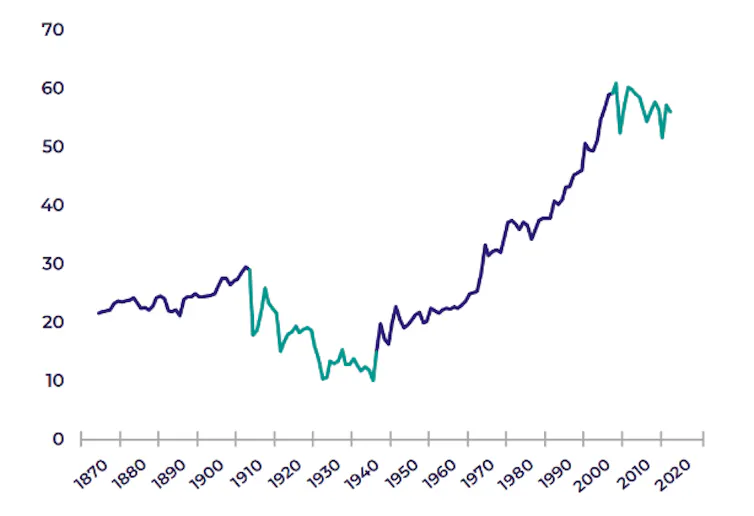
The trade war has become the new norm in the global economy. We see this with the “Chinese shock 2.0”, “Trump 2.0” and the “Gulf War 3.0”. When and why did we enter this new era?
One of the central arguments of our book consists precisely in showing that a significant part of the current reactions of the United States can be explained by concerns deemed legitimate regarding the place occupied by China in this system. The Chinese economy is in fact based on a model that is profoundly different from that of liberal Western economies, particularly with regard to the relationship between the state, industry and international trade.
So Trump’s first term, as well as the measures we observe under his second, are more of a symptom?
It must be recognized that the international trading system was already experiencing problems.Â
One of the key points of our book is to demonstrate that much of the actions of the United States today are motivated by legitimate concerns and by the challenges that China poses within the trading system. Beijing is pursuing a particularly different economic model. President Xi Jinping is absolutely not interested in the world of interdependence. He explicitly stated that he wanted China not to depend on any other country for its supply chains, but instead to be the preferred supplier to others.
In other words, he wants this asymmetry. But it is also because China felt vulnerable during the first Trump administration that it developed and strengthened many assets to no longer find itself in the same position.
Why do those who fight this war need to be taught how to win it? Are political decision-makers going into this blindly?
Soumaya KeynesThere are no instructions.Â
If you think back to the old trading system, we agreed on a set of rules. To some extent, when we had this set of rules, we could refer to them and follow them. The question boiled down to: “Is this within the rules or not?” So, for questions like “should we apply customs duties?” or “should we discriminate against others?”, we didn’t need to look at the details: we had principles to follow.
These rules have broken down and we find ourselves in a less predictable world, facing problems we haven’t had to face before. So we need to think about how to survive in this world of economic conflicts.
So in our book we try to say: let’s take a break. Let’s take the time to think about the real problems and the trade war that needs to be waged. Then, let’s examine the effectiveness of these tools, looking at the state of the economy, the evidence and history.
What are your top recommendations for sales warriors?
Chad P. BowenGet ready. Do your homework, identify your weaknesses and strengths. Get to know the other governments you deal with. Then you have to understand the businesses, because they are the ones on the front lines. You can’t just think they will do what you want. They react to their own incentives. They are waging their own trade war, which may not be the one you want.Â
Soumaya KeynesAround the world, different governments and administrations have conducted preparedness exercises to assess their vulnerabilities, including the European Commission.
In reality, the Europeans had an advantage over some of the other governments conducting these exercises because they had access to data on internal trade. They could thus better evaluate their national production. Indeed, vulnerability does not lie only in sourcing from a single actor, but also in the quantity produced locally. The real challenge, everywhere in the world, lies in the level of visibility that we can actually have: many of these vulnerabilities are indeed found at the very end of supply chains. Even the companies concerned are unaware of the origin of all their purchases.
Many countries are trying to protect themselves against trade-related shocks. Do you think this is possible, and if so, how?
It is achievable and it is a laudable goal. However, extreme caution must be exercised. If you have identified a real problem, namely the dominant position of a trading partner in the market, and they have shown that they are prepared to use it as a weapon, then you can resort to trade barriers, essentially to encourage companies to diversify their sources of supply.
A really interesting idea is currently being discussed within the Union: requiring companies to source from at least three different sources. We could thus grant subsidies to companies which obtain their supplies from several sources and penalize very concentrated suppliers. These penalties could be reduced if stocks are large.
But there is also the risk that governments will turn inward and go too far. They could then go beyond the very specific problem of market domination to adopt an attitude of the “France first” type.
Chad P. BowenIt will also cost more. Businesses that must source from three different sources would probably prefer not to have to do so.
Producing everything at home is also very risky. This simply amounts to concentrating production locally. But everyone is exposed to shocks, whether climate change, earthquakes, strikes or any other events.
What are the tools and policies that can be mobilized in the context of a trade war?
Soumaya KeynesFour main instruments are used: stockpiling, subsidies, customs duties and export restrictions. We analyze them in detail in our book.
The big lesson to learn is that we must not be ideological when it comes to some of these instruments. I sometimes talk to people who say, “I don’t like stocks or subsidies.” This is completely justified, because these tools are often associated with waste, corruption and inefficiency. This is why we generally don’t use it. But in a trade war, the other players will show firmness. Our recommendation is therefore not to exclude anything.Â
In addition, the use of these tools sometimes requires great firmness to achieve its objectives.
Take the example of microchip subsidies. In the event of a very concentrated supply, incentive measures must be taken to divert people from this dominant source of supply. If you give subsidies to companies to build new chip factories, you can’t just wait for the market to demand those chips rather than the really cheap and efficient chips it’s already buying. We could learn lessons from China, which is used to acting across the entire chain, from supply to demand.
Who is better prepared to wage a trade war: the United States or China?
In a way, it is the United States. Indeed, they have considerable assets that they have developed over decades: they have the dollar; a gigantic consumer market and incredible microchip technology.
But at the same time, one could also argue that it’s China. It has been preparing for decades by strengthening its supply chains and consolidating its dominant position. It has a considerable share of global production of many manufactured goods, including those that are essential to other countries’ supply chains. We’ve seen several of these products make headlines over the past year. These included rare earths, permanent magnets and semiconductors from the company Nexperia. These are products that the United States, Europe, Japan and Korea need. However, China supplies 90%.
If we redefine preparedness as a question of mentality, a kind of safe, even paranoid and fearful mentality, then it’s clearly China. Beijing has adopted this type of defensive stance for much longer. Obviously, the challenge is that once a major player starts adopting such an attitude, it becomes a self-fulfilling prophecy, because it is then rational for others to adopt the same mindset.
What about the European Union?
The Europeans were the slowest. They are not the type to rush. But I think they will succeed and we can already see that they are adopting this mentality. The question is whether they will now take all the necessary steps quickly enough to meet this challenge. It wouldn’t be very European, but I’m hopeful they can do it.
Why is the Union having so much difficulty adapting its mode of operation to today’s world?
The challenge for Europe is to reconcile the desire to preserve the benefits of a rules-based system with the need to respond to the policies of other major powers. The Europeans have a very rules-focused approach. So there’s something very strange and uncomfortable about facing this situation and saying, “Actually, we can’t rely on the rules anymore. We have to rewrite them.”
Chad P. BowenTo understand the importance of the rules for Europe, you need to know that they do not only define its interactions with the rest of the world. The rules also make it possible to manage relations between member states. Europe’s concern is this: if it moves towards a situation where it no longer has rules, no longer respects them and has to deal with the United States and China, that’s one thing. But if this also creates internal chaos, that is to say if the questioning of the rules vis-à-vis the outside world also disrupts the rules within Europe itself, then this adds a series of additional concerns.
You have mentioned several times that the actions of the Trump administration are a response to the policies pursued by China. But at the same time, these same actions make collective action aimed at putting pressure on Beijing to change its model impossible, with Washington’s allies now having to protect themselves from both the United States and China. What can Europe do?
Europe must implement a set of measures to remedy its excessive dependence on China for the import of certain products, Beijing having demonstrated its desire to use trade as a weapon by imposing export restrictions in 2025. These products include rare earths and other critical minerals, permanent magnets as well as certain advanced semiconductors These measures may include targeted import restrictions, such as specific tariffs, as well as production subsidies intended to encourage the development of new production sources outside of China. Even if it is impossible to form a common front with the United States due to tariffs. imposed by the Trump administration, Europe should strive to align its policies with those of Japan, South Korea and its other Asian allies, which share common economic concerns.
China’s considerable trade surplus with the rest of the world suggests that Europe and its allies should ask Beijing to rebalance its economic growth model in favor of domestic consumption and to revalue the yuan.
If we consider small and medium powers, Iran seems to be doing quite well. Is this one of your best students?
Absolutely, Iran has understood how to use its pressure levers, notably the Strait of Hormuz, to inflict considerable economic damage, colossal in relation to the size of the Iranian economy. The country has clearly identified its assets and is making the best possible use of them, given the situation in which it finds itself.
Soumaya KeynesIn 2016, when Trump was elected, the trade wars were over tariffs. The goal was to limit access on demand. Since then, the world has understood that it could be much more dangerous to restrict the supply of a product. Indeed, when we impose customs duties, we kill demand and profits fall. But money is fungible. Maybe we can sell elsewhere, it’s a little easier to manage.
But if you need a component or depend on a power source, it’s potentially much harder to escape. This is what Iran is doing.
There are those who fight and there are others. Many countries targeted by Trump’s tariffs have chosen not to retaliate, or even to make concessions. We can in particular think of the European Union, Japan and South Korea. Is this a viable strategy?
One of the reasons some of the United States’ smaller trading partners entered into agreements is that they had a security partnership. They are so dependent on Washington militarily that they fear that the latter will withdraw their support. They would never dare to fight back.
There was also a competitive dimension, with some players wanting to obtain lower customs duties than their rivals. Additionally, it is very difficult for small actors to exert deterrence against the United States. If they wish to set up such a system, they will have to do so with other countries, as within the framework of an economic NATO.
The European case is particular, because the European Union is a leading economic actor with a certain leverage. The Europeans have an anti-coercion instrument, a weapon intended to serve as a means of deterrence. They never succeeded in using it. I think they even had difficulty coordinating to implement it in the context of the Greenland situation. I guess in the current situation this deterrent doesn’t seem particularly powerful. I really think the Americans feel they can put pressure on the Union to get whatever they want.
Chad P. BowenThe other region of the world where this dynamic has clearly manifested itself is South Asia, with ASEAN. At first, they said to themselves: “Let’s try to negotiate with the Trump administration, the United States as a bloc.” But in the end, everything came down to each of these countries: Vietnam, Indonesia, Thailand and Malaysia. What worried them most was quickly obtaining a customs tariff lower than that of China, their main competitor. When they saw that the United States was going to impose higher tariffs on China, they said, “It’s China Plus One, all these big multinationals are going to move their supply chains, we want them to invest in our country, let’s get a lower tariff and let’s get it quickly.” It was therefore very difficult to stay united and negotiate as a bloc.
We’re talking about a trade war: wouldn’t it be better to aim for trade peace? What would be the obstacles to a return to status quo ante ?
We undoubtedly prefer a world without conflict, a more cooperative world. The challenge the United States currently sees from China is that there has been no change in Beijing’s behavior or intentions. Whether with regard to its economic model or the level of interdependence it considers appropriate between the two economies. It continues to reduce its dependence, certainly on the United States, but undoubtedly also on much of the rest of the world.
Over the past five years, China has exported colossal quantities of products, including from incredibly new, sophisticated and cutting-edge industries. But its imports do not follow the same pace.
In this context, it is really difficult to engage in cooperation and say: “Let’s establish a trade peace.” The other party must also want this trade peace. And until we reach that point where major parties are equally willing to go down this path, countries will need to focus on these questions: “Where am I vulnerable?” most profitable possible?
Do you see the risk of an escalation towards open war or an extreme form of economic warfare?
Soumaya KeynesActions taken within the framework of the trade war could make an open war more likely, if another element were to serve as a trigger. One of the things we talk about in the book is stockpiling. The risk of stockpiling is that your partner sees you stockpiling and assumes you are preparing for war. He would then be forced to prepare himself.
But in a broader perspective – and this is again one of the questions we tried to answer – what is the relationship between trade and peace?
To the extent that trade is peacemaking and strong trade ties make conflict less likely, does this risk reduction, decoupling, or whatever you want to call it, increase the chances of conflict? We essentially concluded that a world where everyone is highly interconnected is safer than a world in which we are all isolated and view each other with suspicion.
But it’s on a very general level. Right now, the reality we have to face is that we have concrete examples of over-reliance and acts of coercion. Doing nothing would amount to accepting a kind of peace in which an undemocratic country would be able to force us to do what it wants.

/2026/06/10/6a290ee12f132830223138.png "War in the Middle East: what we know about new Iranian strikes against American bases")