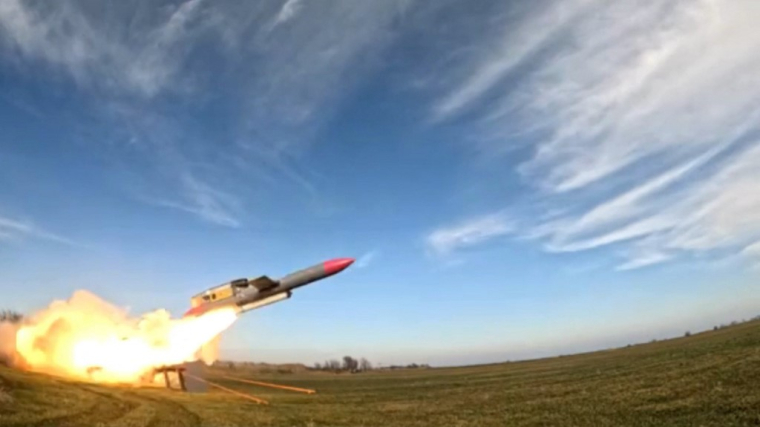
What do a MISTRAL 3 missile, a PROTEUS cannon and a Giraffe 1 X radar have in common? Scania, at the origin of the chassis which will allow these three systems to come into motion to give the Army a supporting low-layer ground-air defense capability. Called Vampire, this new reference in the catalog is also a first experience of successful industrial duality for the French teams of the Swedish group, especially accustomed to producing thousands of trucks for civilian customers.
Repower ground-to-air defense
Difficult, even for the untrained eye, not to notice these touches of French earth brown lost in the middle of a sea of white, red, gray or turquoise cabins. This exception is the Vampire tactical carrier that the Angevin Scania site has been mass-producing for several weeks. The fruit of a successful compromise for the Army and the materialization of a change of gear for the young design office in charge, Scania Public and Defense (SPAD).
More than a hundred Vampires will be produced by the end of the year for France. Once equipped, they will become the V3P MISTRAL, advanced aerial detection radar vehicles (VARDA) and carriers adapted for interim anti-drone combat (PALADIN) on which the Army is relying to reconstitute an intermediate capacity of DSABC support for the benefit of its combat units. Each vehicle has its mission. The 50 PALADIN planned will be based on the 20 mm PROTEUS standard 2 gun, whose fire control will be enriched with AI to better fight against drones. The V3P MISTRAL will make it possible to renew the carriage of the PAMELA platform and its MISTRAL 3 missile launcher, oriented towards higher value targets.
The 16 VARDA systems will provide the latest generation of aerial detection and surveillance capacity. Latest arrival, this version will be based on the Giraffe 1X radar from the Swedish group Saab. Ordered by the DGA’s rapid acquisition force, they will replace part of a capacity based on NC1 30 and 40 radars in service for more than 30 years. Half of the target will be delivered during 2026, the rest in the first half of 2027. The same goes for the PALADIN, which is also eagerly awaited. The French investment has not gone unnoticed: the Vampire will be entrusted to the Swedish army for tests conducted around the summer break.
The Vampire, a winning sprint
The Vampire arrives just in time to fill a capacity gap identified for a while by the Army and further reinforced by the challenge of setting up a first division ready to be projected in 30 days in 2027. Scania has therefore put the turbo on. In ground-air defense or elsewhere, it becomes imperative to “reduce deadlines and adapt materials to the geopolitical situation“, summarizes Vincent Durnerin, director of SPAD. Less than 24 months will have been enough to offer a 4×4 chassis ready for industrialization. A two-year sprint, but a sprint nonetheless given the timetables usually adopted to respond to this type of need.
Created less than a decade ago, the SPAD will have been able to count on the successful experience of the deep resupply vehicle (VRP) delivered to the French special forces to work on a variation for the benefit of conventional units. Scania was then able to demonstrate the capacity of its civilian drivetrain to meet the performance demanded by special forces, a demanding customer if ever there was one. “Today, this VRP gives complete satisfactionVincent Durnerin congratulated himself
Launched in January 2024, the studies on what will become the Vampire then stem from a bold proposal: why not rely on the extreme modularity of Scania’s catalog to define a militarized carrier as needed? Bingo, the Army signed and a first truck materialized barely five months later. Co-designed with the user and in permanent contact with the Swedish teams, the Vampire is evolving into a demonstrator which will carry out its first firing validation tests in November 2024. Optimized and industrialized, it becomes a “Proof of concept» in the fall of 2025. This first POC will have been used to test the industrial maneuver. The second starts two months later and three months before it enters production.
Production is now well underway. Three copies come off the line every week. Around ten are awaiting delivery and around ten others are in the assembly phase. The bet is therefore won for this “handful of motivated people who accepted the challenge because we have a very strong demand from the armies », celle «Âto make an effort and get out of our comfort zone within a very tight deadline“, observes Vincent Durnerin. For Scania, it is also a demonstration of its capacity “ to produce in quantity even if adaptations have to be made“. Its secret to producing quickly and efficiently, apart from a catalog of parts and sub-assemblies worthy of Lego and synonymous with high availability? The duality of its Angevin line, perfectly capable of integrating special vehicles into the ocean of civilian trucks without seizing up the machine or compromising the group’s quality standards.
A line straddling two worlds
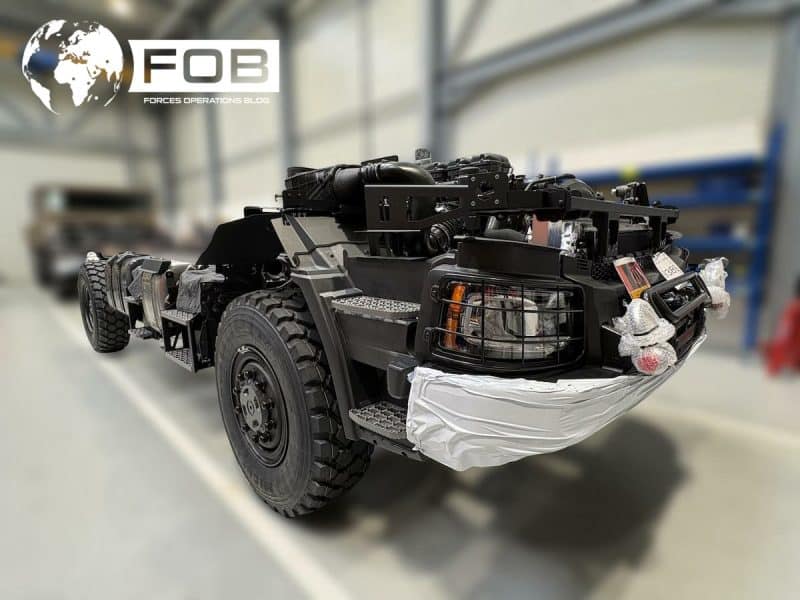
Assembling three Vampires per week and at a controlled cost meant relying mainly on what already existed. There is no question of creating a dedicated line, it will be up to the Vampire to fit into the uninterrupted flow of civilian chassis. The maneuver only required a few minimal investments. This is because the use of common components has been pushed to the maximum to ensure the best fluidity among the assembly stations. Everyone is paced according to the objective of the day. To release the hundred trucks planned for that day, each stage cannot exceed 7 minutes and 48 seconds. And not one more. This is the “takt hour“, this industrial concept modulated to ensure that demand is met. The Vampire cannot cut it, it was necessary to think about the smallest detail, to weigh the smallest choice to find the right balance between standard operations and the flexibility requested by military customers. “The exercise was pushed too far. (…) The teams who are on it are put to the test“, indicates the boss of SPAD.
Militarization nevertheless requires switching to a complementary line. As time is limited, the other challenge will have been to limit the number of specific parts as much as possible to reduce the downtime interval in this additional loop. The best remains the enemy of the good, certain technical choices result from compromises to ensure that we achieve “in a controlled time“. Installed in a secure SPAD building, the three positions which constitute it will have around a hundred hours to integrate 400 references specific to military use. These are, for example, its militarized cabin designed to carry four to five fighters and its multifunction rear tray for carrying mission equipment. The VARDA variant will require a little extra work for Scania. Its rear platform will not only have to accommodate the G1X, but also an energy pack allowing it to be electrically autonomous. The cabin will receive additional seats and screens to accommodate the pilot, the captain and the three system operators.
The Vampire then returns to the main stream for finalization and quality control operations, the last major steps before delivery to the forces. The complexity will have been to achieve this immediate bridge between two worlds, a relatively new phenomenon among civilian actors. The well-established mechanics don’t prevent you from thinking about what’s next. “We started from a somewhat pioneering phase. Now it will be a matter of looking at the possibilities by getting a little deeper into the processes » tout en cherchant à «Âintegrate more within the Swedish side, which is more of an internal organizational issue“, underlines Vincent Durnerin. Above all, it is a question of building on this initial experience to achieve the next objective, that of preparation for an economy assuming increased reactivity and, above all, entirely different volumes.
Du specifice à la masse
From C3P10 and Carapace tankers to refuelers, spreaders and other sprinklers, 535 vehicles of the French armies display the crowned griffin logo of the Swedish group. Vampire included, the order book of the Angers teams now contains 350 vehicles to produce or regenerate. Skills are maintained, but the parks remain restricted. The hybrid scheme created for the Vampire, Scania can absolutely reproduce it or even, why not, extend it to much larger volumes. The hundred copies acquired by France represent only a tiny part of the site’s annual production capacity. More than 20,000 trucks left last year, a quarter of which were for the French market alone.
The daily rate in two breaks can further increase by half to reach 150 copies per day, without taking into account the margin for progress offered by the two other European sites. Around 150 vehicles leave the Dutch factory in Zwolle, which also has a second line which is currently dormant. These volumes which still seemed unthinkable five years ago in defense, the French armies are now seeking to achieve them at least theoretically, just to be ready to launch the first when the time comes. Scania “ knows how to do» , subject to the additional complexity that military specificities will bring. In the absence of modifications, its teams will be able to go so far as to provide a truck in the space of six to eight weeks.
Additional investments are not excluded, Scania France discussing with the French government to define possible state support which will make it possible to materialize the project. Response at the beginning of June. The industrialist came close to putting this mass dynamic into practice. He was one of the candidates in the running for the “big piece” of the French tactical fleet and land logistics (FTLT) program, the one relating to the production of thousands of 6-ton class heavy goods vehicles. Scania then assured that it could provide a truck in 10 weeks, a strong argument which was not, however, enough to prevail over the group led by Arquus.
Regardless, everything remains possible if a new need emerges. This expertise acquired thanks to the Vampire, “we know how to apply it to each vehicle“, underlines the president of Scania France, Benoît Tanguy, while recalling that “the advantage on the Angers site is that we can take out a complete vehicle“. An asset among others at a time when global demand for military trucks is increasing.because the geopolitical situation is unstable“, recalls Petrus Sundvall, CEO of the Angers production site. In France, its Belgian neighbor or elsewhere, the need exists and is growing. Scania France is ready to answer them.