
lediplomate.media – printed on 05/20/2026
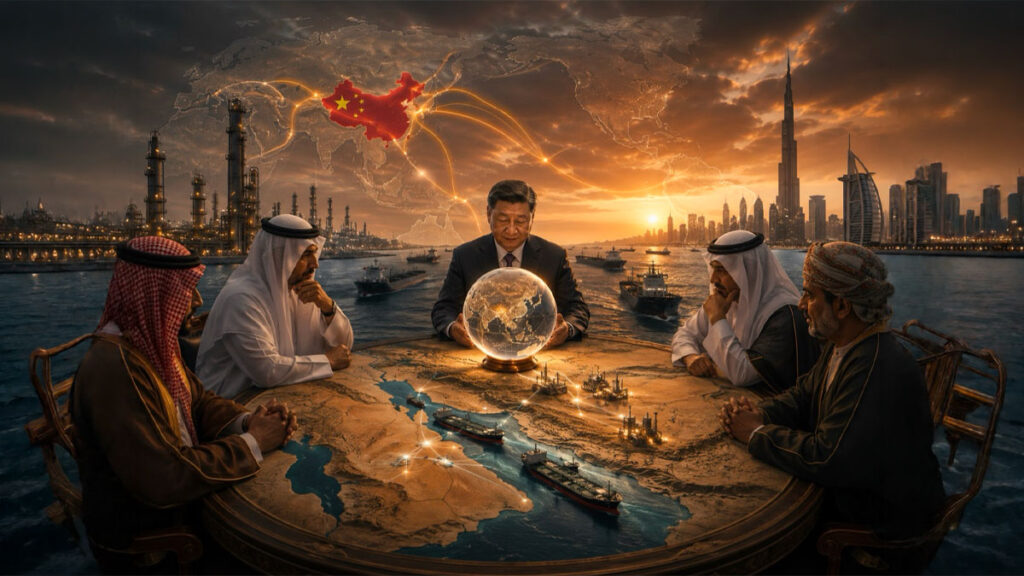
By Olivier d’Auzon – Discover his latest work at Erick Bonnier:AFRICA 3.0
The Strait of Hormuz, barometer of world disorder
While Washington exhausts itself in the permanent turbulence of the Middle East, another power advances quietly but with remarkable strategic effectiveness: China.
The crisis around Strait of Hormuz brutally recalled a reality too often minimized in the West: it only takes a limited disruption in the Gulf to unbalance the world economy.
This maritime artery concentrates a vital part of global energy flows; its partial blockage is enough to cause inflationary shocks, logistical tensions and market nervousness.
Beijing is perfectly aware of this.
The world’s leading importer of Gulf hydrocarbons, China is structurally dependent on regional energy stability. A prolonged rise in oil prices weakens its industrial competitiveness, weakens its supply chains and threatens a still hesitant economic recovery.
Beijing refuses chaos, but exploits American weakening
China can certainly derive a geopolitical advantage from an America dispersed on several fronts – Europe, Indo-Pacific, Middle East – but it cannot tolerate lasting chaos in the Gulf.
The sequence of May 6, 2026 demonstrated this.
That day, Chinese Foreign Minister Wang Yi received his Iranian counterpart Abbas Araqchi in Beijing. His message was clear: reopening of maritime routes and diplomatic resolution of tensions between Washington and Tehran.
At the same time, the oil markets corrected significantly downwards, clearly convinced that a gradual return to normal was taking shape.
The signal is clear: the markets are starting to factor in a now credible hypothesis, that of Chinese pressure being exerted discreetly on Tehran.
Pékin comprend qu’une instabilité prolongée à Hormuz would directly threaten its fundamental economic interests.
Chinese strategy: discreet pressure, maximum influence
However, China carefully refuses to appear as the strategic auxiliary of the United States. She has no intention of openly helping Washington get out of a new regional quagmire.
And for good reason: from the Chinese point of view, an America absorbed by external crises remains a weakened America.
Persistent inflation, budgetary imbalances, political polarization, military over-extension: the United States is today showing signs of a power under permanent tension.
But Beijing distinguishes tactically useful weakening from systemic disorder.
According to several diplomatic sources, the framework currently being discussed would include a suspension of Iranian uranium enrichment, a gradual easing of sanctions, the partial unfreezing of Iranian assets as well as a gradual normalization of maritime traffic in the Strait of Hormuz.
Iran, the Gulf and Washington: all forced to deal with Beijing
This dynamic reveals the geopolitical transformation underway.
Iran needs China, the only power capable of simultaneously offering it economic breathing space and diplomatic cover.
The Gulf monarchies also need Beijing, which has become one of the rare players to maintain operational relations with all regional powers.
And even more significant: Washington itself now seems forced to come to terms with this rise in power.
The Trump-Xi summit on May 14 and 15, 2026 in Beijing could thus take on a dimension going well beyond the simple Sino-American bilateral relationship. It could become, in reality, the real stabilization conference on Iran.
The silent geopolitical shift
This is perhaps the great strategic rupture of our time: the United States retains military power; China is gradually acquiring the role of essential arbiter.
Washington still projects strength. Beijing is starting to dictate the balance.
#Hormuz,#Strait of Armuz,#Iran,#China,#Trump,#XiJinping,#United States,#Persian Gulf,#Beijing,#Washington,#Geopolitics,#Oil,#Energy Crisis,# FinancialMarkets,#Hydrocarbons,#GlobalEconomy,#Inflation,#MaritimeRoads,#Tehran,#WangYi,#Diplomacy,#Multipolar World,#NewWorldOrder ial,#BRICS,#Economic Warfare,#InternationalRelations,#WorldPower,#Gulf,#Energy,#MiddleEastConflict,#ChineseStrategy,#ChinesePower ise,#AmericanWeakening,#GeopoliticalAnalysis,#IranUSA,#Energy Security,#WorldTrade,#GeopoliticalShift,#TheDiplomat,#Africa30


:fill(black)/2026/05/19/6a0c96a05fb0f200012371.jpg "Major de Paris de Rocket League : comment se prépare Team Vitality")


/2026/05/21/6a0eb38a7b8d5577354958.jpg "La Russie et les États-Unis utilisent la désinformation climatique comme une arme stratégique de guerre informationnelle")