lediplomate.media – printed on 05/20/2026
By Giuseppe Gagliano, President of the Carlo De Cristoforis Strategic Studies Center (Côme, Italy)
Shadow finance as a new battlefield
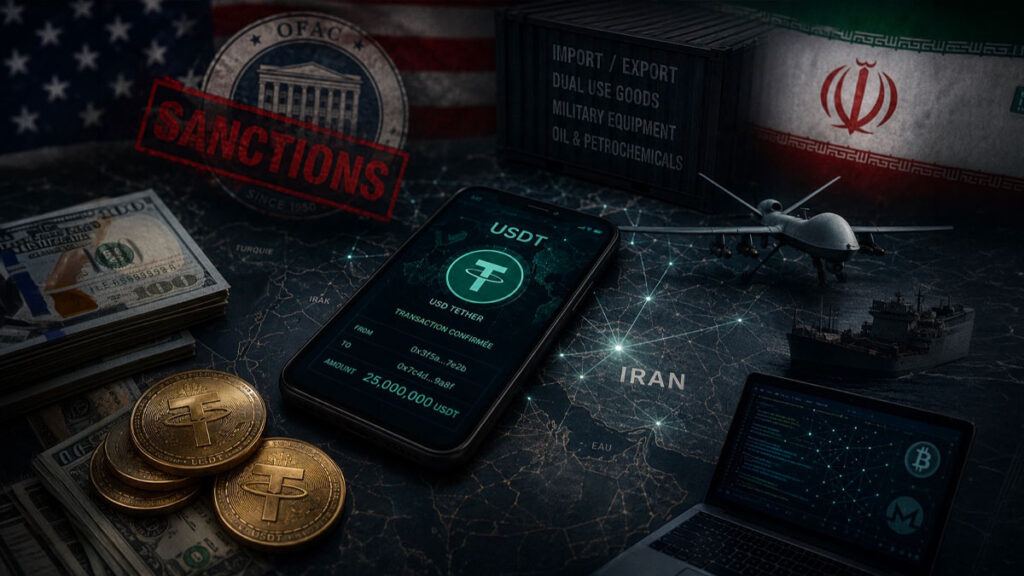
Contemporary war is no longer fought only with missiles, drones, blocked oil tankers and military bases. It also takes place in the invisible circuits of digital finance, where money no longer necessarily passes through banks, no longer waits for authorizations, hardly knows borders and often arrives before the control systems. The Iranian case shows this with brutal clarity: a country subjected for years to American sanctions manages to use a digital version of the dollar to continue to finance its military devices, its strategic supplies and its regional operational networks.
The paradox is obvious. Washington seeks to exclude Tehran from the international financial system, but part of the cryptocurrency ecosystem offers Iran an alternative corridor. It is no longer just about smuggling, front companies or commercial triangulations. We are here faced with a form of financial intermediation that is permanent, rapid, decentralized and difficult to grasp. The stable digital currency, pegged to the dollar and backed largely by US Treasury securities, thus becomes an instrument allowing sanctioned actors to move value, pay suppliers, circumvent restrictions and keep alive a war machine under pressure.
American debt as involuntary guarantee
The heart of the problem lies in the very nature of these so-called stable digital currencies. These instruments promise users a value linked to the dollar. To support this promise, issuing companies often hold reserves in the form of US public debt securities. In simple terms: the American debt gives credibility to the instrument, the instrument circulates on global digital markets, and actors hostile to the United States can use it for operations that the traditional banking system would block.
This is a contradiction of considerable strategic significance. The United States has also built its global power on the centrality of the dollar and its ability to monitor international financial flows. But the private digitization of the dollar risks producing the opposite effect: no longer control, but dispersion; no longer fully manageable traceability, but the multiplication of parallel circuits.
Iran, in this scenario, does not invent the system. He exploits it. And he does it with pragmatism. If the banking channel is closed, if maritime insurance is under pressure, if energy sales must go through cautious buyers or opaque intermediaries, digital finance offers a concrete possibility: transforming local value or commercial income into instruments usable on global networks.
Nobitex and the Iranian laboratory
The role attributed to Nobitex, the main Iranian cryptocurrency exchange platform, is central because it shows how a sanctioned country can build its own internal infrastructure for conversion between national currency, digital assets and external markets. In an economy hit by inflation, the devaluation of the rial and international restrictions, these channels become not only investment instruments or protection against loss of value, but also nodes of strategic finance.
The computer attack suffered by Nobitex in 2025 would not have stopped the mechanism. This is the most important point. Hitting a platform can cause damage, lose resources, slow down transactions. But this does not eliminate the political and military demand that fuels the system. As long as there are buyers, intermediaries, suppliers and digital networks capable of reconstituting themselves quickly, shadow finance remains operational.
In this sense, Iran acts like many other countries subject to external pressure: it does not only seek to resist sanctions, but to transform them into an opportunity to develop skills, alternative channels and operational autonomy. Sanction, when it lasts too long and does not cause political collapse, often ends up producing adaptation.
Military assessment: drones, missiles and logistics
From a military perspective, the issue is not just about money. It concerns the continuity of the supply chain. Drones, electronic components, guidance systems, dual-use materials, spare parts, software, transportation and payments to external suppliers require an agile financial network. An armed force may have arsenals and industrial capabilities, but without secure payment streams it becomes more difficult to purchase, replace and upgrade.
The war in the Strait of Hormuz, real or potential, amplifies this dynamic. Tehran knows that its advantage lies not in symmetry with the United States, but in its ability to saturate, disrupt, strike indirectly and impose increasing costs. Naval mines, coastal missiles, drones, swarms, fast craft, electronic warfare and regional militia networks cost less than an ocean fleet, but require constant and flexible funding.
Digital finance serves precisely this: to support an asymmetric war of attrition, where it is not just about winning a battle, but about preventing the adversary from imposing its order without paying a high price.
Economic scenarios: the dollar against itself
On the economic level, this affair shows the dark side of American financial power. The more central the dollar, the more attractive each of its derivations becomes. The safer Treasury securities are considered, the more they can be used as indirect collateral by global private instruments. The result is a system in which US monetary hegemony can also be exploited by its adversaries.
This does not mean that Washington is powerless. However, this means that the control is no longer automatic. The US Treasury can sanction banks, corporations, individuals, ships and insurers. It can exert pressure on Western intermediaries. But when value circulates on decentralized networks, through digital wallets, foreign platforms and difficult-to-identify actors, repression becomes slower than the circulation of money.
The strategic question is therefore simple: will the United States succeed in regulating stable digital currencies without weakening a sector that now contributes to the demand for American government securities? Because the crux is there. If these companies buy American debt, they also become useful buyers to finance the federal deficit. But if their instruments are used by sanctioned countries, they become a geopolitical fault.
Geopolitics of the short circuit
Iran is not just a national case. This is a precedent. Russia, North Korea, criminal networks, armed groups and revisionist powers are carefully observing this new architecture. Stable digital finance connects isolated economies to global markets without going entirely through traditional channels. It does not eliminate sanctions, but it reduces their effectiveness.
The real issue is the future of economic coercion. For thirty years, the West has used financial control as a political weapon: exclusion from banking circuits, freezing of reserves, commercial bans, blocking of transactions. This weapon now meets a technological countermeasure. It is neither perfect nor invulnerable, but it is enough to complicate the picture.
The economic war is thus entering a new phase. It is no longer enough to control banks and ports. We must control codes, platforms, digital registers, issuing companies, reserves, informal exchanges and IT architectures. The battlefield widens and becomes less visible.
The monster born from innovation
The West has often presented cryptocurrencies as innovation, freedom, efficiency. But any financial technology, when it reaches critical mass, becomes power. And all power can be used against those who made it possible. The private digital dollar, born to make the market faster, can be transformed into an instrument of survival for sanctioned states.
There is not only an Iranian problem here. There is a systemic question. If the American public debt becomes the patrimonial basis of instruments also used by strategic adversaries, then the international financial order enters a zone of dangerous ambiguity. The monetary empire produces its digital replicas; these replicas escape the complete control of the center; the enemies learn to use it.
This is the paradox of American power: so central that it becomes indispensable even to its adversaries, but, precisely for this reason, exposed to the risk of being turned against itself. Iran, more than inventing a new weapon, seems to have understood before others how to use the cracks in the world order to finance its own military and political resistance.
#Iran,#Crypto,#Cryptocurrencies,#Digital Dollar,#Stablecoin,#Digital Finance,#Geopolitics,#Sanctions,#United States,#Washington,#Gold muz,#Bitcoin,#USDT,#ShadowFinance,#Nobitex,#CyberWar,#Economic Warfare,#Drones,#Missiles,#Tehran,#Blockchain,#Dollar,#Debt American,#GlobalFinance,#Russia,#North Korea,#BRICS,#Dollarization,#CryptoFinance,#ModernWarfare,#FinancialNetworks,#Tech nology,#Financial Security,#Geoeconomics,#Global Conflict,#Asymmetric,#CryptoWar,#Financial System,#TheDiplomat,#World Order


/2026/05/21/6a0eb38a7b8d5577354958.jpg "La Russie et les États-Unis utilisent la désinformation climatique comme une arme stratégique de guerre informationnelle")