Donald Trump announced on Monday May 18 that he had canceled at the last moment an attack which should have occurred the next day against Iran, ensuring that there was ” very good chances » to reach an agreement with Tehran.
He explained on his Truth Social platform that he had renounced this new offensive at the request of the leaders of Qatar, Saudi Arabia and the United Arab Emirates, who, according to him, believe that an agreement is possible.
However, he assured that the United States stood ready to launch a “ full-scale, full-scale attack on Iran at any time if an acceptable agreement is not reached » with Tehran.
Previously, he had warned: “ For Iran, time is running out, and (the Iranians) better act quickly, otherwise there will be nothing left of them. »
The head of the central headquarters of Khatam al-Anbiya, Major General Ali Abdollahi, then responded by warning the United States and its allies against any news “ strategic and calculation error ».
Since the ceasefire came into force on April 8 after almost 40 days of strikes, negotiations have been underway via the Persian Gulf countries and Pakistan to try to find an agreement, but the positions of the two parties remain very far apart, particularly on the nuclear aspect.
DIFFERENT OPINIONS IN THE UNITED STATES
For Robert Kagan, a figure of the American neoconservatives and former Republican who has always been one of the most ardent supporters of American military interventions, his country finds itself put in ” checkmate » in the great deadly game which opposes him to Tehran.
This admission is seen among American elites as a sign of a real crisis of confidence in the ability of the United States to impose its world order by force.
For Kagan, Iran did not win a ” military victory “in the literal sense of the term, but the United States has not been able to transform its overwhelming military superiority into a decisive strategic result.
He specifies that Washington is not faced with a simple ” reverse » or to a « wear » in its conflict with Iran, but rather with the prospect of a « strategic defeat » likely to lastingly modify the position of the United States on the international scene.
For him, the war did not achieve its main objective, which was to overthrow the Iranian regime by eliminating – with the help of Israel (1) — its main political, religious and security leaders.
This was done, but the succession was mainly taken by veterans of the Iran-Iraq war, predominantly Pasdaran, who are even more intransigent than the previous authorities.
THE IRANIAN CHANGE
After the elimination of Ayatollah Khamenei on February 28, 2026, an interim leadership council of three notables was tasked with ensuring the political transition. It included religious dignitaries Gholam Hossein Mohseni-Eje’i and Alireza Arabi, as well as the head of state of the Islamic Republic of Iran (RII), Massoud Pezechkian.
The cleric Gholam Hossein Mohseni-Eje’i has been the head of the judiciary since 2021, having made a career as a judge. He was also Minister of Foreign Intelligence called at the time Vevak (now Vaja), who organized the assassination of opponents and anti-Israeli attacks abroad.
The high religious authority, Alireza Arafi, was considered one of the great favorites to succeed Ali Khamenei.
Finally, Massoud Pezechkian is a former doctor and president of the RII since 2024.
This council organized an election by the assembly of experts (which has 88 members.) It designated Mojtaba Khamenei, the son of the former Supreme Guide of the Islamic Revolution of Iran, who died on February 28, 2026, to occupy the position on March 8 2026.
The problem is that although there are many messages on his behalf, he has not appeared in public since his father’s death. According to some sources, he was seriously injured during the same strike, then treated in Tehran hospital.
THE PERSONALITIES WHO COUNT TODAY ARE FEW IN NUMBER
Major General Ali Abdollahi Aliabadi, commander of the central headquarters of Khatam al-Anbiya since 2025, is responsible for planning and coordinating joint Iranian defense operations that include the armed forces, the IRGC, the Basij and the police. Overall, he is responsible for national security.
Mohammad Bagher Ghalibaf is the current speaker of the Iranian Parliament and a former leader of the air wing of the Revolutionary Guards, responsible for missiles and special weapons. He was mayor of Tehran and a four-time candidate for the post of Prime Minister. He represents the Iranian political side.
Major General Ahmad Vahidi has been Commander-in-Chief of the Revolutionary Guards since 1is March 2026. An officer of the old guard of the Pasdaran, founder of the Lebanese Hezbollah, he took part in the assaults against American and French troops in Beirut in 1983. He then created the Al-Quds Force responsible for the external operations of the Pasdaran. He is also wanted for the 1994 anti-Israeli attacks in Argentina. He’s a “tough guy among the tough guys.”
Major General Sabzevar Rezaee Mirgha’ed, better known as Mohsen Rezaï, is the military advisor to the successive Supreme Guides of the Revolution. This former leader of the Revolutionary Guards during the Iraq-Iran war is a leading “influencer”.
Major General Yahya Rahim Safavi, former commander of the Pasdaran, is a member of the regime’s hardest branch. Today he serves as principal military advisor to the Supreme Guide.
IRGC Brigadier General Eskandar Momeni was appointed Minister of the Interior in 2024. As responsible for maintaining order, he is responsible for the heavy repression at the end of 2025 and the beginning of 2026, which would have killed some 30,000/40 000 dead and ten times more injured (according to the opposition in exile). If these figures prove accurate (the authorities only recognizing 2,000 to 3,000 deaths), it will be the most significant internal massacre in a very short time since the creation of the RII. Under his command is former IRGC Ahmad Reza Radan, commander-in-chief of the Iranian National Police since 2023.
Brigadier General Esmail Qaani, commander of the Al-Quds Force of the Revolutionary Guards, was previously the deputy of Major General Qasem Soleimani, killed by the Americans in January 2020. He is one of the rare officials to escape the strikes of 2025 and 2026, to the point that he was for a time suspected of being a Mossad agent… It is he who is responsible for Iranian external operations and in particular proxies, such as the Iraqi Shiite militias, who are very active (2).
Ali Asghar Hejazi is a religious creator of MOIS. He was deputy chief of staff of the Supreme Guide, and also miraculously escaped the strikes that targeted him. He would have kept his position.
Mohammad Bagher Zolghadr, who took over from Ali Larijani as secretary of the Supreme National Security Council, was previously a commander-in-chief of the IRGC.
For Robert Kagan, the Iranian regime is therefore still standing and capable of imposing a strategic cost on the United States and its allies.
He considers that the difference between this war and those of Vietnam and Afghanistan lies in the fact that the current conflict is taking place at the heart of the world order, and not on the periphery: its center is the Strait of Hormuz, one of the most vital passageways in the world for energy, trade and submarine cables.
Its consequences have a direct impact on the reputation of American power and on the world order itself. Washington finds itself in an impasse having been unable to force Tehran into a total capitulation and unable to initiate a land invasion which would be far too costly and long.
A simple declaration of “victory” followed by a withdrawal will not be enough to restore the previous situation, because things are turned upside down: the United States is no longer dissuasive and its allies have largely lost confidence. This risks prompting adversaries like China and Russia to test the limits of American power in other regions of the world.
WHAT REMAINS OF IRANIAN ARMAMENT (3)?
According to an American intelligence report cited by the New York TimesIran « has regained access to most of its missile sites, launchers and underground facilities […] What worries some senior officials most is evidence that Iran has restored operational access to 30 of the 33 missile sites it maintains along the Strait of Hormuz, which could threaten U.S. warships and oil tankers using the narrow sea passage […] Iran still deploys around 70% of its mobile launchers on its territory and has retained almost 70% of its pre-war missile stock. This stockpile includes both ballistic missiles, which can target other countries in the region, and a smaller number of cruise missiles, which can strike short-range targets, land or sea.
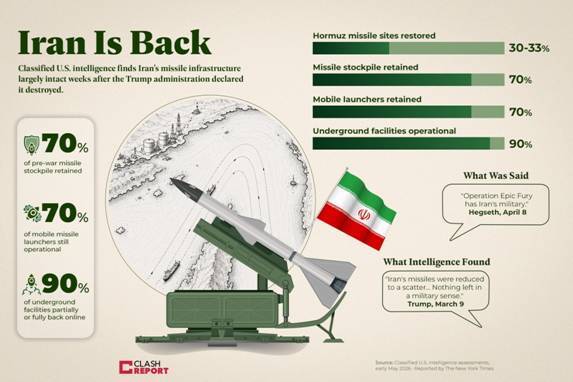
On May 14, during a hearing before Congress, Admiral Brad Cooper, in charge of American military operations in the Middle East, reacted to these estimates: “ The numbers I’ve seen in open sources are inaccurate. »
He clarified that Iran can no longer threaten its regional partners or the United States, as it did before, in all areas.
The exact : « I also think that we should not neglect an aspect as important as simple numbers. It is command and control that is destroyed. This is a considerable degradation and loss of capabilities, including the inability to produce missiles. »
Then, when asked about Iran’s ability to threaten shipping in the Strait of Hormuz, he replied: ” Their capabilities have been significantly reduced. Based on my own professional experience and around a hundred passages in the Strait of Hormuz, we generally see between 20 and 40 speedboats, whereas recently we have only seen two or three. The degradation is therefore significant, but there is nevertheless a residual capacity which still represents a threat. »
He provided additional statistics on Operation Epic Fury to the commission: “ We have destroyed or neutralized a large portion of Iran’s ballistic missiles, launchers and long-range attack drones, with more than 450 strikes against ballistic missile sites and storage systems and approximately 800 strikes against Iranian launch units and drone storage sites […] We destroyed or rendered inoperative Iran’s airfields, hangars, fuel depots, and munitions stockpiles, and we neutralized 82 percent of its air defense missile systems, as well as the radar and command infrastructure that connected them. […] At sea, we destroyed 161 ships belonging to 16 classes of warships, thus crippling the operational capacity of the regime […] We have eliminated more than 90 percent of Iran’s once colossal arsenal of more than 8,000 naval mines, thanks to more than 700 airstrikes targeting those mines. In summary, the Iranian navy can no longer claim the status of maritime power and can no longer project its force in the Gulf of Oman nor in the Indian Ocean. […] Iran retains a capacity to cause harm – harassment, low-power drone and rocket attacks, and residual proxy support – but it no longer has the means to threaten major regional operations or deter the United States from exercising its freedom of action in the air or at sea… »
Both points of view are interesting. As much as Robert Kagan seems very pessimistic – but he represents part of the opposition to President Trump –, Admiral Brad Cooper is optimistic – but he is a general officer in office who is required to defend the official discourse before politicians.
As usual, the truth lies in between…
What seems certain is that Donald Trump does not know how to get rid of the problem that he himself initiated, believing himself to be too powerful. He is not the only one in this case, but Putin is not subject to truly democratic elections… The Chinese President, Xi Jinping, is studying these situations with great care so as not to repeat the same mistakes while playing a distinct role between the two big ones. powers. The rest of the 21st century will probably be favorable to the Middle Kingdom, its competitors having weakened themselves.