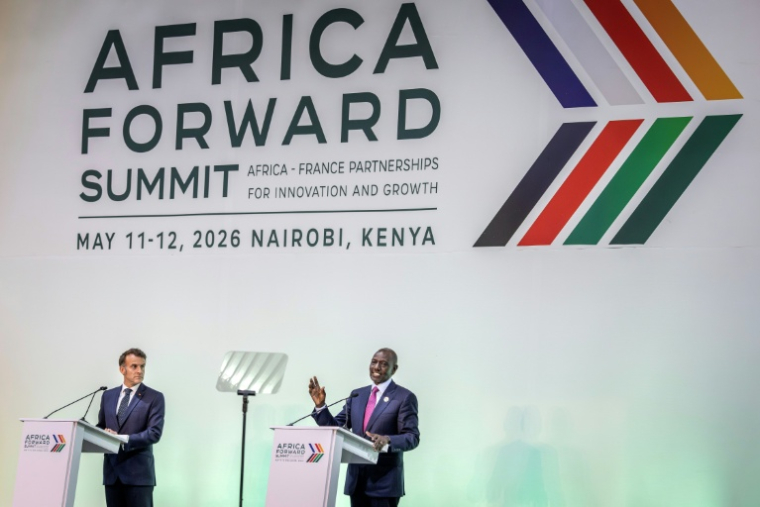
French Presidents Emmanuel Macron (L) and Kenyan President William Ruto (D) close the Franco-African Africa Forward summit on May 12, 2026 in Nairobi (AFP / Luis TATO)
Wanting to resolve international crises without Africa is a “moral and political mistake”, said Tuesday, at the end of the Franco-African summit in Nairobi, French President Emmanuel Macron who has already invited his Kenyan counterpart William Ruto to the next G7 in France.
At the start of the day, William Ruto, the host of the Africa Forward summit, criticized the diplomatic and financial inequalities that Africa suffers at the global level and demanded that the “voice” of the continent be taken into account, particularly in the United Nations Security Council.
“Africa does not demand privileges but equity,” he said from the podium, in the presence of around thirty African heads of state and government, the day after a first day devoted to entrepreneurs, youth and sport. It is “indefensible that a continent of nearly 1.6 billion people” and “54 sovereign states (…) remains excluded from permanent representation on the Security Council” of the UN.
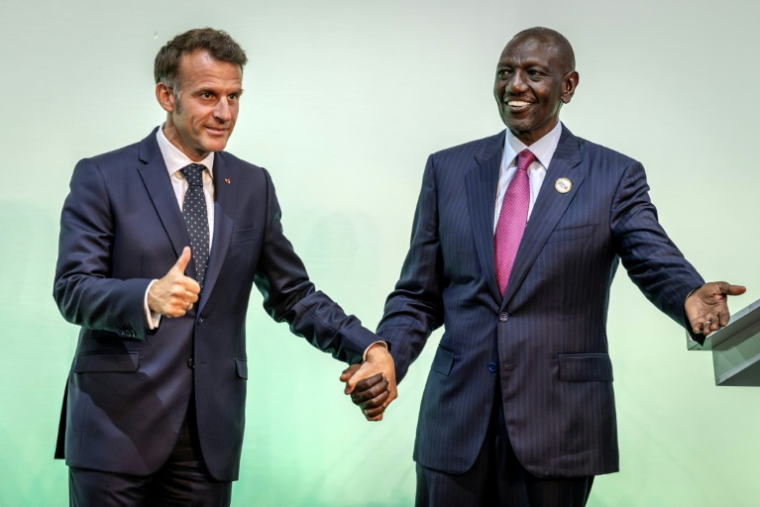
French Presidents Emmanuel Macron (L) and Kenyan President William Ruto (D) during the closing ceremony of the Franco-African Africa Forward summit in Nairobi on May 12, 2026 (AFP / Luis TATO)
“To say that we are talking about the settlement or the capacity to resolve crises with the great leaders of the world without having Africa, is in itself a moral and political fault,” agreed Emmanuel Macron at the end of this Franco-African summit organized for the first time in an English-speaking country.
At the next G7, organized in mid-June in Evian, in the French Alps, the French president said he wanted “an African voice that will be present when we talk about international crises to be resolved.” Africa is one of the continents that have been hardest hit by “the consequences” of the Russian invasion of Ukraine or the current blockade of the Strait of Hormuz, he recalled.
Mr Macron, who increased gestures of complicity with Mr Ruto during the summit, had previously assured that France wanted to see “Africa present at the United Nations Security Council” but also “better represented in financial bodies”.
At the G7, the two presidents will meet to, among other things, advance their common project of reforming the international financial architecture, so that it favors, in particular, private investment in Africa.
– “Ingratitude” –
“The current international financial system remains structurally unequal,” said the Kenyan head of state, deploring high borrowing costs, restricted access to certain financing and even the “prejudice” of rating systems which “discourage” investments.
He saw it as one of the main obstacles to Africa’s development.
Responding to a question on the colonial past of France and other European powers, Mr. Ruto assured Tuesday evening that Africa would no longer allow itself to be exploited. “We will no longer allow ourselves to be slaves to anyone. We will take charge of our own future.”
The Kenyan president noted that Africa had significant unused capital reserves, starting, he said, with more than $4 trillion in long-term savings.
Monday, at the end of the first day of the summit, during which MM. Macron and Ruto stressed that Africa “needs investments” rather than public aid, the French president had announced 23 billion euros of investments for Africa, including 14 billion of French investments, mainly private.
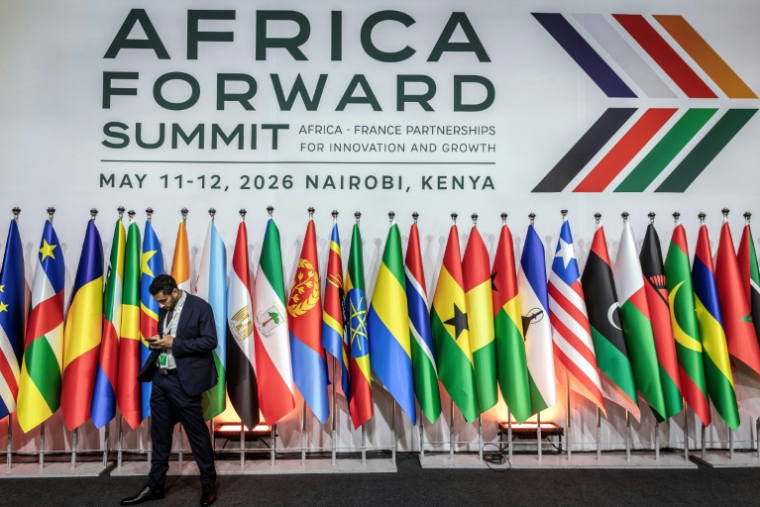
A delegate walks past the flags of African countries taking part in the Franco-African summit in Nairobi on May 12, 2026 (AFP / Luis TATO)
A concrete demonstration, in his eyes, of the merits of a renewed relationship with the continent, which he has been putting forward since the start of his African tour on Saturday after years of setbacks and tensions with several former French-speaking colonies. Particularly in the Sahel, where the putsches of 2020-2023 in Mali, Burkina Faso and Niger precipitated the divorce and the departure of the French army which was fighting the jihadists at the request of these countries.
In an interview conducted in Nairobi with TV5 Monde, France 24 and Radio France Internationale, the French president said he regretted not having “rethought our military presence earlier” in Africa, while defending the overhaul of recent years.
He also felt that he should have been “more demanding” with the Sahelian leaders in place before the coups so that they pushed “development projects” in the territories “taken back from terrorists”, which could have given the impression of a solely “security” response.
But he also denounced again “ingratefulness and a lot of false information” on the part of the military juntas towards the French military.


.jpg "Promoting international relations, communication and language teaching in the era of integration.")