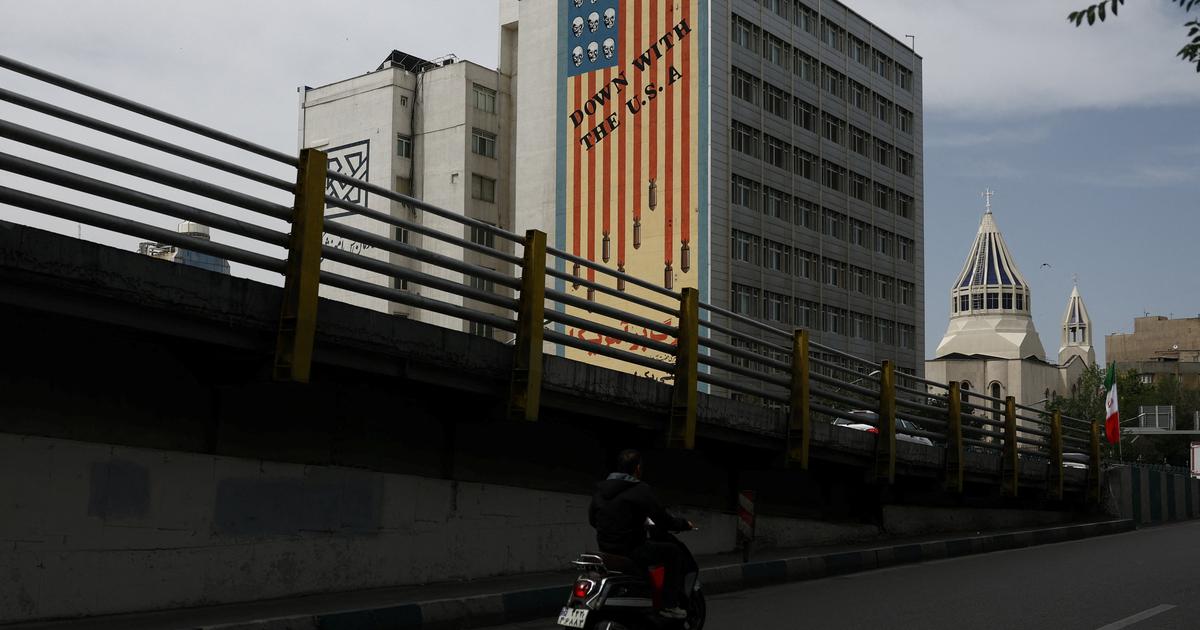
The Iranian response, transmitted via the Pakistani mediator, is “focused on ending the war (…) on all fronts, particularly in Lebanon, and on guaranteeing the security of maritime navigation”.
Iran announced on Sunday May 10 that it had responded to the American proposal aimed at ending the conflict in the Middle East, while several drone attacks were reported in the Gulf despite the ceasefire in force.
The Iranian response, transmitted via the Pakistani mediator, is “focused on the end of the war (…) on all fronts, in particular in Lebanon, and on guaranteeing the security of maritime navigation”, indicated, without further details, Iranian state television.
Meanwhile, attacks are increasing at sea, while the Strait of Hormuz continues to be the subject of a standoff between Washington and Tehran despite the ceasefire that came into force on April 8.
In Qatar, a bulk carrier coming from Abu Dhabi was targeted by a drone in the morning in territorial waters, before continuing its journey, according to the Ministry of Defense.
According to the British maritime safety agency UKMTO, the attack caused a fire which was able to be extinguished. The Iranian Fars news agency claimed that the boat “flew the American flag and belonged to the United States”, without explicitly saying that Iran had targeted it.
Kuwait and the United Arab Emirates have also reported drone attacks, but only Abu Dhabi has directly accused Tehran of firing them.
Two Iranian oil tankers targeted
As soon as the war was launched by Israel and the United States on February 28, the Gulf monarchies, accused of supporting Washington, were the subject of unprecedented Iranian strikes.
This series of drone attacks on Sunday comes two days after the US military targeted two Iranian oil tankers without cargo in the Gulf of Oman, an access route to the strategic Strait of Hormuz.
“Our restraint is over,” declared Ebrahim Rezaei, the spokesperson for the national security committee of the Iranian Parliament.
“Any attack on our ships will trigger a strong and decisive Iranian response against ships and bases” of the United States, he added.
“We will never bow our heads to the enemy, and if it is a question of dialogue or negotiation, this does not mean capitulation or retreat”, the objective being “to assert the rights of the Iranian nation”, for his part wrote on X the Iranian president, Massoud Pezeshkian.
Tehran has blocked Hormuz since the start of the war, authorizing sparsely the crossings of the strait through which normally passes a fifth of the oil consumed in the world. In response, Washington has imposed a blockade of Iranian ports since April 13.
The American government also announced on May 1 new sanctions against Iranian interests and warned ships that would pay the Tehran authorities to cross this strait.
Tehran, for its part, threatened to block access to countries that support a draft UN resolution aimed at ensuring freedom of navigation there.
“Countries that side with the United States by imposing sanctions on the Islamic Republic of Iran will certainly encounter difficulties crossing the Strait of Hormuz,” Mohammad Akraminia, an army official, threatened on Sunday, quoted by the official Irna agency.
“From now on, any ship wishing to cross it will have to coordinate with us,” he added.
In an interview with the Iranian Minister of Foreign Affairs, Abbas Araghchi, the Prime Minister of Qatar warned against exploiting this strategic maritime passage.
Its closure or its use “as a means of pressure would only worsen the crisis” in the Middle East, said Sheikh Mohammed ben Abdelrahmane al-Thani.
Iranian state television also announced that the head of the armed forces command, Ali Abdollahi, had met with Supreme Guide Mojtaba Khamenei, who has not appeared in public since his appointment in March. Mojtaba Khamenei gave “new directives and directions for the continuation of operations aimed at confronting the enemy,” the television said.
On the other front of the conflict, in Lebanon, Israel and pro-Iranian Hezbollah continue their mutual attacks, despite a ceasefire in force since April 17. Two rescue workers affiliated with Hezbollah were killed in two Israeli strikes in southern Lebanon, the Health Ministry said on Sunday.