Oil prices rose by about 6% on Monday as Iran intensified its attacks on the United Arab Emirates and maritime traffic in the Gulf over the past 24 hours, marking the most serious escalation since the ceasefire between the United States and Iran began in early April.
The Brent futures contract rose by $6.79, or 6.3%, to $114.96 per barrel at 12:54 EDT (16:54 GMT), while the U.S. West Texas Intermediate (WTI) crude gained $4.23, or 4.2%, to $106.17.
A South Korean ship was hit by an explosion in the Strait of Hormuz on Monday and Iranian drones caused a fire in a tanker port in the UAE. Tehran demonstrated its hold on the Middle East oil after U.S. President Donald Trump said his navy would open the strait.
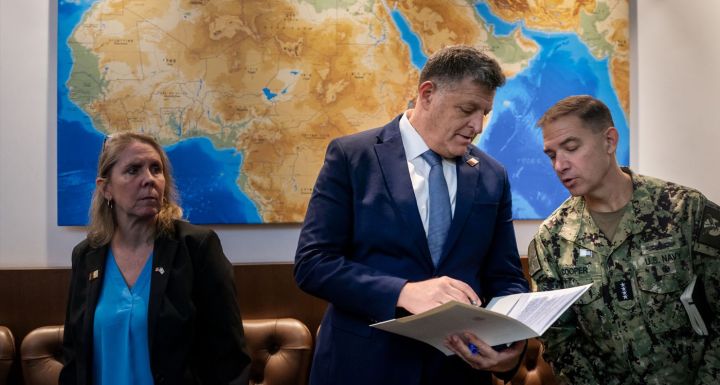
The U.S. military said it destroyed six Iranian light boats and intercepted cruise missiles and drones launched by Tehran as the U.S. conducted an operation to free shipping in the Strait of Hormuz, said U.S. Admiral Brad Cooper, head of the Central Command.
Iranian military officials denied light boats had been sunk.
Before U.S. and Israel strikes against Iran on February 28, about 20% of global oil and liquefied natural gas supplies passed through the strait.
The Iranian Revolutionary Guard Navy released a map showing an extension of areas controlled by Iran near the Strait of Hormuz, now including the UAE ports of Fujairah and Khorfakkan and the coast of the Emirate of Umm al-Quwain, according to Iranian news agencies.
‘The price trajectory remains upward as long as flows through the strait remain restricted,’ said Giovanni Staunovo, an analyst at UBS.
Later in the day, the U.S. military said two American merchant ships had successfully crossed the strait, without specifying when. Iran denied any passage.
IRAN ALSO STRIKES OTHER SHIPS
Including the South Korean ship, Iran may have attacked four ships in the Gulf region over the past 24 hours.
Prior to this, the UAE accused Iran of attacking, with drones, an empty oil tanker owned by the state oil company of Abu Dhabi, ADNOC, as it tried to cross the strait.
At the same time, the United Kingdom Maritime Trade Operations (UKMTO) reported an incident involving a cargo ship about 36 nautical miles north of Dubai. UKMTO also reported another incident earlier in the day near the UAE.
The Energy Minister of the UAE, which left OPEC last week, stated that his country must produce what global oil markets demand without restrictions, while cooperating with other oil producers.
OPEC and its allies, known as OPEC+, announced they would raise oil production targets by 188,000 barrels per day in June for seven members, marking the third consecutive monthly increase.