
Major Japanese media extensively covered the official visit of Prime Minister Takaichi Sanae to Vietnam on April 28, following the official announcement by the Japanese Ministry of Foreign Affairs.
> Japanese Prime Minister Takaichi Sanae expected in Vietnam
> Visit of the Japanese Prime Minister: Vietnam’s strategic role reaffirmed
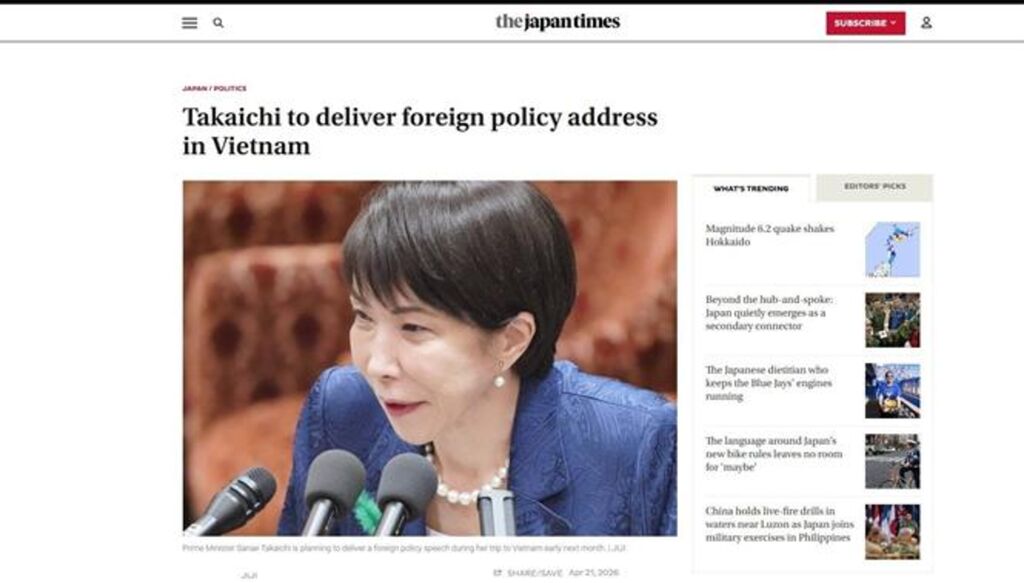
Capture of the article “Prime Minister Takaichi to address foreign policy in Vietnam” on “The Japan Times” website. Photo: VNA/CVN
A common point highlighted in these analyses is the growing importance of security and economic cooperation between Japan and Vietnam in a regional and international context marked by strong uncertainties. Japanese media also view this partnership as a crucial element in implementing the strategy for a free and open Indo-Pacific (FOIP).
Major news outlets like Kyodo, NHK, Asahi Shimbun, Nikkei, and The Japan Times see this visit not only as a routine diplomatic trip but as having significant strategic implications. It is expected to help restructure supply chains and strengthen Japan’s energy security amid tensions in the Middle East, export controls, and global technological competition, which pose risks to an economy heavily dependent on imports.
Kyodo agency quoted Deputy Chief Cabinet Secretary Kihara Minoru as stating that Japan aims to reaffirm the strengthening of a “global strategic partnership” with Vietnam, particularly in areas related to economic security such as energy and critical minerals. NHK and Asahi Shimbun highlighted that Vietnam, alongside Australia, is an important partner in Japan’s regional policy, especially in forging ties with countries sharing common objectives.
According to Japanese media, Vietnam is one of the fastest-growing economies in Southeast Asia and holds a strategic geopolitical position. This allows Tokyo to diversify its sources of essential resources, particularly energy and critical minerals, reduce dependence on certain markets, and enhance its long-term economic resilience.
Additionally, Japanese press is paying close attention to the foreign policy speech Prime Minister Takaichi is expected to deliver in Vietnam. This speech is seen as a key step in adjusting and “renewing” the FOIP strategy after over a decade of implementation since the era of former Prime Minister Shinzo Abe, with a greater focus on concrete elements like economic security, strategic autonomy, and resilience to external shocks.
Government sources indicate that this speech may emphasize strengthening supply chains for essential goods and expanding cooperation in energy security. Analysts believe this shift reflects a more flexible approach by Tokyo in an international environment where economic, technological, and security dimensions are increasingly interconnected.
Japanese media also view Vietnam as a symbolically significant choice for this visit, underscoring Japan’s long-term strategy in prioritizing Southeast Asia while highlighting Vietnam’s growing role in the regional architecture.
Quoting Vietnamese officials, Asahi Shimbun reported that the Vietnamese Ambassador to Japan, Pham Quang Hieu, stressed the importance of enhancing cooperation between middle powers to reduce excessive dependence on major powers amid heightened geopolitical rivalries, fostering a more balanced and stable cooperative environment.
Overall, Japanese media see Prime Minister Takaichi Sanae’s visit as a positive and strategic step not only to deepen bilateral relations but also to strengthen Japan’s role in shaping a regional order based on rules. Vietnam is seen as a central partner in building a flexible and sustainable network of economic and security cooperation, contributing to peace, stability, and development in the region and beyond.
VNA/CVN


