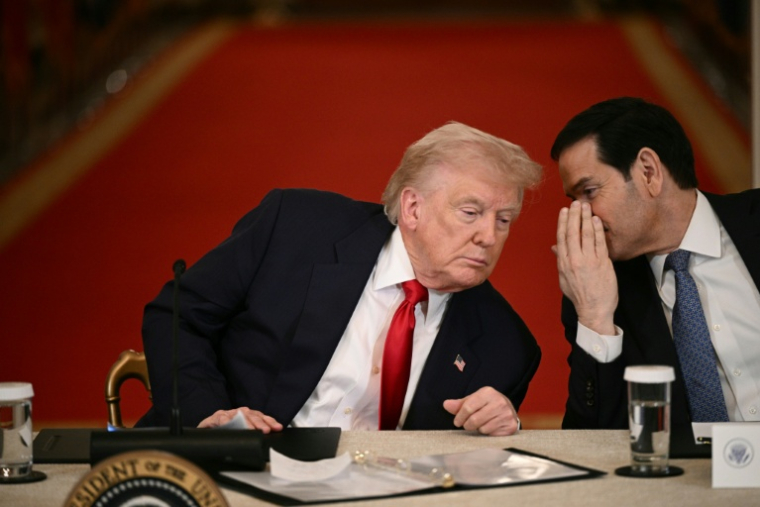
President Donald Trump has led America into its most significant conflict in decades based on a “feeling”. This assertion comes not from his political opponents, but from the White House itself.
Throughout the first week of war in Iran, the American president prioritized impulse over argumentation, emotion over reasoning.
Official government accounts on social media platforms have been publishing clips portraying the military operation as a video game, with sharp comments that could be easily imagined being narrated in a high-budget movie trailer.
“I hope you are impressed,” Donald Trump asked a journalist from ABC on Thursday. “Do you like the performance?” inquired the former reality TV host – the word “performance” in English can also mean “show”.
Comedian and television host Jimmy Fallon mocked, “This could be the first war ever started on +vibes+”, referring to a highly subjective impression.
White House spokesperson Karoline Leavitt faced questions on Wednesday about the reason behind this military intervention, which Donald Trump oversaw from his residence at Mar-a-Lago in Florida.
– Imperial Presidency –
She responded that the president, who had promised during his campaign not to engage America in new wars, acted because he had “the feeling” that Iran was going to strike American positions.
The idea that the 79-year-old billionaire had “free rein” to strike Iran “is nothing new, as the +imperial presidency+ has been a constant in the United States for decades,” noted Richard Haass, who held important positions during both Bush administrations.
“What is different is that he conceived and executed this project without following a proper national security procedure,” continued the former advisor in a newsletter published on Friday.
The National Security Council, an entity that assists the president in formulating diplomatic and military strategy, has been significantly reduced since Donald Trump returned to power.
Marco Rubio now combines the roles of diplomat-in-chief and national security advisor – roles that were previously distinct and extremely strategic within the White House.
– “Arrogance” and “Amateurism” –
Sean Aday, a professor of public relations at George Washington University, declared that he had “never seen worse communication from an American government in times of war,” citing a “combination of inconsistency, immorality, arrogance, and amateurism.”
“The administration of George W. Bush may have invented reasons to justify its unfortunate and tragic war in Iraq, but they spent almost a year and a half trying to convince the public that it was necessary,” the expert reminded the AFP.
Donald Trump, on the other hand, has been vague both on the reason for entering the war and the objectives being pursued.
The language used by the president is uncertain. While he refers to it as a “war,” House Speaker, conservative Mike Johnson, stated on Friday: “We are not at war. We do not intend to go to war.”
Instead of holding a press conference, Donald Trump is conducting multiple short phone interviews with journalists, resulting in a mosaic of sometimes contradictory comments.
– “Midterms” –
While some ministers assert that Washington is not seeking a “regime change,” the American president insists that he will be involved in choosing the next Supreme Leader of Iran and that the United States will participate in the country’s reconstruction.
He has also dismissed concerns about the economic consequences of the conflict, which have already significantly increased the cost of gasoline, a politically important indicator in the United States.
With a few months left until the November elections, which could cost the Republican Party and therefore Donald Trump control of Congress, polls show that the war is quite unpopular.
A survey published on Wednesday by NBC revealed that 52% of voters are opposed to the military intervention in Iran.
The outbreak of the war in Afghanistan in 2001 initially garnered strong support, while public opinion initially backed the offensive launched in Iraq in 2003. In both cases, negative opinions gradually prevailed as the conflicts prolonged.
:quality(80)/outremer%2F2026%2F05%2F12%2F6a0291539cfe5499488284.jpg "War in the Middle East: what strategic fuel stocks does New Caledonia have?")
/2026/05/13/6a04da5720b34213529980.jpg "War in the Middle East: Israeli strikes kill 12 in Lebanon, announces the Ministry of Health")