According to a study, 80% of polled consumers are willing to change their consumption habits. In this supermarket, one customer asserts that buying French products has become the norm, even if it means spending a few extra euros. On the producers’ side, they are struggling to cope with the rise in production costs.
Half of the French population is prepared to pay 3% to 5% more for food to support food sovereignty. This insight comes from the 2026 Food Sovereignty Barometer by the Agri-Éthique label, revealed on Friday.
This publication comes as Michel-Édouard Leclerc also stated that there may be a need to renegotiate commercial agreements with large retailers if the conflict continues. Commercial negotiations, concluded on March 1, led to a price increase of 1% to 1.5% on the shelves, according to estimates.
The study also shows that 80% of polled consumers are ready to change their consumption habits. Additionally, 87% of consumers and 82% of farmers believe that France relies too much on imports. Overall, 95% of those surveyed consider food sovereignty important or a priority.
In one supermarket in Hauts-de-Seine, at Potager City, Caroline carefully checks the origin of each vegetable, holding a tote bag on her shoulder. She inspects the labels diligently, which frustrates her daughter Jeanne, offering her a bunch of tomatoes. “Are these from France? Are you sure? Look closely… Spain.”
For this consumer, buying French is now a rule. “I am very careful to buy French. I fear that products may not be as regulated as they are in France.” But this choice comes at a cost. “It’s much more expensive. In a €20 basket, I think there’s a €5 or €6 difference.”
Almost half of French people are willing to make a financial effort. “I don’t have a high income, but if I have to pay more, it’s okay.” This woman believes it’s a way to support farmers in uncertain times. “To help farmers, given all that’s going on right now, we support them as best we can. There’s also a desire not to import products when we have everything we need here.”
In an unstable international context, food sovereignty is increasingly seen as a priority. According to Ludovic Brindejonc, director of Agri-Éthique, “consumers are realizing the need to protect farmers on local territory.”
Farmers are also facing the impact of international tensions on production costs. Arthur Portier explains that the non-road diesel fuel (GNR) used for agricultural machinery has significantly increased in price. “On my farm, we went from around €700 per thousand liters to nearly €1,400. We experienced a 100% increase, roughly,” he details in an interview.
The volatility of prices also complicates the supply chain. “Some distributors tell us: I’ll deliver to you today, but you’ll only know the price on the day of delivery, because there’s too much variation.”
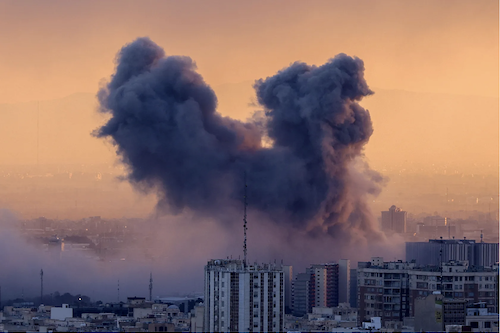
Another source of tension is nitrogen fertilizers, with a significant part of global trade passing through the Strait of Hormuz. Its production heavily depends on gas. In Europe, a large portion of urea is imported from Egypt, which in turn depends on gas from Israel. The halt in gas transit due to security reasons has led to a price increase for gas and therefore, fertilizer production costs.
As a result, farmers are facing a 15% increase in the price of nitrogen fertilizers since the start of the conflict. “Our costs are increasing, but our selling price, the raw material, wheat, has only increased by 5 or 6%,” summarizes Arthur Portier.
By Léonie Guilbaut with Léo Manson.