
Despite expectations, the price of gold fell in March as geopolitical tensions intensified. This paradox raises questions in the markets. Discover the reasons for this decline and the strategic movement of the Bank of France.
Key takeaways
- -9.7% in March, +9.7% in 2026
- While geopolitical risk increases, gold falls
- The Bank of France “repatriates” its gold from the United States
- 527 billion dollars per day
-9.7% in March, +9.7% in 2026
By the end of March, the price of an ounce reached 3,995.9 euros (4,608.35 $), marking a significant 9.7% drop for the month. This decrease halved the 2026 performance, with the yellow metal’s progress in 2026 reaching 9.7% by April 7.

The month of March was marked by the war in Iran, which affected all markets. The CAC 40 dropped in similar proportions to gold: -8.9% for the month, but its 2026 performance excluding dividends turned negative at -2.3%. Bitcoin, on the other hand, appreciated by nearly 6% in March, yet its 2026 performance remains largely negative at -20%.
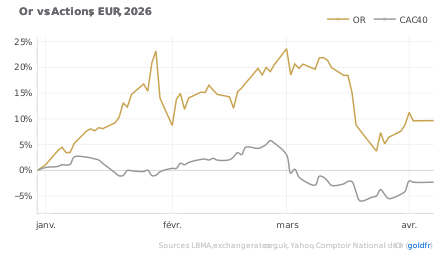
As the conflict enters its second month, all eyes are on oil prices and Donald Trump’s social media. Given the inconsistencies in American statements and Iranian inflexibility, the risks of conflict escalation are numerous, with the primary concern being a surge in barrel prices amid initial shortages in Asia and Europe. In France, following the Easter weekend, nearly a quarter of French gas stations are experiencing shortages, according to the President of the French Union of Petroleum Industries (UFIP).
Paradox: while geopolitical risk increases, gold falls
It may seem surprising that gold, the ultimate safe haven, falls so sharply in the midst of an international geopolitical crisis.
There are several explanations:
- The rise in energy prices creates inflation that central banks will need to combat by raising interest rates. The prospect of rate hikes is unfavorable to gold, which unlike bonds does not generate interest.
- While overall financial markets have declined, gold, which had appreciated by nearly 20% before the crisis, faced profit-taking. A similar phenomenon was observed during the 2008 crisis, where gold, after being appreciated following the Lehman Brothers collapse, lost over 15% in a month during a sell-off. In the following months, the safe haven resumed its course before gaining over 25% in 2009.
- High prices may slow down central bank purchases. The latest data from February showed net purchases of 19 tons, with notable buyer Poland (+20t), and in March, the Chinese central bank accumulated 5 tons of gold. However, the trend needs monitoring, as some countries may be tempted to realize profits on gold to finance conjunctural actions. Recently, Turkey carried out gold sales to support its currency.
- The demand from individuals, especially from India and China, may have slowed. After the Chinese New Year holidays (February 15-23), jewelry demand usually enters a low season.
- Professional investors have reduced their gold positions in favor of oil to protect against the most pressing risk.
Most analysts have taken this correction into account and revised their short-term forecasts while maintaining a positive outlook in the medium term. This reflects the role of gold: the concept of value makes sense in the long term.
The Bank of France “repatriates” its New York gold stock and records 12.8 billion in profits
The Bank of France announced that it had repatriated the 129 tons of gold it held in New York. But rather than orchestrating a complicated logistical operation, it sold this gold on the American market and bought an equivalent amount in Europe. This also avoids the political implications of announcing repatriation, which could have been misinterpreted by American authorities.
These operations, carried out between July 2025 and January 2026, generated a profit of 12.8 billion euros. A technical profit since the bank repurchased an equivalent amount of gold.
This allows the Bank of France to display a positive result of 8.1 billion euros for 2025. Without this operation, the central bank would have been in the red. The other beneficiary is the French state, which receives 1.5 billion euros in corporate tax revenue.
527 billion dollars per day
This is the average daily exchange value of gold in March 2026, according to the World Gold Council. This makes it one of the most liquid assets in the world. For comparison, it exchanges around 5 billion euros per day on the Paris Stock Exchange.
Disclaimer:
The price of gold can vary significantly up or down. The information in this document does not constitute investment advice, and readers are advised to seek professional advice for managing their savings.


/2026/04/09/69d7586ce4a8d164327303.jpg "An open war with Russia is the top concern of the chief of the armed forces")


/2026/04/09/69d75959c93cb877191184.jpg "War in the Middle East: Iranian nuclear at the heart of negotiations between Washington and Tehran")