France Anchors Itself in the Indo-Pacific with this Military Agreement with the Philippines.
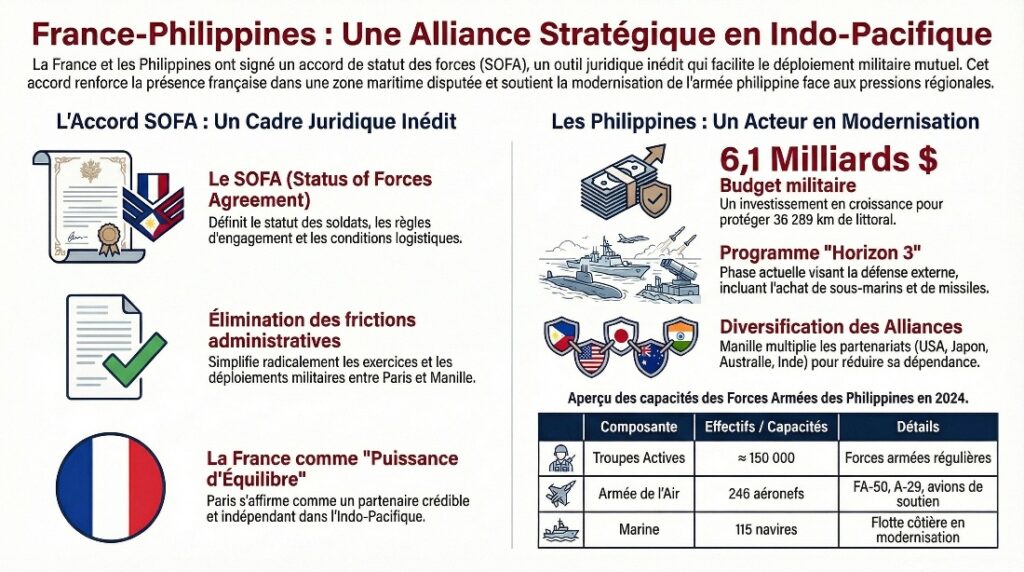
By signing a Statute of Forces Agreement (SOFA) with the Philippines, Paris and Manila are equipping themselves with a legal tool that will allow their armed forces to operate more easily on their respective territories.
Until now, each deployment, each exercise, each military presence required complex negotiations. Now, the framework is in place. The rules are clear.
And in a region where every military movement is scrutinized, this changes a lot of things.
Read also:
A unique Status of Forces Agreement signed between Paris and Manila
The SOFA signed between France and the Philippines concretely structures military cooperation. It defines:
- The legal status of foreign soldiers
- The rules of engagement and responsibility
- The logistical conditions of deployment
In other words, it secures military presence and eliminates administrative frictions.
This type of agreement already exists between the Philippines and other partners, notably the United States. With France, it is a first at this level of integration.
Subtly, this means that Paris is now considered a credible military partner in the region.
Après avoir trahi la France et “promis la Lune” aux Australiens, les Américains décident enfin d’accélérer avec un milliard de dollars débloqué pour AUKUS
A Tense Zone: the South China Sea in the Background
It is impossible to understand this agreement without looking at a map.
The South China Sea is currently one of the most disputed areas in the world. Territorial claims, militarization of islands, naval shows of force… tension is constant.
The Philippines are directly involved and face regular pressure in their exclusive economic zones.
In this context, France is advancing its pieces.
As an Indo-Pacific power thanks to its overseas territories (Reunion Island, New Caledonia, French Polynesia), Paris claims an active role:
- Defense of freedom of navigation
- Respect for international law
- Regional stabilization
This partnership with Manila is therefore part of a larger strategy: to exist militarily in the Indo-Pacific, without being a dominant local power. This is what Paris readily defines as an “balance power”.
The Philippines: a Strategic Archipelago at the Heart of Global Tensions
The Philippines has 114.9 million inhabitants, spread over more than 7,600 islands, allowing it to control a vast maritime space at the heart of Southeast Asia.
With 36,289 kilometers of coastline, the country is directly exposed to tensions in the South China Sea. A zone where vital commercial routes, energy resources, and geopolitical ambitions intersect.
Economically, the Philippines remain an emerging power:
- GDP: $437.1 billion (2023)
- GDP per capita: $3,805
- Military budget: $6.1 billion (2024)
This particular geography imposes a simple strategic reality: control the sea, monitor the sky, and protect a fragmented territory. This is precisely what drives Manila to multiply partnerships, including with France.
An Enhanced Modernization in the Face of Sea Tensions
The country has launched an extensive modernization program over 15 years, structured in three phases. The current phase, Horizon 3, clearly aims at external defense.
Recent acquisitions illustrate this shift:
- Strengthening of the air fleet with the FA-50 and A-29 Super Tucano
- Purchase of BrahMos anti-ship missiles (India)
- Order for new corvettes and patrol ships (South Korea)
- Project to acquire submarines
The army is not left behind, with investments in:
- Modern armored vehicles
- Long-range artillery
But a weakness remains: a strong dependence on foreign suppliers.
In response, Manila is trying to develop a local industry through the SRDP (Self-Reliant Defense Posture) law.
Armed Forces of the Philippines:
| Component | Personnel / capabilities | Details |
| Active troops | ~150,000 | Regular armed forces |
| Reservists | ~131,000 (up to 1.4 million mobilizable) | Strategic reserve |
| Paramilitary | ~80,700 | Internal security and support |
| Air Force | 246 aircraft | FA-50, A-29, support aircraft |
| Navy | 115 ships | Coastal fleet, ongoing modernization |
| Total Forces | ~239,710 personnel | Total combined |
| Defense Budget | ~$6.1 billion | Increasing |
In this context, the agreement with France makes complete sense. It is not just a punctual partnership, but an additional piece in the transformation of an army seeking to shift from an internal logic to a credible regional power posture.
A Strategy of Balance in the Face of Major Powers
This agreement is part of a much larger balancing game, where multiple powers seek to influence the region (especially China).
For the Philippines, the challenge is to build a solid network of alliances:
- United States (historical partner)
- Japan
- Australia
- India
- And now… France
For France, the objective is different but complementary: to exist as a credible actor in the Indo-Pacific.
Sources:
- Opex360, “France and the Philippines strengthen their military cooperation by signing an agreement on the status of forces during a visit” (March 27, 2026)
https://www.opex360.com/2026/03/27/la-france-et-les-philippines-renforcent-leur-cooperation-militaire-en-signant-un-accord-sur-le-statut-des-forces-en-visite/ - Theatrum Belli, “A France-Philippines agreement to reinforce military cooperation in the Indo-Pacific” (2026)
https://theatrum-belli.com/un-accord-france-philippines-pour-renforcer-la-cooperation-militaire-en-indo-pacifique/ - Global Military, Military Forces of the Philippines (accessed in 2026),
https://www.globalmilitary.net/fr/countries/phl/
Summary page presenting the overall military capabilities of the Philippines, including personnel, land, naval, and air equipment, as well as comparative indicators such as global military index and international ranking.
Featured image: A Philippine Navy AgustaWestland AW109 naval helicopter approaching a Tarlac-class landing platform dock during exercises.