The crews of ships from the Quebec maritime carrier Desgagnés are still anchored in the Persian Gulf, at the heart of the crisis unfolding in Iran, but the sailors are in “relative safety” and strategies to address the instability are constantly being analyzed, the shipowner assures, whose headquarters are in Quebec.
In total, around thirty sailors are still stranded on one or the other of the Desgagnés group’s ships, near the Strait of Hormuz, where navigation has been halted for almost three weeks following American and Israeli attacks that resulted in the death of the supreme leader, Ayatollah Ali Khamenei, and then the Iranian retaliation.
Of these, three sailors are students from the Quebec Maritime Institute (IMQ), cadets on a sea internship who are considered “part of the family,” according to Serge Le Guellec, senior advisor to the president of the council and CEO of the Desgagnés group.
“These are difficult situations. The crew stands together. […] We have to think in terms of a family that is on board the ship,” says Le Guellec.
“It’s always necessary to be cautious. Port facilities tend to be located near energy and transportation nerve centers that could be targeted. So, it is preferable in the circumstances […] to be aboard a ship that is far from the coasts. It’s true that it’s a relative safety,” indicates Serge Le Guellec.
“For the moment, it’s preferable for the sailors to be aboard a ship,” the sailor added.
Adapting the Strategy
Serge Le Guellec is aware that the situation is fluid, “very fluid,” he says, and can deteriorate rapidly, requiring flexibility with the strategy, which must not remain static. “We have to stay alert to what is happening,” he adds.
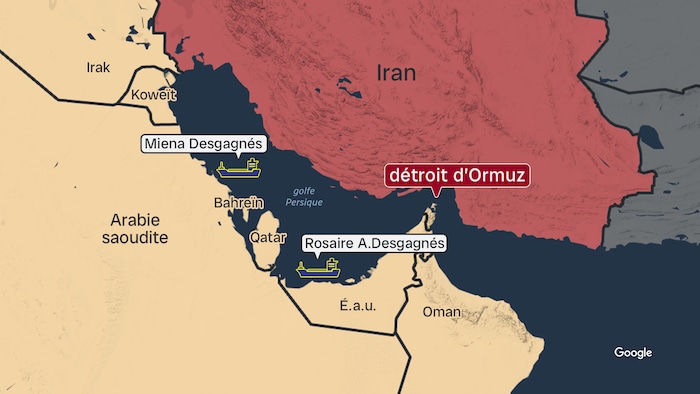
Two ships from the Desgagnés Group are still stranded near the Strait of Hormuz, a crucial route for global hydrocarbon trade.
The possibility of Iran potentially targeting ships anchored near the Strait of Hormuz cannot be ruled out, assures the advisor. “That’s why it is necessary to carefully choose the [anchoring] areas,” states Serge Le Guellec, emphasizing that his sailors are moored on the western side of the Persian Gulf, “a little further from the action, I think.”
The maritime carrier has no choice but to consider an extension of the conflict.
“We thought we would have a conflict that would be resolved quickly. […] We are forced to say, in the third week, that this scenario is out the window. That’s not it at all. And we see very clearly that it is very difficult to agree internationally on what needs to be done to reopen the Strait of Hormuz within a reasonable time frame. And for the sailors, this translates into additional delays,” he admits.
An evacuation of the crew is not “a viable or playable scenario” at this stage, says Serge Le Guellec. “It is possible that, in the long run, we may be more in a logic of evaluating crew rotation potentials, but once again, should this be done in a context where, around the anchoring point, there is a port available, there are airports available for which the airspace has not been closed, so you can see the complexity,” drops Serge Le Guellec.
The Troop’s Morale
Faced with the possibility that the situation may drag on, the sailors are resilient, assures the main advisor of the shipowner, acknowledging that the context is far from ordinary.
“They are used to sailing on all the seas of the world. They have seen worse. But we will also understand that what they are currently experiencing is quite extraordinary,” he points out.
Satellite communication has been compromised at certain times since the conflict flared up, but the situation was of short duration, says Serge Le Guellec. “People are able to talk with their family, with their friends.” In such circumstances, this is crucial, testifies the main advisor.

/2026/04/07/69d545cef2185728972943.jpg "An entire civilization will die on Tuesday evening, Donald Trump threatens before the expiration of his ultimatum counter")