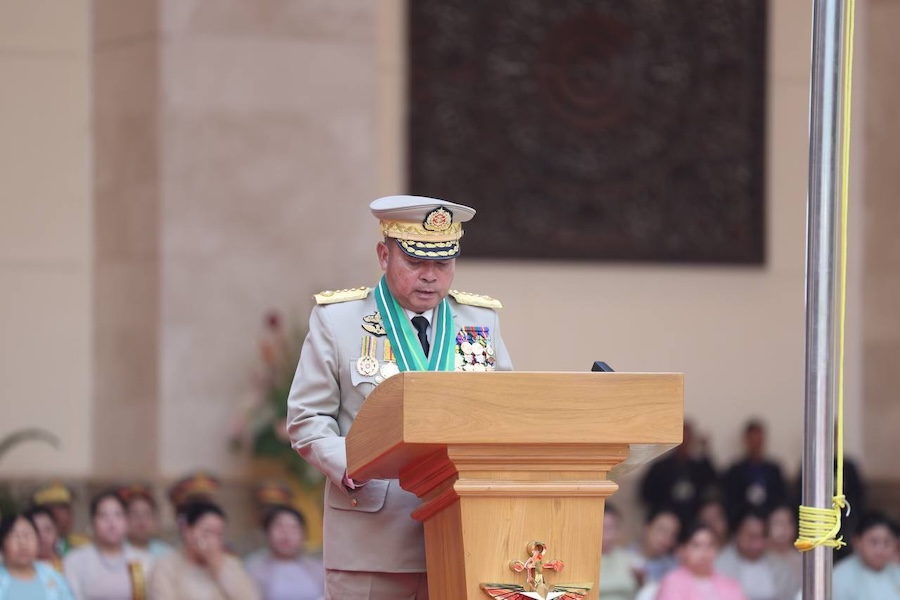
To comply with Article 63 of the 2008 constitution, General Min Aung Hlaing resigned from his military position on March 30 to be elected president of the Republic. His responsibilities as commander-in-chief of the defense forces were handed over to another. The choice, unsurprisingly, fell on his trusted man from months ago: General Zeya Kyaw Htin Sithu Ye Win Oo.
The recently sixty-year-old is the first non-graduate officer from the military academy to reach the highest ranks of the Tatmadaw.
This infantry soldier graduated from the Officer Training School (OTS-77), a less prestigious institution than the Defense Services Academy (DSA), whose alumni have held all the important positions in the armed forces for decades. He is also the first director of military intelligence (OCMSA: 2020–2026) to become the number one in the military hierarchy. These two unique features belong to a leader with little battlefield experience but more in the administrative system. This situation has led him to be somewhat less respected by his peers within the military institution.
His rise to the highest echelons of power accelerated following his promotion to the rank of army general on August 1, 2024. In 2025, he became the deputy director-general of the National Defense and Security Council (NDSC). In early March 2026, he took another step by assuming the responsibilities of Chief of the General Staff, a position that allows him to have influence over the three armed forces (land, air, sea). Like his previous promotions, this one is attributed to his over ten-year relationship with General Min Aung Hlaing and his family. Their respective wives are reputed to appreciate each other.
In fact, the trust between the two senior officers has been strengthening since the time Ye Win Oo was a colonel at the regional command headquarters in Rangoon. This continuous loyalty has helped him establish a presence in all key political-military institutions of the regime established by force in February 2021: as Deputy Secretary of the State Administration Council (SAC) and later as Secretary of the State Administration Council for Security and Peace (SSPC).
In these positions, he frequently accompanied the commander-in-chief on international trips and national inspection tours. His position within the state apparatus is also linked to his marital relationship with the sixty-year-old General Maung Maug Aye, the Defense Minister of the junta since December 2024. Nevertheless, in recent years, General Ye Win Oo was not necessarily seen as the most likely successor to General Min Aung Hlaing.
It is a twist of fate that has now bestowed General Ye Win Oo with his baton of command
Three other soldiers had long been in a better position than him to reach the highest functions of the army.
Even in recent days, some observers mentioned the name of General Soe Win as a possible successor. Was he not the number 2 in the army for fifteen years and also part of the junta since day one of the coup? At a certain point, he also served as vice prime minister, making the 65-year-old man a potential candidate. He is a skilled soldier and highly regarded in ultranationalist circles. In 2024, amid territorial advances by guerrillas, protesters demanded in the streets for him to immediately replace the number one of the Tatmadaw, who was accused of mishandling the insurgents.
His popularity within the armed forces’ leadership posed a risk to General Min Aung Hlaing, even though General Soe Win had never faltered in loyalty towards his superior. Nevertheless, his influence in the security and defense apparatus might now hinder his chance for further military promotion. Worse, in recent days, he had to relinquish his positions as Deputy Commander-in-Chief and Chief of the General Staff. These roles were assigned to General Kyaw Swar Lin, who is ten years his junior (55 years old). Furthermore, he was not designated as the military candidate for the vice presidency. The soldier-parliamentarians instead proposed the name of the head of government since July 31, 2025, General (cr) Nyo Saw, who was recently elected to the lower house.
The future of General Soe Win still remains uncertain. However, many believe that he could soon be associated with the Union Consultative Council (UCC), whose members will be chosen by General Min Aung Hlaing. But his retirement, at the same time as his commander, seems more like a removal from the inner circle of decision-makers.
General Ye Win Oo and the future of the army
General Ye Win Oo seems likely to remain at the helm of the army for a shorter period compared to his two predecessors, General Min Aung Hlaing (15 years) and Than Shwe (18 years and 11 months).
He might only serve for the upcoming five-year legislature. This short term may not be enough to solidify enduring power and transition to even more prominent political roles. This constrained military mandate offers President Min Aung Hlaing the opportunity to effectively remain the army leader, a position he has held for 52 years. A civilian president whose appointment of his army successor lacks full constitutional guarantees. This raises concerns about the rule of law by the one expected to uphold it.
Article 342 of the 2008 constitution states that “the president appoints the commander-in-chief of the defense forces upon proposal and with the approval of the National Defense and Security Council,” yet there has been no public mention of an NDSC meeting. Another worrying sign for Burma’s future is that the new army chief is none other than the one who, along with Lieutenant General Moe Myint Tun, led the arrest raids in Nay Pyi Taw on February 1, 2021, against the residences of the President of the Republic U Win Myint and the State Counselor Daw Aung San Suu Kyi, both now detained for over five years.
François Guilbert
Every week, receive our newsletter Gavroche Hebdo. Sign up by clicking here