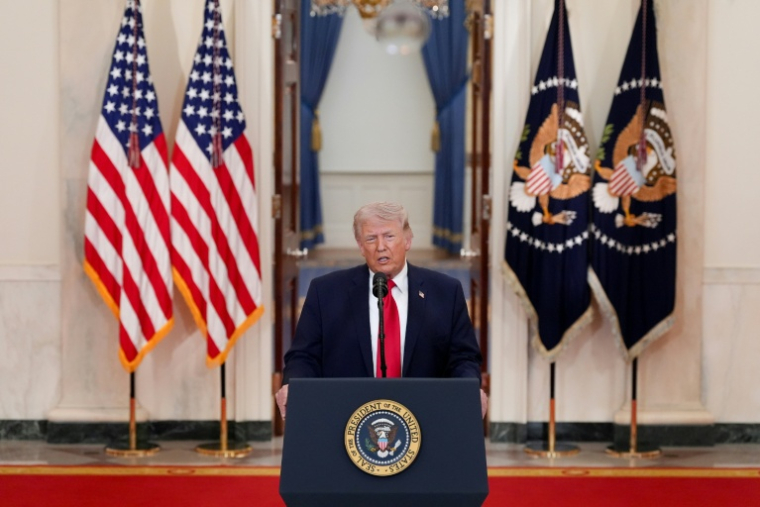
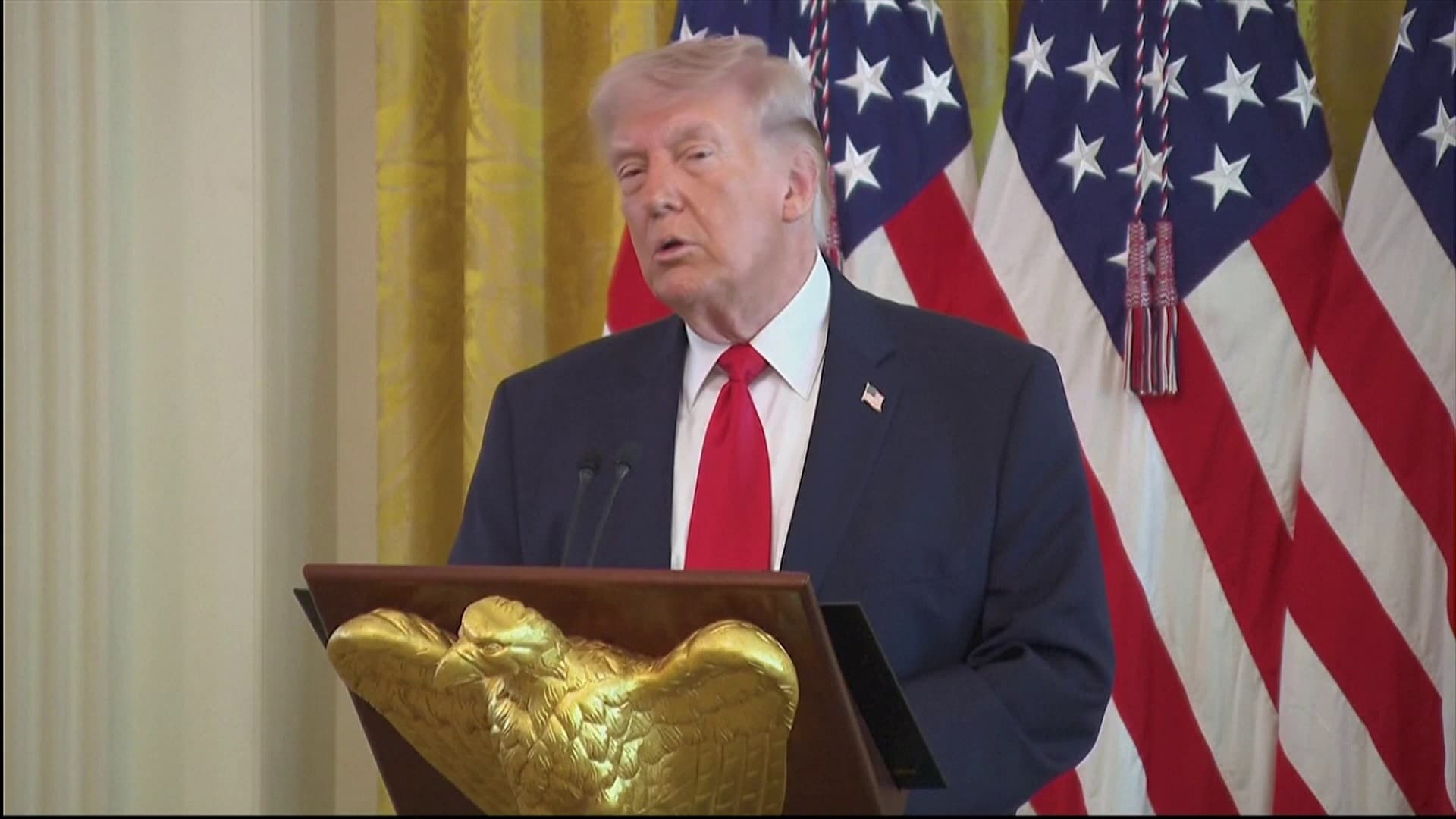
In a national address, President Donald Trump declared on Wednesday that the United States was “close to achieving” their goals in the war against Iran, stating that they would continue to strike the country “extremely hard” for another two to three weeks.
During his first speech to the nation since the conflict began over a month ago, the American president praised the “decisive” and “crushing” victories achieved by the United States, reiterating that the strikes were necessary to prevent Iran from obtaining nuclear weapons.
Despite this, Trump emphasized that the end of the conflict was not yet in sight.
“We are going to hit them extremely hard over the next two to three weeks. We will bring them back to the Stone Age where they belong,” he declared.
Trump also threatened to target Iranian energy infrastructure again, stating that without an agreement, the United States would “hit each of their power plants very hard and probably simultaneously.”
The American president also called on countries dependent on the Strait of Hormuz to “deal with” and resolve the blockade by Iran of this strategic maritime route for the distribution of hydrocarbons worldwide.
– “Maximalist demands” –
Earlier that morning, Trump had ruled out any ceasefire without the reopening of the strait, the blocking of which destabilizes the global economy. He warned that without the lifting of the blockade, Iran would be bombed “until annihilation.”
The near-closure of this maritime passage has caused a surge in oil prices, fueling fears of lasting inflation.
The Revolutionary Guards, the ideological army of Iran, reiterated on Wednesday that the strait would remain closed to the country’s “enemies.”
In light of this, London announced a virtual meeting involving about thirty countries on Thursday to ensure security in the strait once hostilities have ceased.
Before his address, Trump claimed on his Truth Social network that his Iranian counterpart, Massoud Pezeshkian, had called for a ceasefire.
These claims were dismissed as “false” by the Iranian foreign ministry spokesman, Esma’il Baghaei, who also denied direct negotiations with the United States and described Washington’s demands as “maximalist and irrational.”
Massoud Pezeshkian had mentioned on Tuesday a desire to “end” the war, but listed requirements such as security guarantees and financial compensation.
– Brent rises again –
Encouraged by hopes of de-escalation, European stock exchanges and Wall Street closed higher on Wednesday before Trump’s speech.
However, following the address, the price of Brent crude oil — the global benchmark — rose again, surpassing $105.
The economic repercussions of the conflict continue to be felt worldwide.
In an interview with AFP, World Bank Managing Director Paschal Donohoe expressed deep concern on Wednesday about the consequences of the war, specifically “on inflation, jobs, and food security.”
On Wednesday, Gulf countries were once again targeted by Iranian attacks, including in the United Arab Emirates, where a Bangladeshi was killed.
As in Israel, where the army reported missile fire from Iran into Tel Aviv overnight, following a day marked by other shelling that left 14 injured near the city.
In his speech, Trump promised not to abandon these Gulf allies, specifically naming “Israel, Saudi Arabia, Qatar, the United Arab Emirates, Kuwait, and Bahrain.”
– “Vengeance” –
Israel also continued its airstrikes, carrying out a “wave of large-scale strikes” on Tehran.
Powerful explosions were heard in the western part of the city on Wednesday afternoon, according to an AFP journalist.
Despite the strikes, thousands of Iranians attended the funeral of a commander killed by an Israeli strike in the capital. A sign held by a child declared “Vengeance” in English.
In Israeli circles, while the government believed that some of its objectives had been achieved by dealing a blow to Iranian nuclear and ballistic programs, Prime Minister Benjamin Netanyahu emphasized that the “campaign is not over.”
In Lebanon, the toll of Israeli airstrikes over a month now stands at over 1,300 deaths, with the government reporting seven deaths in the Beirut region on Wednesday.
The pro-Iranian Hezbollah movement dragged Lebanon into the war on March 2 by attacking Israel to avenge the death of Iranian Supreme Leader Ali Khamenei, starting on the first day of the conflict on February 28.
Israel has warned that it plans to occupy part of southern Lebanon once the war is over.