The energy shock caused by the war in the Middle East will “slow down” the recovery of the German economy, whose momentum will depend on additional public investments, warned on Wednesday the main German economic institutes.
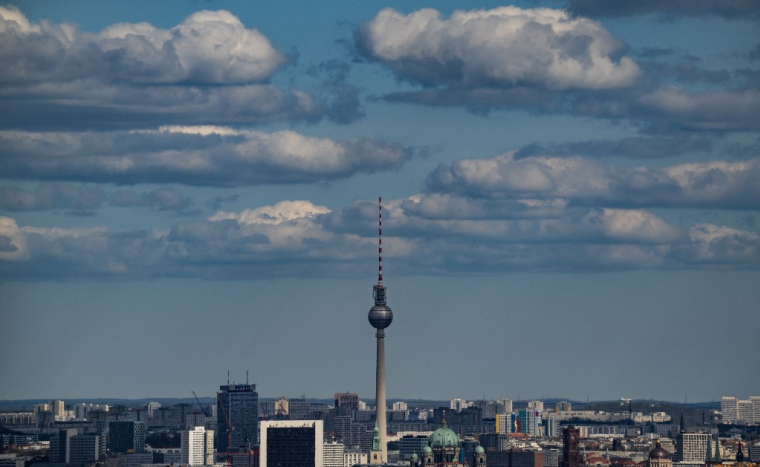
Aerial view of Berlin, in April 2025 (illustration) (AFP / JOHN MACDOUGALL)
According to these institutes, the German Gross Domestic Product (GDP) will increase by 0.6% in 2026 and 0.9% in 2027, respectively a decrease of 0.6 and 0.5 percentage points compared to the autumn forecast.
“The energy price shock will slow down the recovery in Germany, but should not completely interrupt it,” said Timo Wollmershäuser from the Munich-based ifo institute during a press conference.
They also warned against a hasty government response, such as a general fuel price reduction: this would lead to “higher costs” and “distort prices,” according to Geraldine Dany-Knedlik from the DIW institute, who favors targeted income-linked assistance.
The closure of the Strait of Hormuz, a passage for 20% of global oil supply, and attacks on critical energy infrastructure in the region are responsible for half of the growth decline in Germany, according to the report that anticipates a summer easing of the conflict.
The estimated impact of the war is currently less than the Covid-19 pandemic or after the Russian invasion of Ukraine, but a prolonged blockade of the strait “will have much more significant consequences,” added Mr. Wollmershäuser.
Driven by energy prices, inflation is expected to rise to 2.8% this year and 2.9% next year, “weighing on household purchasing power.”
An assumption based on a rise in interest rates by the European Central Bank, by 0.75 percentage points by 2027, to control inflation, according to the report.
– Billions of Investments –
The energy shock hits a country where the “industrial momentum is weaker,” after the timid awakening observed at the end of last year.
The German economy faces several shocks that shake its prosperity model, between higher energy costs, exports hindered by tariffs, and heightened Chinese competition.
Therefore, the institutes recommend deregulating as much as possible to “improve investment and innovation conditions” as well as “increase incentives for employment.”
Growth in 2026 and especially in 2027 will receive “essential support” from the “expansive fiscal policy,” made up of hundreds of billions of euros in infrastructure and defense investments adopted last year, Mr. Wollmershäuser added.
The government, which still hopes for a 1% growth this year, will release its own growth projection after the Easter break.
On Wednesday, the institutes already painted a bleak picture for the future of growth in the leading European economy, also “strongly hit” by demographic change.
“We will have to get used to average GDP growth rates of 0%,” said Timo Wollmershäuser, emphasizing that this is an “optimistic” assumption.