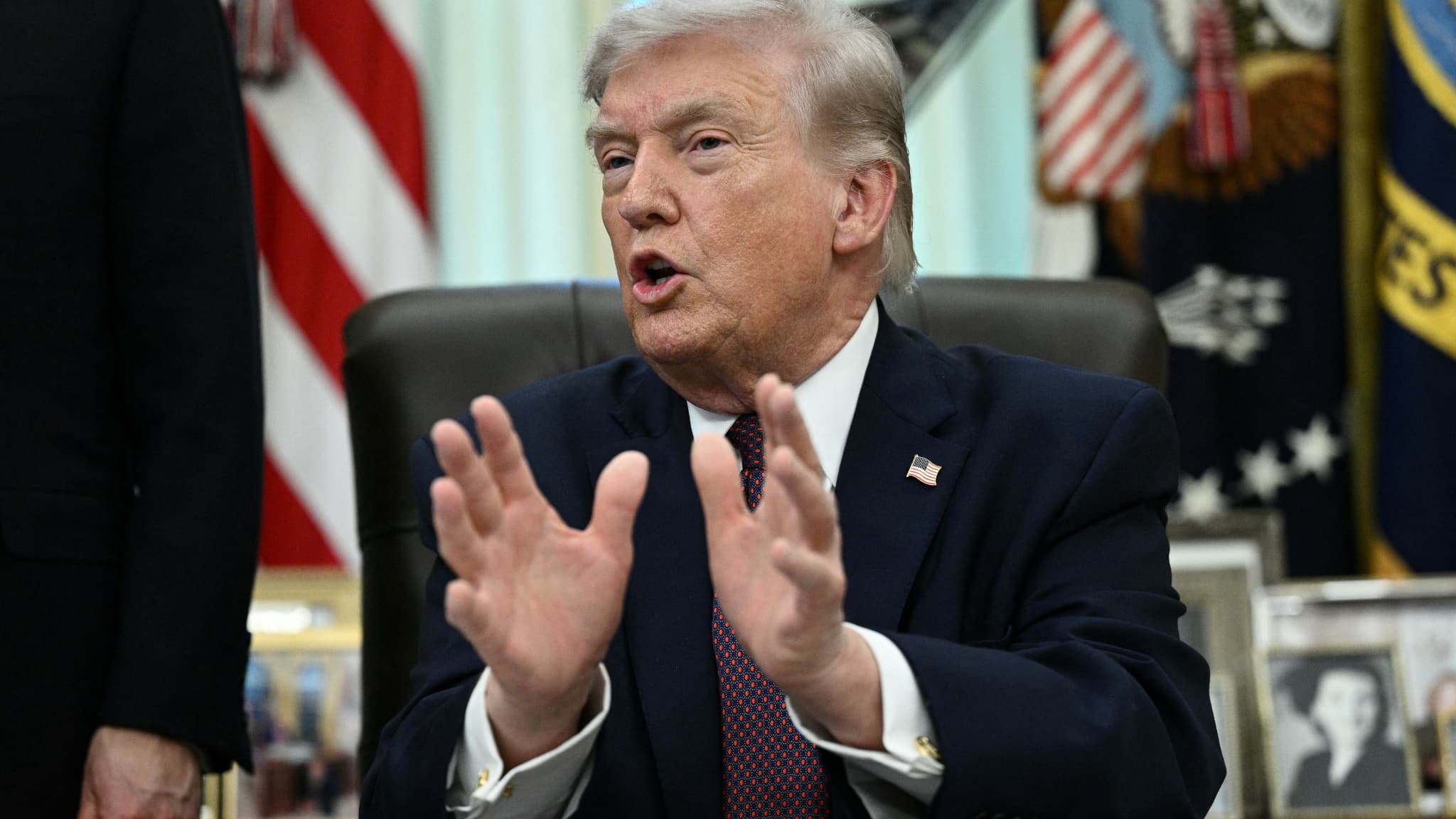
Donald Trump must appreciate the – sad – power of his words. Tuesday, the American president stated that the United States would leave Iran “very soon,” in “two or three weeks,” regardless of whether an agreement is reached or not. In summary, the Strait of Hormuz, blocked by the Islamic Republic, is no longer his problem, according to him.
The billionaire, at the head of the world’s leading military and economic power, is accustomed to blowing hot and cold over very short cycles, and his decisions and positions wash over financial markets, which fluctuate according to his announcements. Fortunately for the stock exchanges, his latest remarks seem to give them a breather.
Asian stock exchanges are on the rise
Wednesday morning, the East Asian stock markets were the first to react, due to time zones. At 4:50 AM French time, the Tokyo flagship index, the Nikkei, rose by 4.04% to 53,128 points, while in Seoul, the Kospi jumped by 6.62% to nearly 5,387 points.
The same in China, where the Shanghai Stock Exchange composite index rose by 1.42% and the Shenzhen index gained 1.24%. In Hong Kong, the Hang Seng index progressed by 1.81%, and the Taipei Taiex also showed an increase of 4.17%.
“Given that information suggesting a ceasefire has been communicated by both the United States and Iran, the Japanese market should progress,” Tokai Tokyo Securities predicted before the session opened.
The market wants to believe that Donald Trump is determined to end the war
This morning’s good health of the Korean stock exchanges is explained in particular by the pressure exerted by the conflict in the Middle East on oil prices and, more generally, on energy.
Equally attentive, European stock markets also looked favorably upon Donald Trump’s latest reversal. In Frankfurt, the DAX rose by 2.64% around 9:30 AM. In Paris, the CAC 40 was not left behind (+2.26%) nor in Milan (+2.77%). London, more sensitive to oil majors, progressed more quietly (+1.72%), against a slight drop in the price of a barrel.
“The market wants to believe that Donald Trump is determined to end the war in Iran within two to three weeks as he indicated,” according to analysts at Natixis.
The statements of the Iranian president reassure
Above all, Iranian President Massoud Pezeshkian demanded “the necessary guarantees to prevent the repetition of aggression.” “This is the first concrete statement from Iran that seems reliable,” says Art Hogan of B. Riley Wealth Management.
“The key remains the lasting opening of the Strait of Hormuz, as well as the vulnerability of the energy infrastructure in the region, including beyond oil and gas,” add Natixis analysts.
The wave of optimism then spread to the markets across the Atlantic, where the New York Stock Exchange had already ended sharply higher on Tuesday: the Dow Jones gained 2.49%, the Nasdaq soared by 3.83%, and the broader S&P 500 index gained 2.91%.
Oil and government debt also react
Donald Trump’s remarks not only affected the stock markets but also calmed the oil markets. The global benchmark crude, the North Sea Brent, dropped below $100 per barrel for the first time in several weeks ($99.14, -4.65%) on the first day of new June delivery contracts. Its American counterpart, WTI, also fell to $97.25 per barrel (-4.07%).
“Crude oil prices remain high and uncertainty persists regarding a possible escalation in the Middle East,” remarks Andreas Lipkow at CMC Markets.
“Energy sector disruptions could continue for several months and are likely to weigh on both inflation and economic growth,” notes Emma Wall, chief investment strategist for Hargreaves Lansdown.
The easing was also felt in the government debt market, weighed down by inflation risks that concern investors.
The ten-year bond yield for Germany fell below 3% for the first time in several days (2.94%). Its French equivalent showed a yield of 3.62% over ten years, compared to 3.72% the day before.
Find all the news here on the Middle East conflict.