ESTA: A More Clearly Defined Photo Journey
Since April 1, the official ESTA portal no longer treats the step of taking a photo as a mere formality.
A first window now opens to guide the submission of the applicant’s selfie, with specific instructions: clear and plain background, no shadows or patterns, direct facing, neutral expression, eyes open, original image distinct from passport photo.
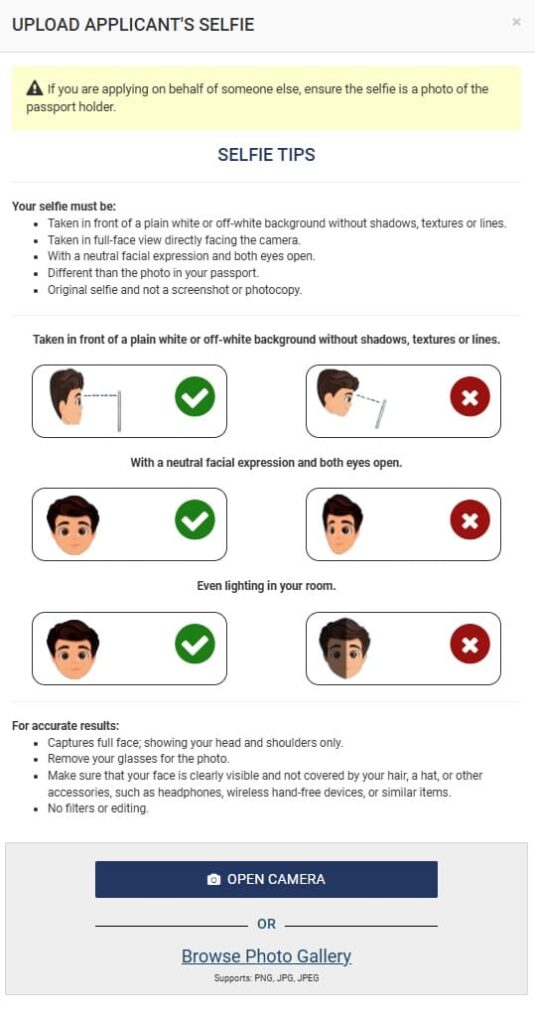
This initial screen now serves as a filter.
It immediately places the applicant in a technical compliance logic, reminding that the expected photo should be usable by the system. The selfie is no longer just a visual aid: it has become an integral control element, prepared and supervised from the beginning of the process.
A Second Correction Step When the Photo Doesn’t Pass
If the uploaded image does not meet the requirements, a second window takes over. This time, the portal goes beyond general reminders and moves into a correction and cropping logic, indicating if the face was not properly detected or the photo is non-compliant.
The content of this second step is more detailed and practical.
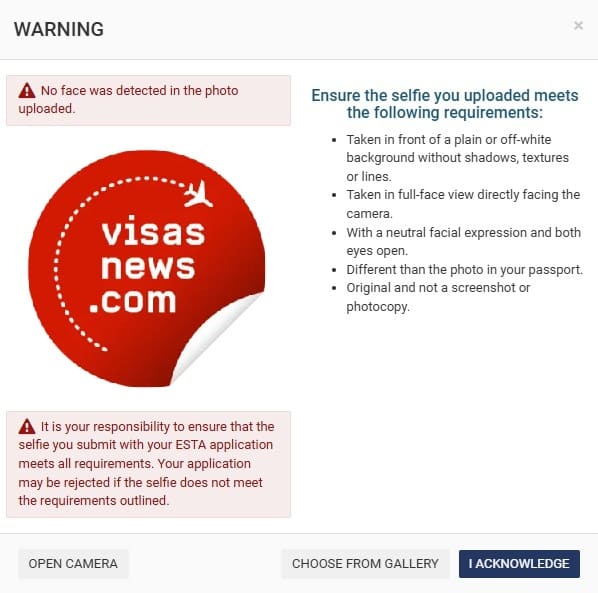
Clear instructions include showing the entire face with only head and shoulders, removing glasses, avoiding accessories that obscure features, opting for uniform lighting, and refraining from filters or edits.
The applicant is then prompted to either retake a photo or select another one. In other words, the portal no longer solely accepts or rejects an image: it actively guides the user towards a usable selfie.
The portal also states that it is the applicant’s responsibility to verify the conformity of the submitted selfie, warning that a file may be rejected if the image does not meet the specified criteria. In practice, this means a request may still be submitted with a technically imperfect photo, and it will later either be accepted or rejected during review.
A Very Concrete Adjustment in Line with Previously Announced Logic
This tightening did not come out of nowhere.
In a December 2025 notice published in the Federal Register, the U.S. Customs and Border Protection (CBP) explained its intention to require, on the ESTA site and third-party deposits, a photo of the applicant’s face in addition to the passport biographical page image, to better verify the authorization requester’s legitimacy.
While a selfie was previously required on the ESTA site, its processing seemed more lenient and less detailed in technical requirements. The text also specified that this evolution was meant to align the web requirements with those of the mobile application, where selfie capture is integrated into the process.
The federal document also mentioned reasons for this adjustment. The CBP cited poor image quality uploads, facial comparison failures, and technical weaknesses exploited by fraudsters.
The U.S. administration highlights the superior robustness of the mobile application, enabling direct face capture, vivacity detection, NFC reading of the ePassport chip, and more thorough biometric checks. In light of these elements, the tightening on selfies appears as a very coherent operational adaptation, even before a potential broader reform.
An Apparently Modest Evolution but Far from Insignificant
Travelers are not yet facing all the changes planned over the past months regarding ESTA.
In February, the U.S. Embassy in France reiterated that the planned requirement to provide social media IDs had not taken effect and current procedures remained in place. According to the speculated timeline, any new requirements could only be implemented by mid-2026 at the earliest. However, the photo adjustments indicate a part of the future logic is gradually materializing within the interface itself.
This evolution is limited in immediate scope but revealing in essence.
While it has not yet disrupted ESTA formalities, it confirms a trend towards stricter and more visual, technical, and potentially biometric identity verification processes. This perspective raises concerns in the realm of international tourism, from Hawaii to European data protection entities.
As the 2026 World Cup Approaches, a Detail That Matters for Travelers
Initially, the appearance of these new windows may seem trivial. However, for travelers preparing for a visit to the U.S. in the coming months, this very concrete adjustment can make a difference when submitting an application.
And this point will become increasingly important as the 2026 FIFA World Cup, hosted by the U.S., Canada, and Mexico, with massive influxes of fans expected across North America, draws near.
In this context, the applicant’s photo now deserves much closer attention than before. The change is subtle, but the message is clear: on the ESTA portal, selfie identification is no longer a mere technical step. It has become a critical point in the application process.