Par Ãlvaro Sanabria Duque
On May 31, some 41 million Colombians were called to the polls to elect the successor to Gustavo Petro – president in office since August 7, 2022 – who, in accordance with the Constitution, could not run for a second term. These elections had for some time been considered as a referendum on the continuation of his political project, “based on a strengthening of social investments and dialogue with armed groups”. According to New Society in June, “many media outlets highlighted that his popularity was ‘exceptionally high’ for the end of his mandate, approaching 50% according to certain polls, despite various setbacks suffered during his mandate.” However, the first round of the presidential elections resulted in the unexpected first place of Abelardo de la Espriella, a outsiderfar-right who won with 43.7% of the vote, ahead of Iván Cepeda, representative of the ruling coalition, who obtained 40.9%. Conservative senator Paloma Valencia, candidate from the camp of former president Alvaro Uribe – president from 2002 to 2010 – found herself far behind these two candidates and below her own expectations, obtaining only 6.9% of the vote. The participation rate rose to 57.88%, the highest ever recorded during a first presidential round in the recent history of the country. in lvaro Sanabria Duque, in From Below of June 16, 2026, resituates the overall issue of this second electoral round which will end on June 21. – Ed. Against
***
The US government’s explicit support for the obscure, questionable and pathetic far-right candidate, Abelardo de la Espriella, has sparked reactions of all kinds, from complaints about “foreign interference in the democratic process” to protests of incomprehension regarding the attitude of this United States government which claims to fight against illicit drugs while supporting the character in question, who has been linked to confessed drug traffickers such as Salvatore Mancuso, Úber Enrique Bánquez MartÃnez (aka Juancho Dique) and Jorge Luis Hernández Villazón (aka Boliche), to name only the best known. This last type of reaction ignores or passes over in silence the fact that the so-called war on drugs had among its main objectives to criminalize the practices of so-called “alternative culture” groups, to add to the arsenal of intervention tools a very effective instrument of deinstitutionalization, in countries producing and distributing narcotics and, perhaps more importantly, to have of a clandestine source of resources for the financing of the United States institutions responsible for eliminating “communism”. In other words, “fighting” against drugs cannot be dissociated from using the workings of this market for political purposes.
The emblematic case of this last point remains the famous Iran-Contra scandal [dans les années 1980]in which two apparently unrelated facts intersected: 1° the financing by the CIA of a far-right Nicaraguan armed group known as “La Contra”, which fought against the first phase of the Sandinista government, which came to power after the military victory, in July 1979, of the guerrilla warfare inspired by the Cuban revolution, and 2° the sale of arms to the Republic of Iran. Both the financing of “La Contra” – which, due to its acts of terrorism against the civilian population, had been reduced by the American Congress – and the sale of arms to Iran, which was prohibited, were the subject of a financial arrangement in which drug money played the role lubricant and communicating vessel. It was in fact used to purchase weapons clandestinely, while the profits from this trade were ultimately diverted for the benefit of “La Contra”.
Journalist Gary Webb denounced this network in the newspaper Mercury News of San Jose, California, through a series of articles which he then collected into a book entitled Dark Alliance (Seven Stories Press, 1998), initially criticized, but later rehabilitated, when the truth of the facts could be established. The journalist was found “suicided” with two bullets in the head in 2004. Declassified archives, revealed some time later, made it possible to verify that the Medellán cartel (Pablo Escobar and Rodríguez Gacha) and the cartel of Guadalajara (Rafael Caro Quintero and Miguel à ngel Felix Gallardo) permanently financed the Contra with the agreement of the CIA and the DEA (Drug Enforcement Administration).
***
This is why it is surprising the astonishment shown by experienced politicians such as Gustavo Petro, President of Colombia, at the alleged contradiction represented by the fact that, on the one hand, Donald Trump presents himself in his speeches as an implacable fighter against drugs, while, on the other, he supports De La Espriella, who maintained constant contact, and not only as a defense lawyer, with a motley group of mafia figures. And what’s even more surprising is that the president of the Colombians says: “Even though President Trump and I do not always agree on every issue, I am proud to work with him in our common effort to eradicate drug trafficking and bring peace, health and security to our country. The results we have achieved so far are just the beginning; “Through continued collaboration between the United States and Colombia, we can make the Americas great again.” Naivety or diplomacy?
Can we really believe that bombing small boats makes it possible to fight against drug trafficking? Or the act of pardoning a drug trafficker, condemned by the American justice system itself, as was the case of the former Honduran president Juan Orlando Hernández [de janvier 2014 à janvier 2022]does it constitute proof of the desire to “make the Americas great again”? If we examine the last actions of this character and add the names of Alex Saab [homme d'affaires à la double nationalité vénézuélienne et colombienne, mentionné dans les Panama et Pandora Papers, considéré comme une «des banquiers de Maduro», ministre de l'Industrie et de la Production nationale du Vénézuéla en octobre 2024 et démis de ses fonctions le 16 janvier 2026] and Abelardo de la Espriella, we can find points of convergence which show that the objective is not to restore the greatness of “Nuestra America” – Gustavo Petro’s project of a progressive Latin American regional integration – but on the contrary to dismantle it.
The Red Newspaper, Spanish media of the Podemos movement, published the recordings of conversations between Juan Orlando Hernández and the current Honduran president Nasry “Tito” Asfura [en fonction depuis janvier 2026, avec le soutien de Donald Trump, accusé précédemment de détournement de fonds]in which Hernández demanded that Asfura provide him with $150,000 to launch a digital media whose mission would be to attack “progressive” governments in the region, such as those of Mexico, Brazil and Colombia. Likewise, Hernández indicated to Asfura that Argentine President Javier Milei was offering $350,000 for the same purpose.
***
The Colombian far-right candidate indicated that his economic program was identical to that developed by Milei in Argentina. A policy of Milei which, examined closely, clearly sought to dismantle what little social regulation remained, eliminate redistribution mechanisms and attack industrial production, in a clear attack on the viability of the country. Were thus abolished, among others: the ministries of Infrastructure; Women, Gender and Diversity; Education; Labor; of Environment and Sciences; the office for coordination and strengthening of the social and popular economy; the climate change adaptation coordination service and the Directorate of Policies for the Promotion and Protection of Rights. Between 2023 and 2025, the country experienced an industrial collapse – the results of which were only surpassed by the poor performance of Hungary (where Viktor Orbán, another leading figure of right-wing populism, reigned) – employment fell by 6.1% (72,731 jobs lost) and the number of employees decreased by 241,368 people. The textile, leather and footwear sectors fell by 18.4%; metallurgy fell by 8% and the automobile industry by 7.8%. Of the 2,692 public projects inherited from previous governments, 2,284 were not completed within the allotted time and around 1,500 saw no progress. The underfinancing of universities, emblematic hospitals such as the Garrahan in Buenos Aires – specializing in early childhood and adolescence -, as well as the suppression of a large part of cultural institutions and the reduction, in real terms, of salaries and pensions, leave no doubt that the objective sought is a deliberate process of dismantling the nation.
Geopolitics and absolutism
What explains the popularity and election of grotesque figures such as Milei, Trump and de la Espriella, beyond the weariness of societies that see no improvement in their situation under governments of apparently different orientation? There is no doubt that much of the media success of these characters is due to their extreme simplification of the causes of the problems (not counting media manipulation and hopes placed in eccentricity): Trump promises to return the United States to the splendor of the mid-20th century, by imposing customs duties and expelling the immigrant population to whom he blames all the ills, while Milei affirms, without blushing, that if he eliminates the budget deficit, he will make his country the first world power. De la Espriella promises, just as much as the Argentinian, as a saving measure for the country, to reduce the number of public sector employees by 750,000 so-called “protected” jobs, sometimes even relying on the logic of “progressive” economists who estimate that these measures will lift the country out of poverty, because these Expenditures, deemed unproductive, will be redirected towards investment, without specifying the relative importance of these amounts in relation to GDP, nor in what form and in what area these productive expenditures would be incurred. This simplification of reality allows them to lull a population prey to uncertainty, by putting forward the argument that radical solutions mature slowly and that daily sacrifice is the price to pay to later enjoy a distant paradise. The Christian promise of the afterlife transposed into politics.
***
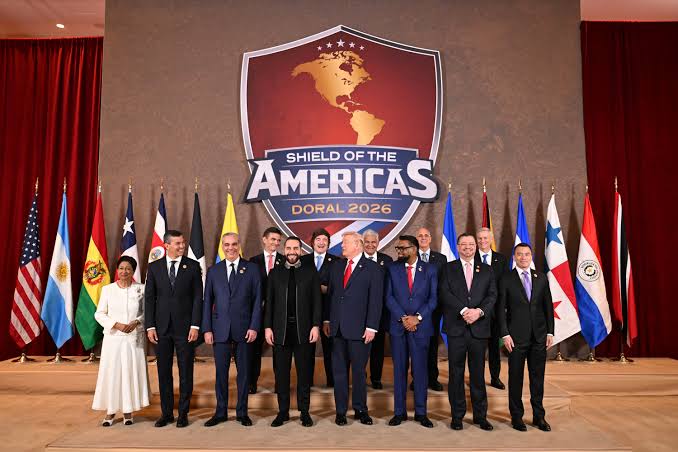
The presence in South America of leaders such as Milei, José Antonio Kast in Chile [en fonction depuis le 11 mars 2026]Rodrigo Paz in Bolivia [depuis novembre 2025]Daniel Noboa in Équateur [depuis novembre 2023]James Rock in Paraguay [depuis août 2023]even the Uruguayan Yamandú Orsi [depuis mars 2025] – member of the progressive party Frente Amplio –, as well as the absolute tutelage exercised by Trump over Venezuela, as well as the unconditional support given to candidates such as Flavio Bolsonaro in Brazil and Keiko Fujimori in Peru, are not matters independent of the declaration of the American secretary to Defense [Pete Hegseth] according to which no government on the continent will be permitted unless it professes “American principles” (white supremacy, tradition, heterosexual monogamous family and highly concentrated private property). The grouping of these personalities under American leadership, called “Shield of the Americas”, therefore constitutes the formalization of the instrument aimed at “argentinizing” completely Latin America, that is to say, implementing complete demolitions and controlled countries. The demand, under the threat of arms, to profess “American principles” is nothing other than the desire to reconquer the “backyard” which has seen the Chinese presence oust the Northern Empire from its position as the main market. Today, the Asian giant is the main trading partner of the South American countries. We must not forget that geopolitics is an increasingly determining factor, although it is not the only one, among the internal conditions, because, for the first time, the empire sees its predominance threatened and does not want to leave any room for the slightest threat, even less if it. comes from the East.
On Saturday, May 24, 2025, during the graduation speech to cadets at the West Point Military Academy, Donald Trump declared: “The mission of the United States Armed Forces is not to put on drag queen shows, transform foreign cultures or expand the democracy to the whole world under gunpoint. The role of the military is to dominate any enemy and annihilate any threat to the United States, at any time and in any place.” He was therefore saying nothing new, if we remember that the former NATO commander, General Wesley Clark, said that after the September 11 attacks In 2001, a Pentagon official showed him a memo listing seven countries that were to be transformed into failed states: Iraq, Syria, Lebanon, Libya, Somalia, Sudan and Iran. The result of interventions in these countries clearly illustrates what the military campaigns, but also the “libertarian” governments that came to power through elections, were aiming for: politically unstructured societies, high unemployment and informal economy rates, poor infrastructure destroyed and high debt levels are the outcome of the new policies of the dominant center of capital. This is not about conspiracy theories: the dream of bringing capitalist modernity to the peripheries is an ideal of the past. What matters now is the degree of submission, and failed states constitute the most conducive structure to this end.
***
The personalities responsible for carrying out this task are not the result of chance or spontaneity. They are chosen and put forward with all the trappings of media techniques specific to the era of politics-spectacle. In the case of Abelardo de la Espriella, his election should not come as a surprise, and this is where the two other names mentioned above come into play: Alex Saab and alias Boliche. Saab, as we know, is a Colombian businessman who was part of the Venezuelan government and who is accused by the United States of money laundering. He was recently extradited to the United States with the obvious aim of having him testify in the trial against Venezuelan President Nicolás Maduro, the victim of a kidnapping. At the same time, the United States government is trying to find out who participated with Saab in money laundering. Alias Boliche, drug trafficker and paramilitary close to Vicente Castaño [narcotrafiquant connu]ended up collaborating with the DEA and FBI, and is currently on trial in Tampa, Florida, for defrauding and extorting other drug traffickers from whom he promised preferential treatment with the United States authorities – promises that had no basis – and then for laundering the dollars harvested through these illicit activities. These two characters are not simple clients, but friends and, it seems, “informal” associates of Abelardo de la Espriella in matters that go well beyond his professional activities as a lawyer.
If we add to this the oath taken by De la Espriella upon acquiring American citizenship: “I hereby declare, under oath, that I absolutely and completely renounce and abjure all loyalty and fidelity to any prince, potentate, State or foreign sovereignty, of which I have until now been a subject or citizen (…)”, we note that this is an individual who has no room for maneuver to oppose any request from his adopted homeland, however shocking it may be. The declarations of Sabb and Boliche, or even a charge of treason – punishable by the death penalty – arising from the aforementioned oath, place the individual under the permanent threat of finding himself behind the bars of an imperial prison. Can we imagine someone more capable of accomplishing the missions entrusted to him?
The pardon granted to the former Honduran president Juan Orlando Hernández, convicted of drug trafficking, was requested by Roger Stone [conseiller politique depuis longtemps de Donald Trump] and supported by Silicon Valley tycoons Peter Thiel (Palantir) and Marc Andreessen (Meta), due to the three men’s investments in Employment and Economic Development Zones (ZEDE), territories whose laws, taxation and regulatory frameworks are set by their owners and which Hernández promoted without taking into account the considerations of national sovereignty. Andreessen and Thiel founded the “start-up” city Próspera on the island of Roatan, a space completely independent of Honduras, which uses bitcoin as currency and where an experimental clinic has been installed seeking to develop new drugs and new practices medical without any regulation. The resurrected dream of Nazi doctor Josef Mengele. And it’s not limited to Honduras: Peter Thiel is already wandering around Argentina as if it were a colonized territory, acquiring properties and looking to set up his data centers in Antarctica to take advantage of natural cooling.
***
The media recently highlighted that the personal fortune of Elon Musk – friend and political and ideological partner of Thiel – has exceeded a billion dollars and that several of his multimillionaire acolytes will do the same shortly. Can we believe that those who concentrate such exorbitant economic power argue in favor of maintaining a system such as liberal democracy? Is this also viable in these new conditions? The current representatives of the economic powers at the head of the presidencies govern through the famous presidential decrees. Parliaments are just puppets acting in exchange for benefits. As for judges, they in turn depend on the executive and legislative powers that they are supposed to control. The separation of powers, if it ever had any meaning, is devoid of any meaning today. An ultra-concentrated economic power corresponds to a political system of the same nature. It is naive to think that forms of government can persist while the creation and appropriation of wealth undergo radical qualitative transformations, in which a handful of people hold almost all the wealth. Hence the proposal by theorists of what is called “Dark Lights” (Dark enlightenment) in favor of a return to absolutism.
Virtual republics or techno-republics present forms of territorial administration operating in the manner of businesses, and the followers of the “Dark Lights” (or “Dark Lights) maintain that the direction of these political-administrative units of the future must be entrusted to emperor-rulers, as explained by some of their gurus, like Curtis Yarvin [parmi ses «exploits», il est à l'origine du projet de l'annexion de la bande de Gaza par les Etats-Unis de Trump]. The expression “post-democracy” has replaced, in debates and forecasts, those of “post-capitalism” and “postmodernity”, thus testifying to the ground gained by the “libertarian” postulate which considers that democracy is the enemy of freedom and prosperity, as they understand them.
They also understood well that, to achieve a full-fledged plutocracy, that is to say a government entirely in the hands of the rich, where politics merges into economics, we must first go through a kakistocracy, the government of the “worsts”. Is Colombia heading down this path? (Article published in From BelowJune 16, 2026; translation-editing writing Against)


/2026/06/17/6a3315751ed59228639872.jpg "Iran reaffirms that it will apply service charges at the Strait of Hormuz after 60 days")