The distress among doctors in our health network also affects medical students, who live with a lot of stress. There have also been cases of suicides in medical faculties in Quebec.
Maxence Pelletier-Lebrun, president of the Quebec Medical Student Federation (FMEQ), maintains that there have been two to three suicides in the last ten years.
“It’s something that is extremely sad and that we continue to follow,” he said.
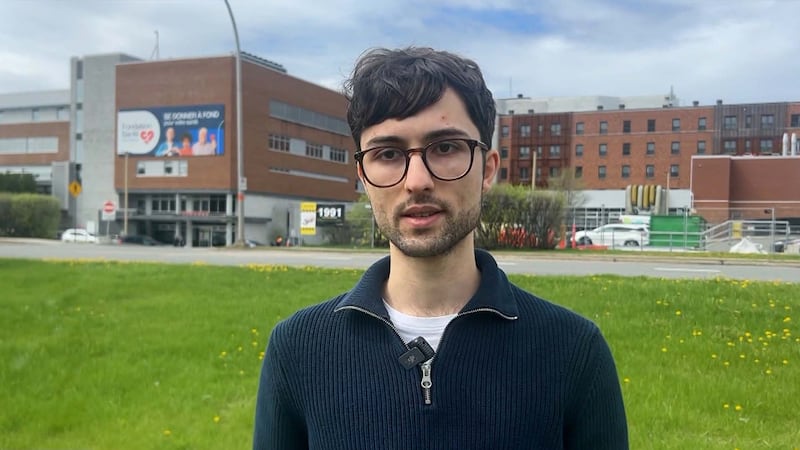
He indicates that the FMEQ carries out surveys every year to assess the well-being of students and that the data is “very worrying”.
“We see that 10% of preclinical students have suicidal ideas and 25% from the moment we start the externship,” explains the president of the FMEQ, emphasizing that suicidal ideas among medical students are not a “isolated phenomenon”.
A coroner’s report dating from 2011 on the suicide of a student also reports the pressure and stress that the resident was experiencing. The young woman, who was studying anesthesiology, was at the end of her training. However, she had not passed one of her exams the previous year.
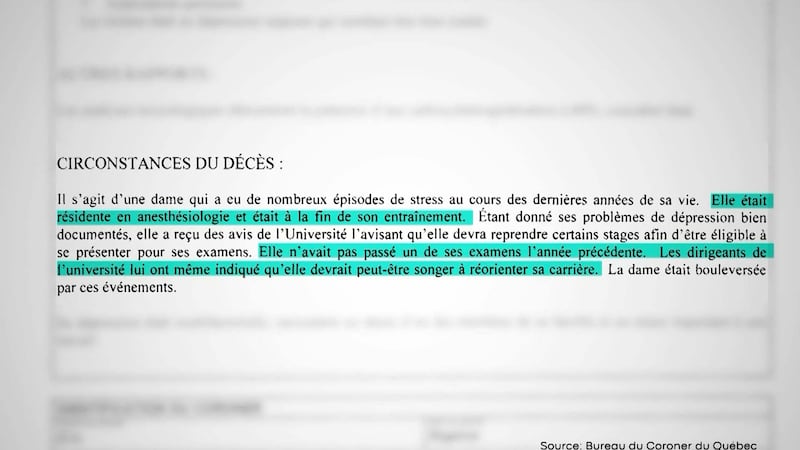
We learn in the report that university leaders told her that she should perhaps consider redirecting her career. A meeting that had completely upset her.
Maxence Pelletier-Lebrun confirms that the climate of competition and stress is omnipresent in medical schools, from the start of training.
“There is a culture of performance in medicine where we always want to be the best. We fight for the same positions at the residence and, sometimes, that can create a somewhat toxic environment where people will always want to outperform,” explains the president of the FMEQ.
A medical resident, who had Dr. Karina Poliquin as a professor at the Trois-Rivières hospital, also maintains that there is great pressure on the students.
“We always have the impression of being scrutinized by our supervisory boss. Because at the end of the day, we always have an evaluation,” she says.
She believes that reducing the number of evaluations would reduce student stress.
“It could help students to put themselves in a better position of “I want to be a better doctor†and not “a better student†,” explains the former student of Dr. Poliquin, who took her own life last April.
This same student relates that help and support are offered to students who demonstrate the need, but that there are still many taboos.
See it in the video.
| If you are in crisis or know someone who is, here are some resources available. |
|---|
| Quebec Association for Suicide Prevention: https://aqps.info/, 1866 CALL (1 866 277-3553) and 535-353 by text |
| Quebec physician assistance program: 1 800 387-4166 or 514 397-0888 |