
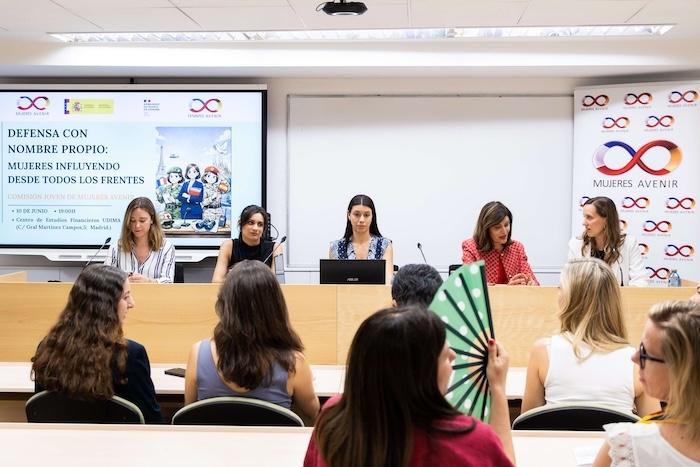
Organized on 10 June at the UDIMA Financial Center, the meeting is titled « Defense with its own name: Women influencing from all fronts » highlighted a shared observation: questions of defense and security remain largely unknown to the general public, even though they occupy an increasing place in the current geopolitical context.
Â
Rehabilitate the historic role of women in defense
At the initiative of Marian Fernández, director of the Youth Commission of Mujeres Avenir, this day aimed to offer inspiring models to young women wishing to evolve in traditionally male sectors.
Â
Â
In her opening speech, Marian Fernandez underlined the urgency of developing a critical outlook in the face of new forms of conflict.“The new generations are actors in their own right who must influence their own future,” she declared, calling for a rediscovery of the often forgotten female figures in the history of defense, from women who supported societies in times of crisis to pioneers of modern medicine like Florence Nightingale, without forgetting the cryptographers who helped decipher the famous Enigma code during World War II.
Â
A strategic sector that is still largely male
Moderated by SofÃa Peleteiro, the round table quickly highlighted the persistent difficulties of access to defense professions. “Defense remains a sector with very high entry barriers, historically dominated by the military and engineers.”a rappelé la modératrice.
For Paula à lvarez-Couceiro, progress exists but remains insufficient. Navantia’s head of institutional relations indicated that women should represent nearly 40% of management and executive management positions within the company.
However, she stressed that the female presence remains marginal in many technical and industrial professions: mechanics, boilermakers, industrial painters or turners.
Beyond the figures, Paula à lvarez-Couceiro insisted on another major challenge: the perception of defense in public opinion. “There is a profound misunderstanding of the world of defense. Because it remains barely visible, the necessary investments are often misunderstood. We must demystify the image of the armed forces,” she pleaded.
Europe facing a more unstable security environment
The debate also addressed the consequences of the conflict in Eastern Europe and the new threats weighing on the continent.
For Ana Botella Gómez, security can no longer be considered the exclusive business of the armies. “All of society must get involved in the security of its country,” she said, recalling that women still only represent around 18% of the security forces and remain under-represented in command positions.
Concerning current geopolitical issues, she believes that European countries will have to strengthen their investments in defense in the face of growing threats coming from the eastern flank of the continent. “When human lives depend on your decisions, you must act seriously and in a spirit of political unity,” she added.
Â
Disinformation, a new front in hybrid wars
One of the major concerns raised during the meeting concerns the circulation of information in the age of social networks.
Alba Lobo, member of the Youth Commission of Mujeres Avenir, recalled that the European Union remains confronted with sometimes divergent strategic visions, making the idea of a true European army still distant.
But it is above all the impact of disinformation that worries him.
According to data presented during the debate, 63% of young Spaniards obtain information mainly via social networks, while only 13% systematically check the reliability of the content consulted.
A particularly favorable terrain for influence campaigns and information manipulation operations which characterize the news “Hybrid wars”.
Â
Train a new generation of decision-makers
For Alejandra Fernandez, institutions must also evolve in order to allow more talents to access decision-making areas.
She regretted the lack of public debate around certain major strategic decisions and pleaded for an approach going beyond traditional ideological divisions.
“We must recognize the existence of threats and construct a discourse based on nuance rather than permanent confrontation,” she estimated.
At the end of this meeting, a message emerged: in a context marked by geopolitical uncertainty, cyber security, disinformation campaigns and the restructuring of international balances, the presence of women in spaces of influence appears more than ever as a strategic issue.
Through this initiative, Mujeres Avenir reaffirms its desire to encourage the emergence of new generations of professionals capable of exercising their influence in key areas for the future of Europe and international relations.
Â


