
The jeweler Roxana Saraev and her husband Claudiu in their boutique are in Sulina on 9 May 2026 in Roumania (AFP / Daniel MIHAILESCU)
In Sulina, the easternmost point of Romania, Roxana Saraev refuses to give in to the anxiety caused by the Russian bombings on Ukraine, located a few kilometers away, and clings to this little corner of paradise where she settled five years ago.
The conflict “looms like a threat” and creates “a feeling of permanent unease”, confides to AFP Roxana, 32, who came to seek peace and quiet in the small town located on the mouth of the Danube where she wants to stay despite everything, as evidenced by the small jewelry boutique she opened in February on the bank of the river.
In four years of war, Romania, which shares 650 km of border with Ukraine, has recorded 28 incursions into its airspace and 47 pieces of drone debris that crashed in the EU and Atlantic Alliance member country, according to the latest data from the ministry of Defense.
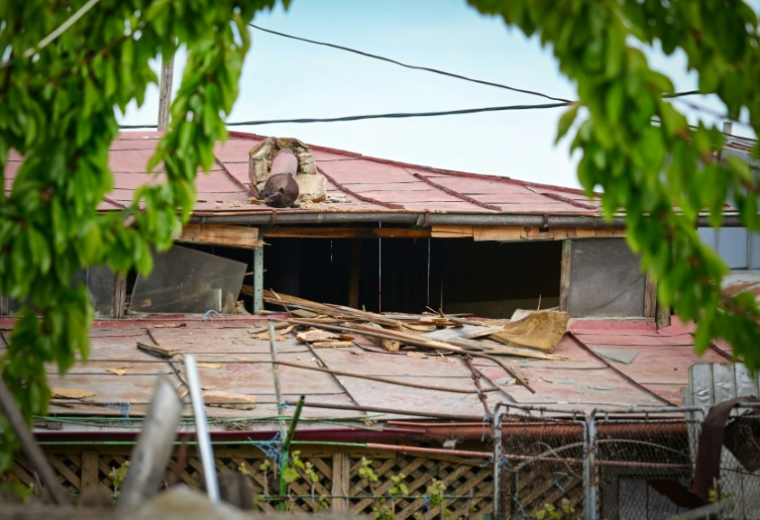
The damage caused by a drone falling on the roof of an outbuilding in Galati in Romania on April 27, 2026 (AFP / Daniel MIHAILESCU)
The latest, a Russian drone according to NATO, exploded on May 29 in the center of the town of Galati, 150 km north of Sulina, on a residential building, a first. A woman and a teenager were injured in the “most serious” incident to hit the territory since Russia’s invasion of Ukraine in 2022.
When the AFP went to Sulina at the beginning of May, there was an atmosphere at the end of the world, with no alerts or bombings in the distance. A deceptive calm, according to Catalin Cosma, who takes tourists there in kayaks on the Danube.
The 33-year-old says that during an outing, he and his group witnessed drone strikes on the Ukrainian port of Vylkove, about thirty km away.
“It was terrifying,” he says. “We just stood there, lit a cigarette, poured ourselves a drink and said that was the end.”
“On the map of Europe”
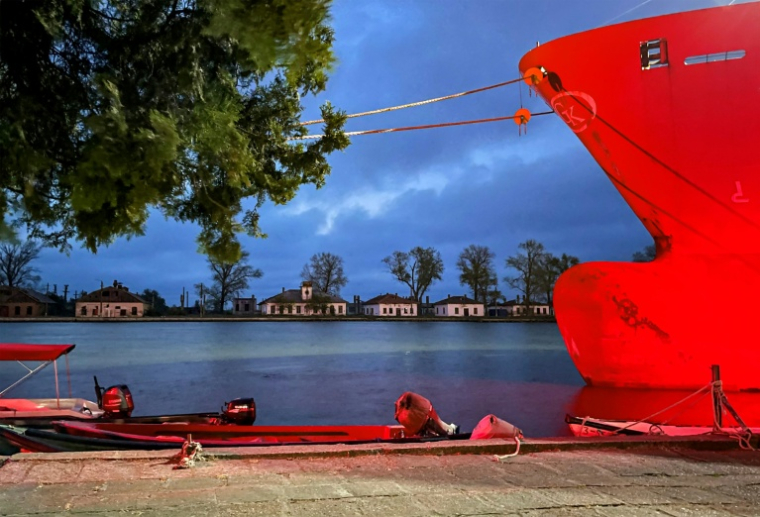
A ship at anchor is illuminated by a red light used during the night for navigation, in Sulina, May 9, 2026, in Romania (AFP / Daniel MIHAILESCU)
Paradoxically, the war in Ukraine gave part of the population the hope of seeing the prosperous activity of its port and the frequentation of its riviera revive in Sulina, as was the case at the turn of the 20th century.
The city, then cosmopolitan, processed 50% of cereal exports transiting the river. The decline, which began in the 1920s, ended after the fall of the communist bloc.
In the two years following the invasion of Ukraine, the city took advantage of the blockade imposed by Moscow on Ukrainian ports, forcing kyiv to rely more on the Danube.
In 2023 nearly 4,300 ships used the Sulina canal compared to 1,800 in 2021, before the war. Enough to remind Violeta Hubati, a 70-year-old retiree, when “before the 1989 Revolution (the fall of the communist regime, Editor’s note) the port was so full of ships…”
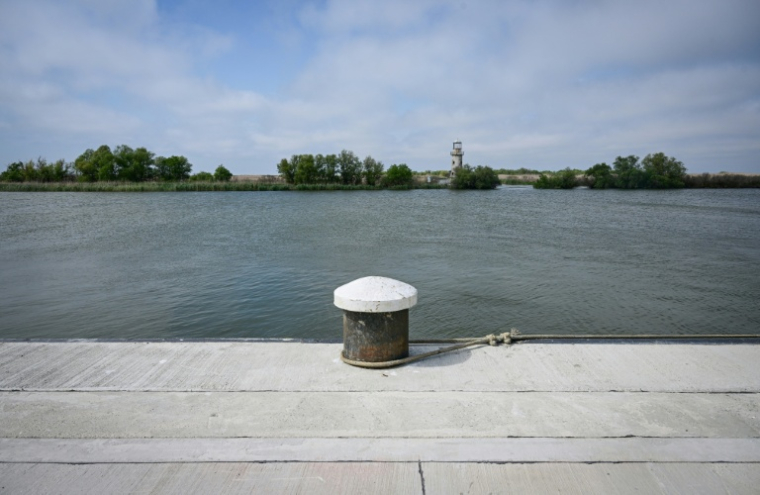
The modernized quay of Sulina, after three years of work, on May 8, 2026, in Romania (AFP / Daniel MIHAILESCU)
Since then, Ukraine has secured a maritime corridor on the Black Sea and traffic on the Sulina Canal has fallen again (2,700 ships in 2025).
However, a project to dredge the watershed is underway, partly financed by the EU at a cost of 24 million euros. Ultimately, this should allow ships to unload their cargoes and transfer them to other boats, in the hope of reaching an annual flow of up to 15 million tonnes.
“We are putting Sulina back on the map of Europe,” Dragos Ionita, director of the free zone administration, told AFP, according to whom “Sulina, thanks to this port, will be of great help to the Ukrainian state.”
In the east of the city, a recently modernized quay looks more like an empty expanse than a bustling port, and the remains of a shipyard and a fish cannery give the place the air of a ghost town.
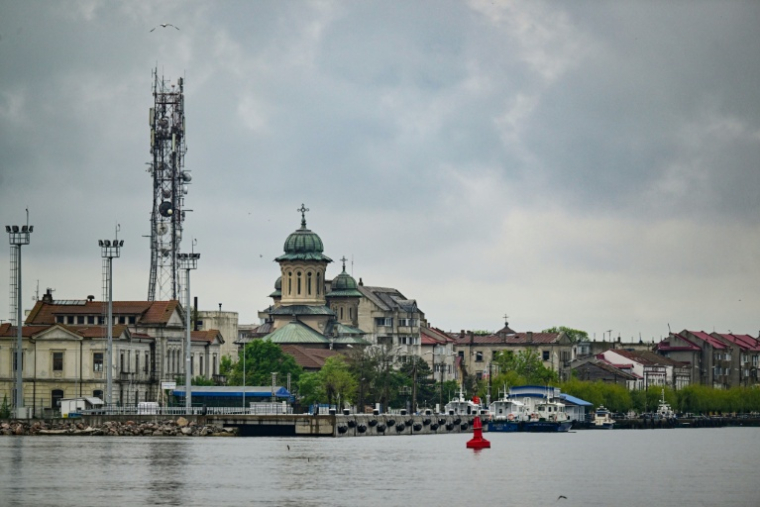
Partial view of Sulina on the banks of the Danube, in Romania on May 10, 2026 (AFP / Daniel MIHAILESCU)
But European funds received after the start of the war made it possible to increase the number of Romanian pilots and improve equipment to escort ships, as well as install lighted buoys equipped with automatic identification systems to allow navigation at night, explains Adrian Maizel, from the administration of lower Danube in Galati, which oversees the Sulina Canal.
“If traffic increases again, we are ready,” he says.
Drone débris
In the meantime the drones are falling.
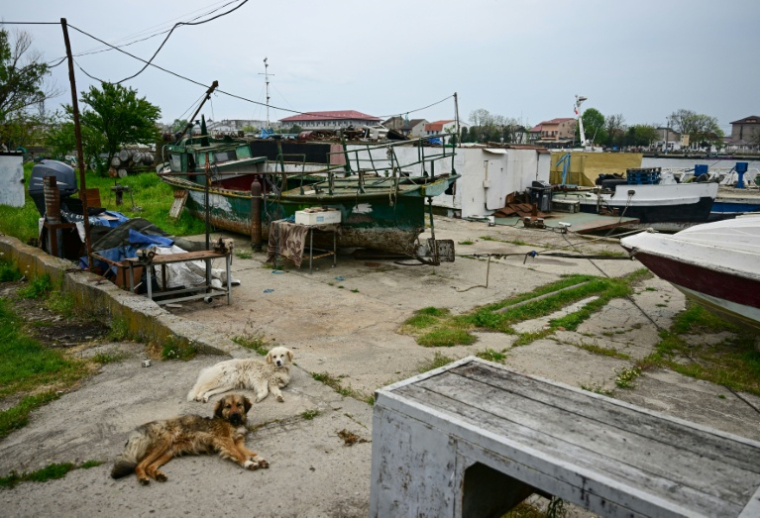
From fishing boats to Sulina in Romania on May 9, 2026 (AFP / Daniel MIHAILESCU)
“Over the past year, there has been an increase in the number of cases where our colleagues, citizens or other vessels have spotted metal debris that appears to belong to drones, floating at sea or washed up on the shore,” said Andrei Ene, spokesperson for the coast guard.
Romania adopted a law in 2025 authorizing it to destroy these devices but it has never done so, raising questions from the population.
In April, already in Galati, a drone loaded with explosives crashed into a tool shed. The octogenarian who lived there had a panic attack and moved out, according to neighbors.
Defense Minister Radu Miruta then explained that the machine had not appeared on radars and that the air defense systems had been repositioned.
On May 29, the Romanian army did not have time to kill the one that exploded in a busy street in Galati.
“Where are the anti-drone systems here?” asked Mihaela, 47 years old. “Where is the EU? NATO?”
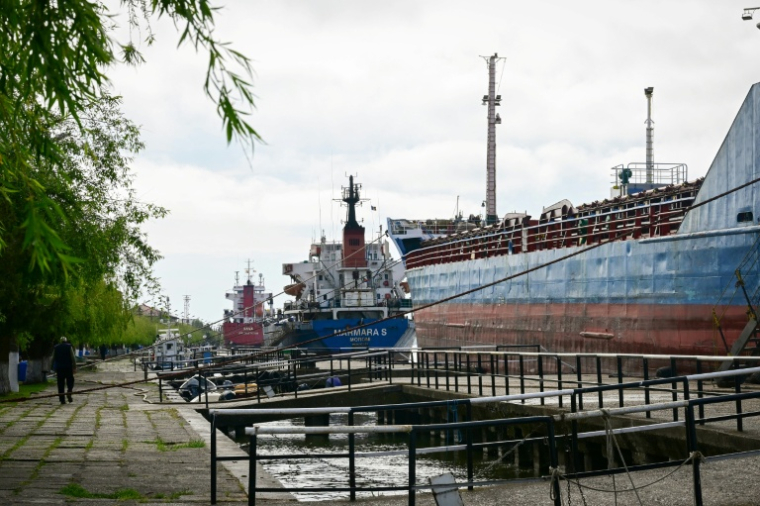
Des navires de amarrés a port of Sulina in Romania, on May 8, 2026 ( AFP / Daniel MIHAILESCU )
Since this incident, NATO has said it is working to strengthen its systems allowing the Alliance and Romania to detect and shoot down drones in mid-flight. Bucharest hopes that this will go quickly.
In the meantime, in Sulina, tourism, today the main activity with fishing, is suffering from the war, notes Catalin Cosma.
In May, however, in the port area, passengers continued to disembark with their wheeled suitcases to visit the biosphere reserve at the heart of which the city is nestled and where pelicans, herons, cormorants and storks frolic.
And a month later, Roxana Saraev notes that despite the Galati incident, visitors continue to come and enjoy the charms of the city.