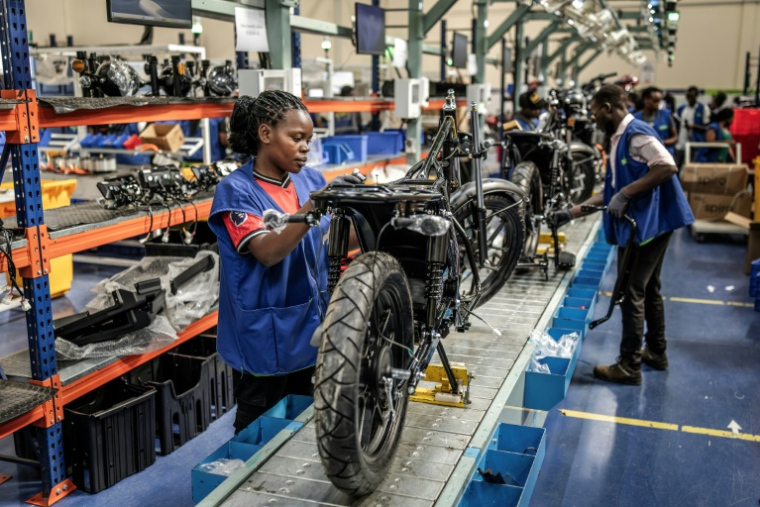
Assembling electric motorcycles on an assembly line at the production center of Spiro, Africa’s largest electric vehicle company, on May 22, 2026 in Nairobi, Kenya (AFP / Luis TATO)
In the congested streets of Nairobi, the Kenyan capital, the almost imperceptible purr of electric motorcycles is quickly replacing the backfire and smoke of their motorized counterparts. A development noted in several African countries and further accelerated by the war in the Middle East, which has caused the prices of gasoline.
Wisly Onyaiti, a boda-boda driver, the name given to the countless motorcycle taxis crisscrossing Kenya, easily understands the phenomenon. His big black mount is the second he owns. And given the savings it makes for him, he says he never wants to go back to a classic engine.
All repairs (leaks, parts changes) linked to a combustion engine have “disappeared”, smiles this part-time driver, who studies criminology and digital marketing the rest of his day. But above all, his fuel bills have plummeted.
Since switching to electric, Mr. Onyaiti saves 2,000 shillings (17 euros) every day. A significant sum in a country where many employees earn just 100 euros per month. “The electric motorcycle changed everything for me,” he rejoices.
This observation has become even more acute since the start of the war in the Middle East, which caused fuel prices to soar all over the world.
Electric motorcycles, whose sales were already taking off before the blocking of the Strait of Hormuz, have seen them jump by 40% in the last three months, according to the brands ArcRide, Ampersand and especially Spiro, an African start-up which commands around 90% of the “e-bike” market in Kenya.
Important economies
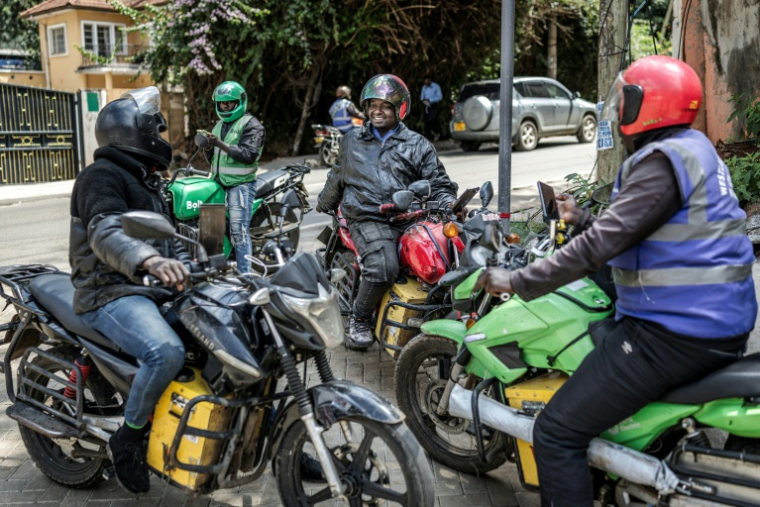
Mototaxi drivers, commonly called “boda boda” in East Africa, chat while sitting on their electric motorcycles while waiting for customers, on May 21, 2026 in Nairobi, Kenya (AFP / Luis TATO)
In its Nairobi factory, dozens of workers mount two-wheelers in a chain. At high speed, more than 400 can be produced each day. Since Spiro’s arrival in Kenya in September 2023, “the growth has been exceptional, quite exponential”, welcomes Raymond Kitunga, his number 2 in the country.
In 2024, the brand sold 4,000 motorcycles there, a figure rising to 14,000 in 2025. For 2026, the target set is 50,000.
Spiro, which is also present in Uganda, Rwanda, Benin, Togo, Nigeria and Cameroon, estimates that around 100,000 of its two-wheelers are now roaming the African roads. And aspires to more than triple this figure by the end of 2026.
In Rwanda, the municipality of Kigali has banned classic motorcycles and Uganda is pushing for a rapid transition to electric two-wheelers.
A switch to electric much faster than in the West, linked to an African specificity: on this continent, the vast majority of motorcycle owners have commercial use (taxi or transport of goods) while in Europe, motorcyclists go “from their house to their office and vice versa, or it is a luxury vehicle for weekend,” explains Hezbon Muse, president of the Kenya E-Mobility Association and director of Ampersand in that country.
The savings made are all the more significant as African drivers earn little.
The brands have also made their mounts very economical to purchase (the cheapest cost around 650 euros new) by only selling the motorcycles, and not the batteries, to owners.
African leap forward
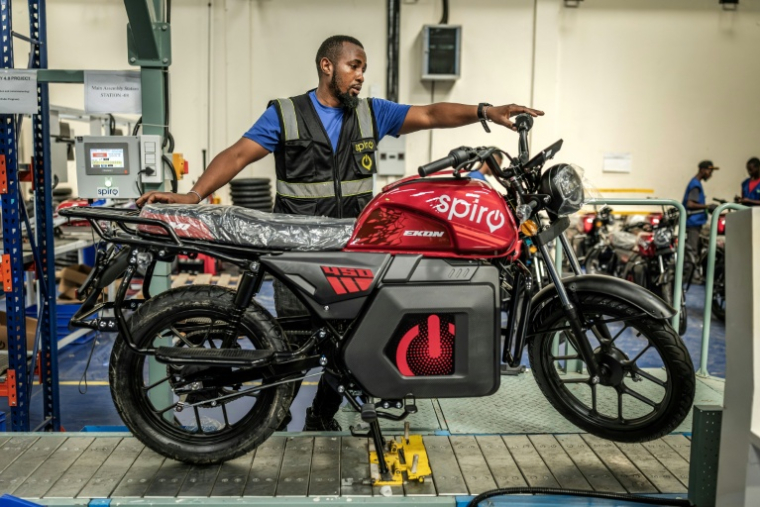
A worker inspects an electric motorcycle on an assembly line at the production center of Spiro, Africa’s largest electric vehicle company, on May 22, 2026 in Nairobi, Kenya (AFP/Luis TATO)
Battery “exchange centers” and recharge centers are multiplying in Kenya. In an Ampersand center in Nairobi, the exchange takes place in barely two minutes, AFP noted.
A fully charged battery, with a range of around 80 km, costs 265 shillings (1.78 euros), from which the electricity remaining in the old battery is further deducted.
By comparison, a liter of gasoline, sold for 214 shillings, allows you to drive about 30 km. Driving 80 km – the range of an e-bike battery – requires 2.5 liters of petrol, costing 530 shillings… double the price of a recharge.
American President Donald Trump, known for his climate scepticism, has, by supporting Israel in the war in Iran, “made electric vehicles much more attractive”, quips Joe Croft, the founder of ArcRide.
Another selling point for the Kenyan government: protecting the environment saves money, underlines Hezbon Muse. Because “100% of gasoline in Kenya is imported” and its consumption affects the country’s balance of payments, he underlines, while electricity is produced locally and is 93% green (geothermal, hydroelectric, solar, wind).
The quest for “sustainable transport”, still a challenge in the West, is no longer inaccessible in Africa, he observes.
A technological leap forward reminiscent of the digital one of the 2000s, when the generalization of mobile phones and electronic money wallets allowed the continent to make up for decades of delay in terms of banking and landline telephony.
The world will still “learn from Africa”, Mr. Kitunga boasts. Spiro, he reveals, is seriously considering exporting its African solutions to other lands, particularly in Asia.