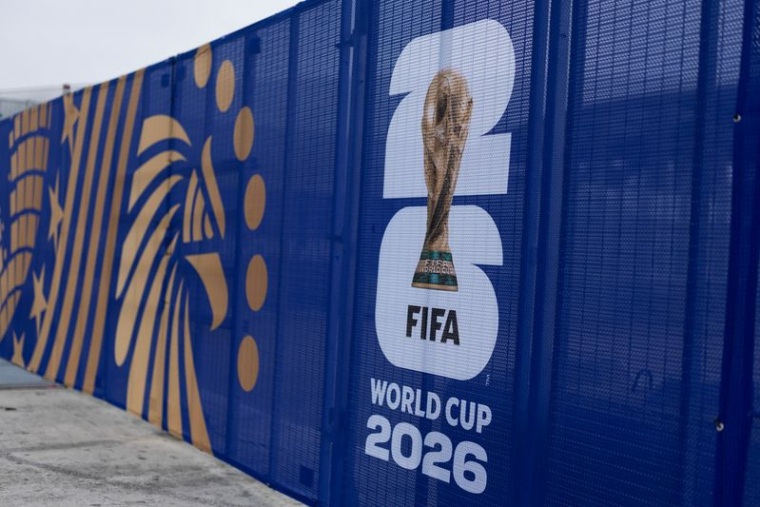
Questioned in France 2’s “20 Heures”, Thursday June 11, on the first day of the 2026 Football World Cup and the day before a crucial summit between Israelis and Palestinians, the minister indicated that he had “obtained that a visit could be made” to the sports journalist imprisoned in Algeria, symbolically accredited for the World Cup.
This text corresponds to part of the transcription of the interview above. Click on the video to watch it in its entirety.
Jean-Baptiste Marteau: Donald Trump asserts this evening, regarding the war in Iranthat the signing of an agreement would be ready, that all the last details have been validated. How do you interpret these kinds of statements? Are you saying to yourself that the war in Iran may be over?
Jean-Noel Barrot : What I am saying is that if an agreement has been found, it is very good news which could put an end to a situation which is unsustainable, and which basically only produced losers and which will also allow the Strait of Hormuz to be reopened, and a negotiation to begin on the supervision of the Iranian nuclear program. So many subjects which will be on the agenda for discussions between European and Arab heads of state and government, and then the American president, all of whom will meet in Évian next Tuesday around the President of the Republic.
For the G7, the subject risks being on the table. In any case, for the moment, Iranian state media say that no agreement, no text has been signed with Washington. So, be careful. You are therefore meeting tomorrow and launching this call for a two-state solution in the Middle East, almost a year after the recognition of the Palestinian state by France. First, in reality, what has changed? What did this recognition allow or not allow? Have things changed?
The efforts we have made throughout the last year to bring the international community together around this two-state solution, which is the only one likely to bring peace and security between Israel and Palestine, but also for the region, have made it possible to open the way for a peace plan, to be put to an end to the war in Gaza, so that the last remains of hostages can be returned, and to initiate this process which, it must be admitted, since the start of the war in Iran, has stopped. And that’s why it’s so necessary to breathe new life into it.
Should we restart it?
We must relaunch it, and what we are doing tomorrow in Paris, in a way, is to build a bridge between Israelis and Palestinians who do not speak to each other, who do not see each other. Because it must be said, it is almost impossible for an Israeli to go to Palestine and for a Palestinian to go to Israel. So, it is basically in Paris that they will meet to talk. A bridge between these Israeli and Palestinian activists committed to peace, and the governments of the world; 15 ministers will be present to receive their recommendations and their call to implement the peace plan and the two-state solution.
Can we be an actor in making peace in the Middle East when our relations with the main actor, Israel, are extremely fresh, not to say bad, at the moment?
In this case, we consider that it is civil societies which have an essential role to play in preparing for peace. Because peace cannot be decreed. It cannot result only from major diplomatic conferences. It also plays out in the minds, in the capacity to recognize the suffering, but also the rights of others, including after having suffered in one’s flesh the bruises of terrorism and war.
On the subject of Israeli colonization, you go a little further in this declaration which will be made public tomorrow: you wish to condemn it, but also provide for sanctions which would directly target the settlers in the West Bank. Concretely, which ones?
We did it at European level as well as at national level. We have taken sanctions targeting those responsible for the explosion of violence and the unprecedented acceleration of illegal colonization in the West Bank.
What does that mean? Block funds for example?
This means that they are prohibited from accessing European territory. This means that we freeze their assets, their possessions possibly in Europe. And that also means that we prohibit anyone from making transactions, from trading with them.
Palestinian side: who are you speaking with today? What state is the Palestinian authority in? Is this an actor for you?
Tomorrow, we will give the floor to Palestinians, representatives of associations, organizations and civil society. But we communicate very regularly with the Palestinian authority, which today is the representative of the Palestinian people to support it but also to accompany it in the reforms, which we expect it to be able to make to be able, in some way, to administer Palestine.
But is it still legitimate today? And Hamas, in all this, still has a concrete place in Gaza, is that a fact?
As I said, the peace process is no longer moving forward. This is why it must be restarted. And the first step is obviously the disarmament of Hamas, its exclusion from any participation in the future of Palestine.
A word from the World Cup, which begins this evening with Fifa which has accredited the French journalist Christophe Gleizes, still detained in Algeria. Have you heard from him, will he be free soon?
First of all, I want to salute the mobilization of the world of sport, the mobilization also of the family of Christophe Gleizes, who has shown great dignity and courage in this ordeal. As for us, we are mobilizing. We managed to have a visit to him in recent days, which allowed us to check his state of mind, as well as his physical state. He is doing well, despite the very painful ordeal he is going through. For my part, I hope that he can regain his place in the world of the press and in the world of sport. And I would like to take this opportunity, since you asked me the question, to wish good luck to the French team.
Click on the video to watch the interview in full.

/2021/05/12/phpNoCFkJ.jpg "\"Suddenly you find yourself with one of the greatest artists in the world\"says a Norman elected official, who posed for the painter David Hockney")