The right wing of the Senate demanded an additional envelope which sows discord to the point of paralyzing the vote on the budgetary trajectory of the law. A Joint Commission will now have to reach a conciliation.
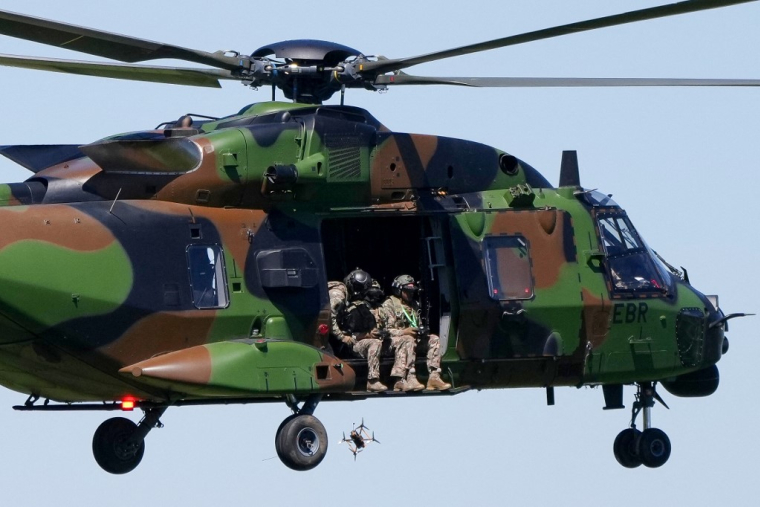
An NH90 Caiman helicopter, near the Suippes military camp, in April 2026 (illustration) (POOL / AURELIEN MORISSARD)
The Senate adopted on Tuesday June 9 the update of the military programming law, recognizing the need for an increased defense effort by 2030 in the context of international conflicts. But the precise amount of the budgetary increase for the armed forces continues to divide the political class.
How many billions more for the French armies by the end of the decade? The debate, thorny in a period of budgetary scarcity, is still not resolved.
The government and the National Assembly are proposing an additional 36 billion euros, for a total of 436 billion over the period 2024-2030.
The senatorial right is demanding an additional windfall of 14 billion euros to deal with potential crises.
This divergence led to the Senate’s rejection of the article setting the budgetary trajectory of the military programming law (LPM), a setback for the executive which hopes to see this text completed before the symbolic date of July 14.
The senators therefore approved on Tuesday a shaky text, stripped of its financial aspect, by 297 votes to 33. Only the communist and environmental groups opposed it.
A compromise to be found
Parliamentarians from both chambers will now have to find an agreement on this financial roadmap, during a joint committee (CMP), a crucial conciliation meeting between deputies and senators. It should take place before the end of June.
Prime Minister Sébastien Lecornu has already called on Parliament to “find a solution” which is “sustainable” for public finances. The Minister of the Armed Forces, Catherine Vautrin, also hoped that this conclave would make it possible to “find a path” towards a compromise supported “extremely widely” in the Senate as in the National Assembly.
The discussions still promise to be complex for the government, which risks losing the support of the Socialist Party if it gives too many pledges to the right.
“We want to get to the end of the negotiation,” warned Senator Cédric Perrin, who is leading the examination of this text for Les Républicains and intends to obtain a budgetary extension in the final text.
“LR’s presidential campaign cannot be the determinant of our national defense”, retorts the socialist Rachid Temal, who will defend in CMP a return to 36 billion, the only trajectory likely according to him to guarantee “social acceptance” of this effort among the French.
“In the international context, it would be unthinkable to remain at this impasse,” worried Senator Horizons Claude Malhuret, head of the Independents group, calling on his colleagues to “imperatively find a compromise” in the coming days.
The military programming law, which sets the main orientations and means of the French armies, is however not binding on the government, the army budget having to be voted on each year in Parliament in the finance bill.
Many parliamentarians also expect that a new military program will be established by the future executive after the presidential election, which would erase the current discussions by 2027.