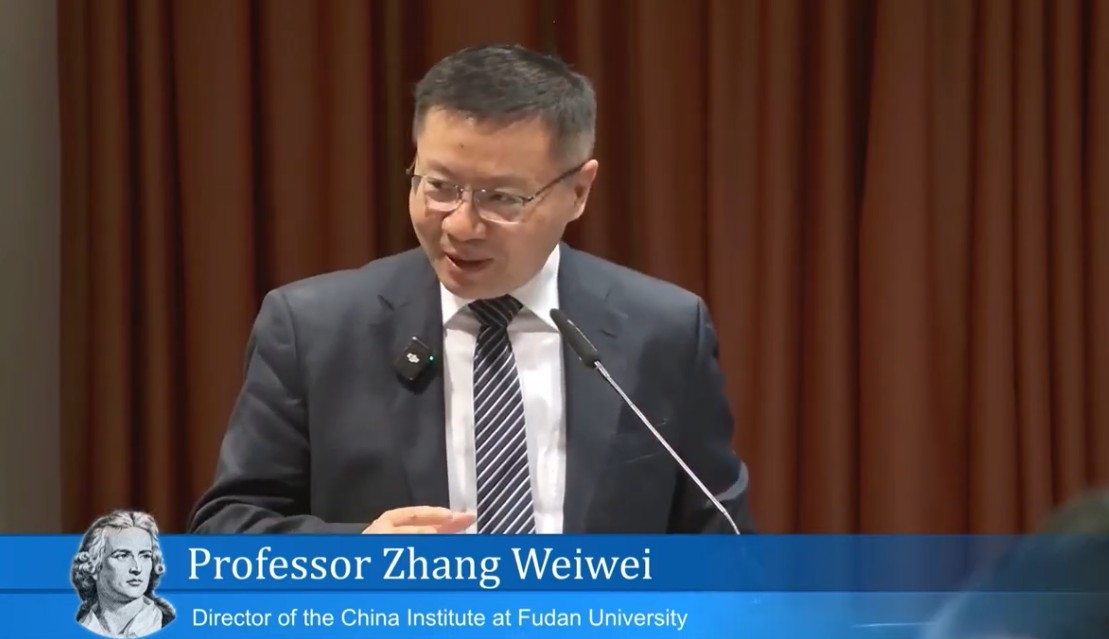
Speech by Zhang Weiwei, director of the China Institute, at the international conference of the Schiller Institute, in Berlin, May 30 and 31, 2026.
Can the China-ASEAN partnership lead the way?
The theme of the 2024 Munich Security Conference was “lose-lose”, a stark reflection of Europe’s current critical situation. The Ukrainian conflict has triggered a series of crises on the continent: galloping inflation, refugee flows, energy insecurity, economic stagnation and, above all, loss of peace. Conversely, la région Chine-ASEANwhich is home to more than two billion inhabitants (three times the European population), has enjoyed unprecedented peace, development and prosperity for fifty years.
How can we explain Asia’s success where Europe has failed? Can the China-ASEAN partnership serve as a model for a mutually beneficial multipolar world order?
Asia’s success is based on a “3 + 1” framework: three fundamental pillars of institutional construction (development, political and civilizational security), to which is added China as the main catalyst.
The first pillar is development. The China-ASEAN region favors development as an essential condition for peace and prosperity, an approach strategically different from that, more ideological, of Europe. This region has become the epicenter of global economic growth, contributing nearly 40% of its totality. ASEAN also benefits from China’s green economy and technological advancements. The recently concluded China-ASEAN Free Trade Agreement 3.0 strengthens bilateral cooperation in the areas of green economy and energy security.
The second pillar is that of politics and security. ASEAN has adopted a unique approach based on its principles of “ASEAN centrality” and strategic neutrality. This policy framework ensures strict non-alignment, avoids big power sectarianism, and has developed sophisticated multilateral mechanisms, including the 10+1 (China), 10+3 (China-Japan-Korea), and 10+8 dialogue platforms. China’s foreign policy fits remarkably well into this vision, relentlessly supporting the central role of ASEAN.
The third pillar, cultural and civilizational, constitutes the philosophical foundation of the China-ASEAN community of destiny. This framework emphasizes “Asian wisdom” and political traditions, such as strategic patience in conflict resolution, negotiated settlement of territorial disputes, the art of informal diplomacy, and the gradualist approach of “two steps forward, one step back.” “. He also defends the Five Principles of peaceful coexistence, a major intellectual legacy of the Bandung Conference of 1955.
These three pillars have transformed the entire region. Southeast Asia, once considered the “Balkans” of Asia due to its ethnic, religious and political diversity, marked by internal conflicts, has transformed what was called its “geographic curse” into a “blessing geographical”. This model of transformation is now extending to Central Asia thanks to the New Silk Roads connectivity projects, transforming the historic isolation of this landlocked region into a central strategic position, thanks to land corridors linking Chinese and European ports.
In this context, we can better appreciate the Chinese president’s four global initiatives Xi Jinping — for development, security, civilization and global governance — which builds on the successful experience of the China-ASEAN partnership and beyond.
The contrasting results of the “win-win” situation in Asia and the “lose-lose” situation in Europe are largely explained by the different roles played by China and the United States. Their main differences are as follows:
First of all, China is a civilizational state, an amalgamation of the oldest continuous civilization in the world and a very large modern state. China has unique cultural traditions that are much more inclusive and long-term than American culture. For example, while the American mentality tends to categorize other countries as “friends or enemies”, the Chinese mentality perceives them as “friends or potential friends”.
Second, in addition to its inclusive and syncretic culture, China possesses neither the messianic tradition of converting others, nor the militaristic tradition of conquest found among Western powers.
Third, this tradition is reflected in the distinct state behaviors of China and the United States. When it conducted its first nuclear test in 1964, China immediately declared that it would never be the first to use nuclear weapons, nor would it use them against non-nuclear-weapon states. Of all the great powers, China has the highest threshold for the use of force – a tradition that has its origins in China’s famous warning. Sun Tzu on prudence in military action, two millennia ago. However, China has equipped itself with a powerful defense capacity to preserve peace.
We are living in a transformative time that requires innovative ideas and courage. In this regard, lessons from Asia, particularly the “3+1” model, can be a valuable source of inspiration for our common effort to build a mutually beneficial multipolar world order.