lediplomate.media – printed on 01/06/2026
By The Diplomat
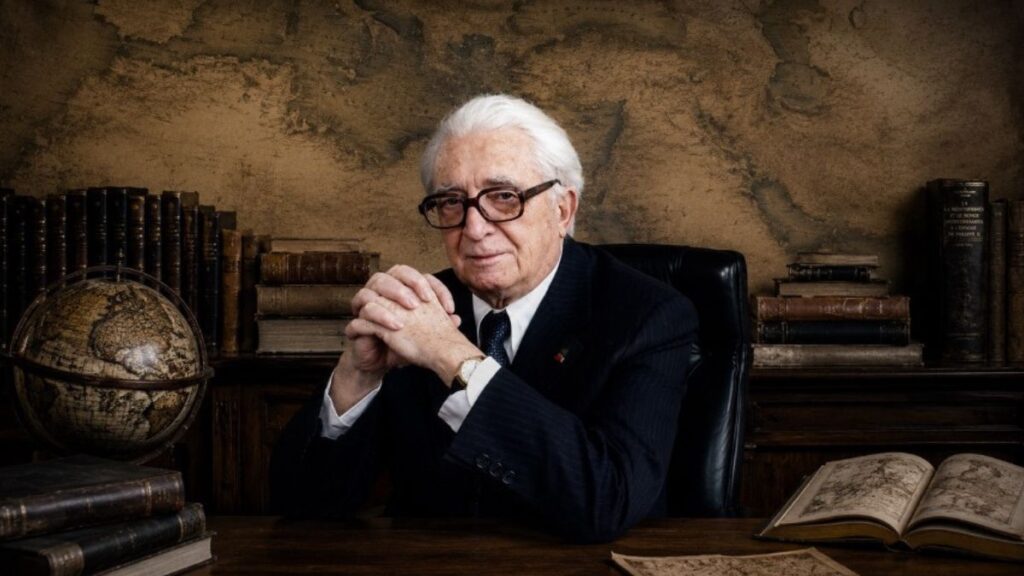
Died in 1985, Fernand Braudel never commented on the war in Ukraine, the rearmament of Europe or the Sino-American rivalry. And yet, its founding concepts, notably the long term, the world economy and the gravity of civilizations, today offer a reading grid of remarkable lucidity to decipher current geopolitical upheavals. Portrait of a giant of French strategic thought who inspired generations of historians and geopolitologists, such as the famous American Samuel Huntington, among others, but to whom the State has listened too little, and which the world is rediscovering with a new urgency.
From Algiers to German captivity: the formation of a global perspective
Born in 1902 in the Meuse but raised in Algeria, Fernand Braudel does not belong to the tribe of armchair historians. It is the concrete, living Mediterranean, that of the markets of Algiers and the Kabyle coasts, which will shape his outlook even before he sets foot at the Sorbonne for his history studies. Registered in 1923, he taught for several years in Algeria then in Paris, before joining the University of São Paulo from 1935 to 1937. His Brazilian experience opened his eyes to the dynamics of Atlantic capitalism and non-European civilizations.
But it is an episode of existential brutality which reveals the man and forges the thinker. Taken prisoner by the Germans in 1940, Braudel spent five years in officer camps in Mainz and then in Lübeck. It was from memory, in clandestine notebooks, that he wrote most of what would become his master thesis,La Méditerranée et le monde méditerranéen époque de Philippe IIsupported in 1947. The work consecrates a major epistemological break against event history and against the tyranny of battles and treaties, Braudel imposes the primacy of deep structures with geography, trade routes, climatic cycles, long time. “Events are foam on the surface of the waves,” he said. It is this conviction, born in the barbed wire, which structures his entire geopolitical vision.
Appointed to the College de France in 1949, then at the head of the 6th section of the École Pratique des Hautes Etudes – which would become the EHESS – Braudel built a true French intellectual hegemony in the social sciences global. He directed the Annals of Economic and Social History, founded the Maison des Sciences de l’Homme, and joined the French Academy in 1984, a year before his death. His trilogyMaterial civilization, economy and capitalism(1967-1979) constitutes to date one of the most accomplished analyzes of capitalism as a world-system, anticipating Wallerstein, anticipating Huntington and contradicting Fukuyama before he even took up the pen.
Also read: Large interview with Jean-Baptiste NoÂ: “What do the Humanities live!”
Neither Marxist nor liberal: The primacy of civilization
Braudelian thought is disturbing because it resists labels. Braudel dialogues with Marx by integrating the productive forces, long economic cycles, the domination of capital, but refuses class determinism as a universal key. For him, civilizations are not reduced to their modes of production, they have a cultural, geographical and religious depth, which transcends and conditions the economy itself. This heretical position earned him the lasting distrust of orthodox Marxists, who saw in his insistence on duration and geography a way of perpetuating relations of domination.
Conversely, the liberals are no more comfortable with Braudel. His concept of a world economy, with a space structured around a dominant central city (Venice, Amsterdam, London, New York) which captures value and redistributes dependence towards its peripheries, is a structural critique of ideal free trade. For Braudel, the market is never neutral: it is always the political territory of a hegemonic center. Capitalism, in his work, is not synonymous with the market on the contrary, it is precisely the anti-market, the opaque zone where the large operators circumvent the rules that the small ones are subject to.
His vision is, basically, what we could call a civilizational realism. Nations and states are only superficial layers of deeper realities: cultural areas, geographic basins, thirst and silk routes. The Mediterranean is not a border between Europe and Africa, but a unit of civilization.
This sensitivity brings him closer, politically, to Gaullism in what is most structural: sovereignty as a condition of civilizational survival, distrust of universalist ideologies which mask particular interests, the conviction that France is only fully itself once it is part of its long term.
Informal advisor to several ministries, notably in the reform of history teaching programs at the turn of the 1960s and 1970s, Braudel advocates for a school history freed from the narrow national novel and open to major global dynamics, an ambition that national education will pursue for decades to integrate, partially and clumsily.
The long term in the face of the fractures of 2026: was Braudel right?
The analytical tools forged by Braudel throughout his work make it possible to illuminate with striking precision the fractures of the world in 2026, not as prophecies, but as reading grids whose rigor is verified by the test of facts.
The concept of long duration is the first tool. Braudel defines it as the time of quasi-immobile structures such as geography, climate, millennia-old trade routes, etc. which weighs on societies much more heavily than government decisions or diplomatic upheavals.
The borders of the Ukrainian conflict follow civilizational dividing lines – between Eastern Orthodoxy and Western Catholicism, between the Slavic world of the steppe and Central Europe – which Braudel identifies in hisGrammar of civilizations (1963) as structures of very long duration. The great northern European plain, a recurring invasion ground for centuries, is precisely one of the examples that Braudel uses to illustrate the permanence of geographical constraints on the behavior of continental powers. These are not new data, they are fundamental constraints that the post-Cold War euphoria believed it could erase in a decade.
The concept of world economy, second tool, and perhaps the most operative for understanding 2026. In the third volume ofMaterial civilization, economy and capitalismBraudel establishes that any dominant economic system is organized around a center which captures value, a semi-periphery which relays its power, and a periphery which is dependent on it. It also shows, through history, that these centers are mortal: Venice yields to Antwerp, Antwerp to Amsterdam, Amsterdam to London, London to New York. Each shift causes a period of systemic turbulence during which the peripheries reorganize, often violently. The current recomposition of the world order with the relative withdrawal of the United States as guarantor of the Atlantic world economy, the forced European rearmament, and the rise of Beijing as an alternative center, corresponds exactly to this pattern of hegemonic transition described by Braudel.
China, which he analyzes in his trilogy as a potential world economy, endowed with a civilizational coherence several centuries old, is not an anomaly of contemporary history, but the return of a structure that five centuries of Western domination had temporarily put to sleep.
Finally, Braudel’s distinction between market and capitalism, one of the most original ruptures in his work, sheds a harsh light on the economic tensions of 2026. Braudel insists, the market, that of small, transparent and competitive exchanges, is not capitalism. Capitalism is the opaque zone of big business, of monopolies, states serving private interests, this is the zone where the rules that some are subject to do not apply to others. This reading makes trade wars, extraterritorial sanctions, massive subsidies disguised as industrial policy intelligible: so many manifestations of what Braudel had. theorized as the hidden, anti-competitive face of really existing capitalism In 2026, at a time when each power openly exploits the economy for strategic purposes, Braudelian grammar regains a relevance that it has never really lost.
And to conclude, and as Roland Lombardi, historian, geopolitologist and director of theDiplomate média : « Braudel is essential for those who want to understand the world because he reminded us that true History is read neither in the emotion of the moment nor in passing ideologies, but in the long term of civilizations, peoples and geographies. Like Huntington later, and who also drew much inspiration from it for his own work, he understood that cultures and spaces often survive empires, political fashions and the illusions of men. »
Also read: BOOK – INTERVIEW: The Battle of the Bulge, the new book by Sylvain Ferreira
#FernandBraudel #Geopolitics #LongDuration #GeopoliticalHistory #France #GeopoliticalPortrait #ÉcoleDesAnnales #Ukraine #Civilizations #WorldEconomyCapitalism #GlobalMultipolarity #FranceStrategy #GaullismAndGeopolitics #Mediterranean #StrategicThinking #GeopoliticalAnalysis #GlobalConflicts #RisingChina #SovereignEurope #BraudelAndTheWorld #ForeignPolicy #InternationalRelations #HistoryAndStrategy #InternationalOrder #TheDiplomateMedia #Realpolitik
/2026/06/15/6a300ed27f452888096128.jpg "\"Nothing is sacred to the enemy\" : the Russian attack on an Orthodox cathedral seen from Ukraine")