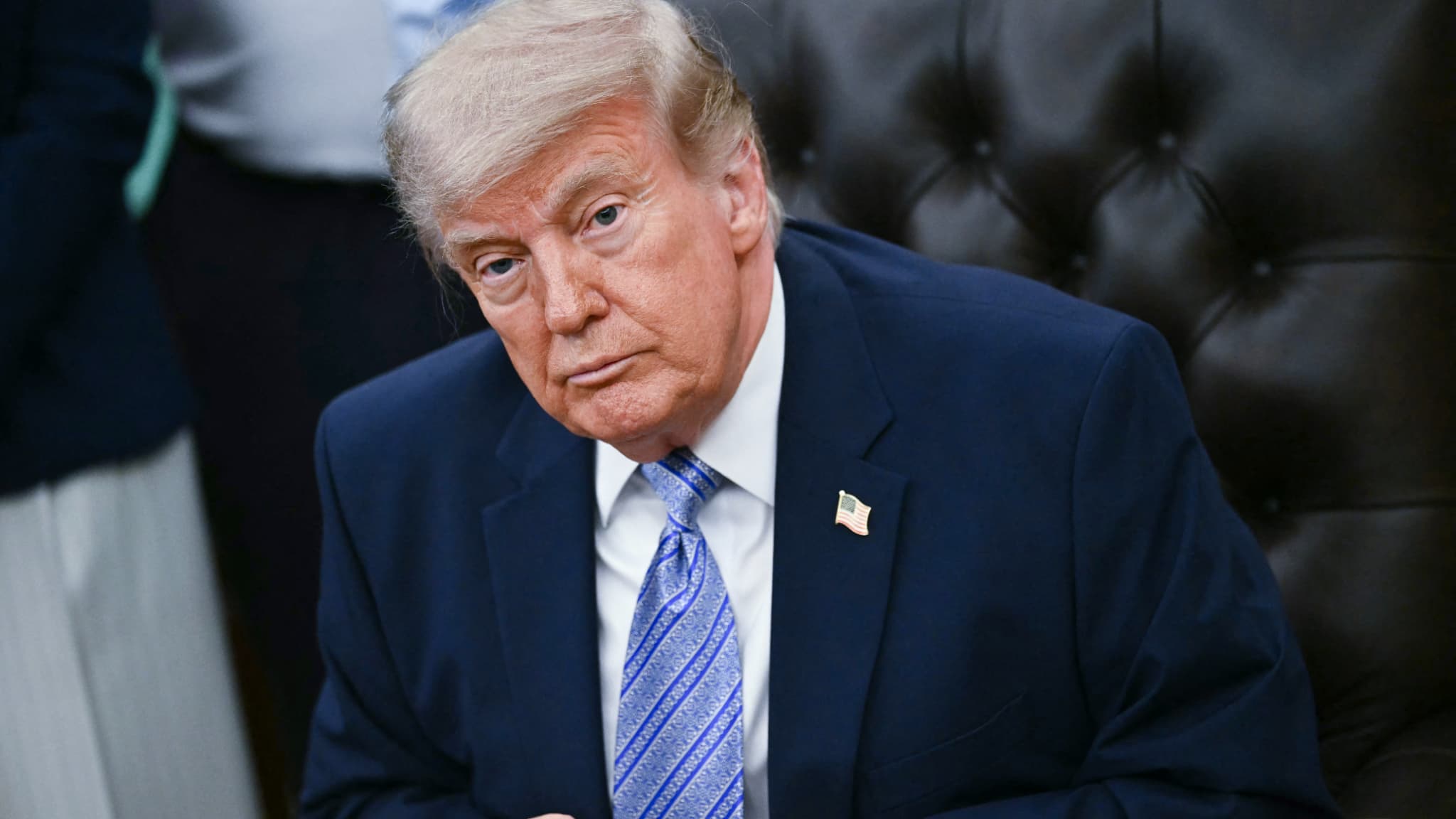
Installed in the Oval Office, Donald Trump is a threat and an easy trigger. Since his return to the White House, the president has intimidated or struck at least 15 countries over his two terms. This Wednesday, in a ministerial council, he declared that he would “break down” Oman if the country intervened alongside Iran in the Strait of Hormuz. A sentence that the president would have dropped casually, like a digression in the meeting, report CNN journalists. Casual, sure, but not unusual.
Since the start of his second term, seven countries have been attacked by the United States: Iraq, Nigeria, Somalia, Syria, Yemen and, of course, Venezuela and Iran. American bombs have sometimes targeted terrorist groups rather than governments, as in Iraq, notes CNN. However, this count does not include strikes against some 60 boats suspected of drug trafficking in the Caribbean and the Pacific Ocean which cost the lives of 190 people, underlines CNN.
Imperialist threats and ambitions
Over the past 16 months, in addition to Oman, Donald Trump has also threatened or refused to rule out the possibility of striking six other countries. At the beginning of January, the president, who has always had a tense relationship with Mexico, declared on Fox News: “Do you want us to eliminate the cartels? […] We’re going to have to do something with Mexico.” For its part, Colombia, which the billionaire also criticizes for its management of drug trafficking, has been targeted by similar threats. Asked about the possibility of a military intervention in Bogota, similar to that carried out in Venezuela, Donald Trump responded: “That seems good to me.” An intervention criticized by the Colombian president who assured that he was ready to “take up arms”.
Panama and Cuba were also targeted by the wrath of the tenant of the White House. Except that, with regard to these countries, Donald Trump has also expressed his imperialist ambitions. In December 2024, while awaiting his inauguration, Donald Trump threatened to regain control of the Panama Canal. To drive the point home, the president posted a photo of an American flag flying above the waterway, captioned “Welcome to the United States Canal.” As for Cuba, Washington said it was “determined” to impose political change on the island by overthrowing the existing communist government.
Canada and Greenland were also targeted by Donald Trump’s imperialist ambitions, but for these two countries, the president went so far as to threaten them with annexation. While the billionaire has stated on more than one occasion that he wants to make Canada the 51st state of his country, Greenland has been attacked because of its strategic position and its immense mineral wealth.
To these seven countries is added North Korea, which Donald Trump threatened during his first term.
A list which brings, according to CNN calculations, the proportion of countries threatened or hit by Donald Trump to one in 13 in the world (15 out of 195). Thus, in accordance with the population of these states, one person in 11 on the planet has been threatened by Washington’s weapons. The Middle East was the most targeted geographic area with 5 out of 20 countries.
“The theory of insanity” or the “Donroe doctrine”?
According to the American television channel, this bellicose behavior could partly be explained by the fact that Donald Trump adheres to the “madman theory” in matters of foreign policy. “In other words, he likes to present himself as unpredictable, convinced that this further encourages his foreign adversaries to comply with his demands,” analyzes the media.
For his part, the president had justified the capture of Nicolas Maduro in Venezuela by his strategy inspired by the Monroe Doctrine, subtly renamed “Donroe”. The initial version, thought up in the 19th century by the former President of the United States, James Monroe, condemns any European intervention in the affairs of the “Americas” (North and South), as well as any intervention by the United States in European affairs. In the “Donroe” diplomacy invented by the billionaire, “America no longer only defends the political independence of its neighbors, it transforms the region into a geo-economic and migratory preserve, a direct extension of its southern border and showcase of its industrial power”, explains the policy specialist. American, Jérôme Viala-Gaudefroy, on The Conversation website.