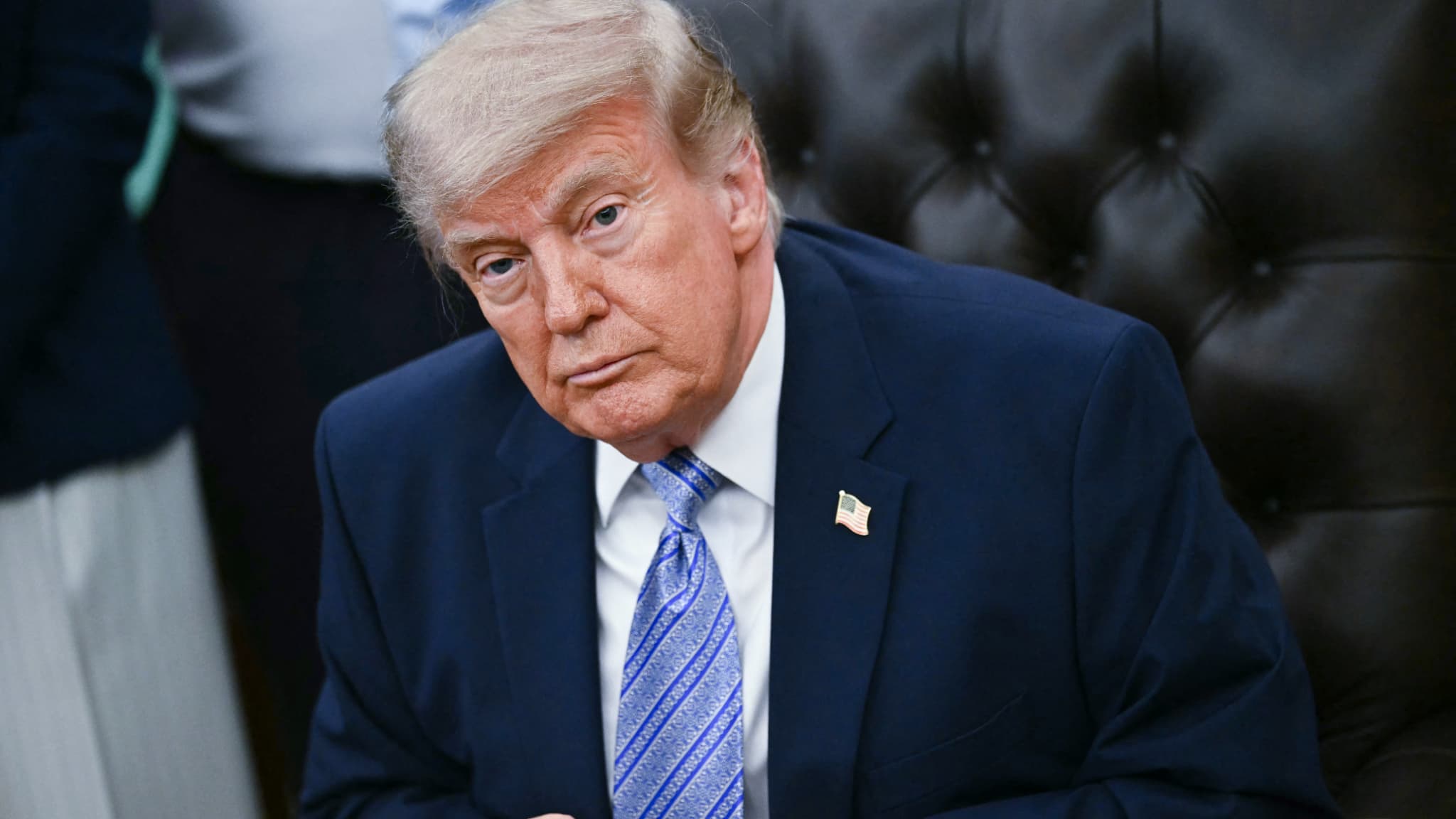
The United States and Iran have established a framework of agreement with a view to ending the war in the Middle East, which has entered its fourth month, American sources told AFP on Thursday, but Donald Trump has not yet validated it.
The Iranian Tasnim agency, citing a source close to the negotiating team, denied the information. “This is false and the text is not yet finalized,” she wrote.
On the other front of the conflict, in Lebanon, Israel extended its “combat zone” and continued its deadly strikes even though the end of hostilities against pro-Iranian Hezbollah is a requirement from Tehran to reach an agreement.
The war in the Middle East, triggered on February 28 by an Israeli-American offensive, has left thousands dead. And it is shaking the world economy by driving up oil prices, with the Islamic Republic blocking the Strait of Hormuz, strategic for global hydrocarbon trade.
While negotiations were believed to be in danger, sources in Washington reported a framework agreement with Iran which provides for a 60-day extension of the ceasefire in progress since April 8, and still requires the approval of the American president.
This announcement came after Iran and the United States exchanged strikes on Wednesday night, the most serious clashes since the truce came into force.
The information was first revealed by the American site Axios, according to which this preliminary agreement does not resolve the question of the Iranian nuclear program – which will be addressed later – but includes a commitment from Iran not to seek to acquire the atomic bomb.
The United States and Iran have made “a lot of progress” towards an agreement but Donald Trump is not yet ready to approve it, declared American Vice-President JD Vance.
“We are negotiating some wording. We have made a lot of progress,” he told reporters. “We hope that we continue to make progress and that the president will be able to approve the agreement, but of course, that is still to be determined.”
– Accès “illimité” –
The markets reacted cautiously: European stock markets reduced their losses, while Wall Street posted new records. Oil prices have changed little.
“How many times has a compromise seemed within reach, and how many times have investors been disappointed?” commented Andreas Lipkow of CMC Markets. “It is only when the ink of the signature is dry that we can consider repositioning.”
On the question of Hormuz, the protocol provides for “unlimited” access to the Strait, according to Axios, which cites two American officials. In return, the American blockade of Iranian ports would be lifted and Tehran authorized to sell oil thanks to a suspension of American sanctions.
Saying he does not tolerate “any attempt to establish a toll system”, American Finance Minister Scott Bessent threatened to attack Oman, an ally of the United States and a neighbor of Iran, in the event of cooperation with Tehran for the control of the strait.
Washington also announced new sanctions on Thursday aimed at drying up funds from the sale of Iranian oil.
Other issues divide the two camps. In addition to the end of fighting on all fronts, the Iranian government is seeking the release of 24 billion in assets frozen abroad. And on the nuclear side, he refuses any transfer abroad of the stock of enriched uranium, which Donald Trump is demanding be destroyed.
– “Day to day” –
Earlier Thursday, the two camps had accused each other of violating the ceasefire.
During the night from Wednesday to Thursday, the United States shot down four Iranian attack drones which represented a “threat around the Strait of Hormuz” and struck a site in Bandar Abbas “which threatened to launch a fifth drone”, according to an American official.
In retaliation, the Revolutionary Guards, the ideological army of the Islamic Republic, announced that they had targeted an American base, without specifying which one. Kuwait and the American army have reported strikes, attributed to Iran, on the territory of this Gulf kingdom.
In this tense climate, residents of Tehran express their concern. Mahtab, 62, a hairdresser in the Iranian capital, is delighted that her daughter was able to leave the country because “it’s hell here” and laments seeing her son live “day to day”, without perspective.
In Lebanon, at least 17 people died in Israeli strikes in the south of the country, where Israel extended its “combat zone” against pro-Iranian Hezbollah, as well as near Beirut.
The United Nations Interim Force in Lebanon (UNIFIL) has deplored an “escalation” in recent days, despite a ceasefire that came into force on April 17.
The Pentagon was to welcome Lebanese and Israeli military representatives on Friday before a new session of talks on June 2 and 3 in Washington.
publié le 29 mai à 02h32, AFP